The Camino: Oct. 1 – 4, 2016

IMG_0155.JPG

Oct. 1- Fromista: 15 and one-half miles, 5 and one-half hours

This is our kind of road (flat and dirt) and we are making good time on the meseta. We prepared ourselves for the steep incline, but the descent is even steeper than I had imagined. Luckily, I am mesmerized by the life stories of two women from New York and before I know it, we are back on the flat path.

While Fromista is not a big town (population 840), it is famous for its Iglesia de San Martin. Built in 1066, this church is considered to be one of the finest examples of Romanesque architecture in all of Spain.

Our Hotel Doña Mayor is very contemporary. Our room has a nice terrace an (a great treat). We are sleepy, but we freshen up and go exploring. We run into our friend from California and enjoy a glass of wine together.

Oct. 2- Carriòn de Los Condes: 12 miles, 3 and one-half hours

We start the morning out with a good laugh, when a German Pilgrim wonders out loud if those are real roosters crowing (as if on cue) every time we leave and arrive in a new town.

Today’s route is on what is called the “Soul-less Senda,” a gravel path that follows along the highway. Only a ravine divides the road from the path, but luckily today is Sunday, so traffic is sparse (everything shuts down on Sundays in Spain except restaurants and bars).

I pass the time thinking about how pilgrims made this trip hundreds of years ago without the latest equipment from REI and wondering if all these lovely little towns we’ve visited would even still exist without the Camino.

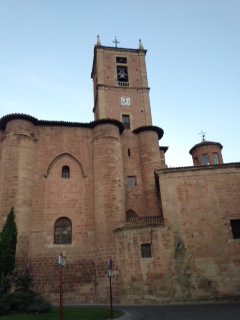
We have to walk to the end of town to get to our hotel, San Zoilo Real Monesterio and we are captivated from the moment we see it. Dating back to the 11th century, this monastery has been meticulously restored and is now a national monument.

We investigate every nook and cranny of this immense building. Only guests may visit the cloisters and the church. The door is opened for us and we are the only ones to enter. The cloisters are so still, so peaceful and we can almost still hear the Gregorian chant CD that was playing at reception. We marvel at how ornate the church is, with its impressive artwork and sculptures.

Oct. 3- Terradillos de Los Templarios: 17 miles, 5 and one-half hours

Another morning ritual is the gathering of toilet paper into our pockets. We have been lucky to find bathrooms in every little town, but sometimes they are not very well stocked.

Today, there are no services for miles, so it is suggested that we eat before starting out. The path is somewhat flat and featureless. We pass the time by chatting with pilgrims from England, Australia and Michigan.

We are pleased to see that Albergue Templarios is right at the beginning of town. We meet up with a couple from Utah and enjoy dinner together.

Oct. 4- Calzadilla de Los Hermanillos:, 17 miles, 6 and one-half hours

We are walking on history. This is the longest stretch of Roman Road left in Spain today, with probably little change. It’s a wide path with loose rocks, pebbles and ruts. There is no refuge from the sun and the flies are swarming around our heads as we try to focus on the path.

When we arrive at Casa el Cura we hear someone singing in the kitchen. It is the husband, Leo, and he and his wife, Jemma, the owners, come to greet us. The place is so charming and we feel right at home.

We enjoy Leo’s cooking at a big table with pilgrims from Iceland, France, Ireland, Montana and Oregon. The wine flows and we enjoy the stimulating conversation.


The Camino: Sept. 27 – 30, 2016

img_0184

 Sept. 27- Burgos: 16 miles, six hours

The path starts flat, then gives way to loose rocks on blacktop, then flat again on the river route and it seems to last forever.

Burgos is the oldest city in Europe and is known for its medieval architecture and its unpleasant climate (luckily except for May and September).

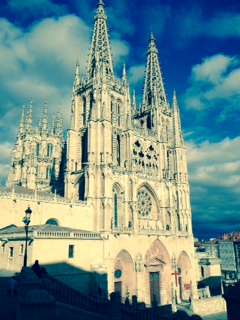
We have to walk all through Burgos to get to the Hotel Mesón del Cid in the old city. We’re hot and tired, but when we turn the corner and see our first view of the Cathedral, it takes our breath away.

Initially built in 1221, this Gothic Cathedral is one of the largest in Spain and is now a UNESCO World Heritage site. As soon as we freshen up, we head over to see the church. A German pilgrim tells us that the admission is free for pilgrims. We spend lots of time looking in every nook and cranny and admiring the art and artifacts.

We are concerned that our feet are throbbing as if they have a heartbeat, until we meet up with some pilgrims for a glass of wine and they all feel the same; blame it on the cement.

Sept. 28- Burgos: Rest Day!

We awake early, but it’s nice to be able to lounge around. I am so excited to have a hairdryer, but the funny thing is my hair looks just the same.

After breakfast, we head out to explore the city. We decide to stop back at the hotel to grab jackets and wind up taking a nap. We later visit the Castillo de Burgos, an old stone castle recently renovated after being damaged during the Napoleonic wars. We enjoy the wonderful views and the heat brings out the smell of the pines.

Later, we sit in our hotel’s courtyard, enjoying a beer and staring up at the Cathedral, marveling at how they were able to build such a structure all those thousands of years ago and how it was so fortunate that it has remained intact since then. We meet some other pilgrims and continue the discussion.

We run into our pilgrim friends from Connecticut and join them for a glass of wine on the plaza. Across from us, a musician serenades us with his Spanish guitar.

Sept. 29- Hornillos: 13 miles an, four hours

We are feeling great after our rest day. We enjoy catching up with our pilgrim friends from Connecticut over breakfast, then take off at a good pace. There is little shade on the meseta. Endless fields of barley and oats surround the path. It’s peaceful, quiet and very still. We enjoy a wonderful conversation with a young woman from Oregon.

Not much has changed in Hornillos over the past centuries. It’s a lovely medieval village with a population of 60. It’s a nice treat to have a room on the first floor at La Casa del Abuelo.

We take a walk over to see the Gothic Church of San Román. There’s a remarkable difference between the warm outside temperature and the cold church interior. We are humbled by the beautiful artwork and the ornate vestments on hangers at the back of the church.

One of the most important rituals that we look forward to each day is eating. Spaniards are not big on breakfast; a hunk of bread from the local bakery (hopefully with chopped tomatoes and olive oil) or a slice of a tortilla, an egg and potato pie, gets us on our way. We make a sandwich and share an apple for lunch and take a break along the way. Dinners are reasonable and plentiful. A three-course meal with a bottle of wine costs from 10 – 16 euros. So far, our favorites have been Paella de Marisco, shellfish with rice flavored with chicken broth and saffron, Arroz Negro, shellfish with rice flavored with squid ink, Cocido, a thick soup made with beans and chorizo (Spanish sausage) and bull stew (the best pot roast we’ve ever had).

Sept. 30- Castrojeriz: 13 miles, 4 and one-half hours

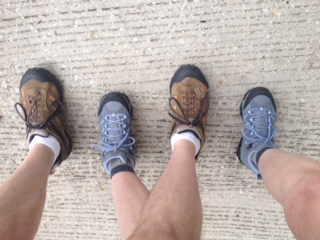
Another important daily ritual is putting on our hiking boots each morning. Our feet must feel snug, but not too tight. We get to the point when we can tell when the delicate balance is just right. We’ve seen other pilgrims with feet so sore, they are hiking in flip flops, so we are very grateful for minimal foot problems.

It’s make your own breakfast this morning at our Casa Rural and a German couple is kind enough to show us how all the European appliances work. We then return the favor and pass on our newfound knowledge to the next group of pilgrims.

It’s 48 degrees and we are bundled up, but 15 minutes later the sun is out and the jackets come off. It’s back to the meseta again. It’s a rougher path than yesterday and when it narrows to single file, no one is talking and the only sound you can hear are the hiking poles as they hit the ground; very Zen.

Castrojeriz is a sleepy little town, though it was a major Camino stop during medieval times. We have to walk through the whole town before we arrive at Hotel Iacobus. A knight in armor greets us at the entrance near the carved wooden staircase. A lovely antique armoire is the focal point of our room. We eat lunch on our terrace and then go exploring around the property. We feel as if we are in Old World Spain. The parlor is decorated with elegant period furniture, interesting books, art and the owner’s personal mementos. We meet a fellow pilgrim from California, dine out on the terrace and fall asleep feeling sorry that we have to leave here tomorrow.

The Camino: Sept. 23 – 26, 2016

img_0013

Sept. 23- Nájera: 18 miles, seven hours

The Harvest Festival revelers kept us up with their shouting and singing, but we still are up and ready to go.

Today’s path starts out flat through towns and then vineyards. We welcome the cooler temperature in the 60s, no sun and no steep inclines or descents.

Throughout the day the path changes from dirt to rocks to concrete. Trails flow through forests, fields, vineyards, towns and along busy and quiet roadways. The terrain dictates how long the days walk will be.

Nájera was the capital of the Navarre kingdom in the 11th century and its old stone buildings still stand proudly. We arrive at the Hostal Ciudad de Nájera and are greeted so warmly by the father and son owners as if we were family. They carry our backpacks up the stairs to our rooms and present us with a cold bottle of red wine, which we gratefully accept. All this and a bathtub too!

Sept. 24- Santo Domingo de la Calzada: 14 miles, five hours

It’s such a peaceful start to the day when you walk just before sunrise.

The flat path soon gives way to long inclines, then long descents, with lots of loose gravel, but the welcoming smiles and wishes of “Buen Camino!” from the townspeople in each little town we pass through gives us the energy we need to continue.

We thought we had another hour to go and are so surprised and happy to see the town sign that we celebrate with a Coke with lemon. The Hospederia Cisterciense is run by the nuns of the same name and we are impressed by its Old World charm and the simple, clean, crisp feeling of the rooms.

Sept. 25- Belorado: 14 miles, five hours

The nuns are fussing over us at breakfast, making sure we have enough to eat and wishing us “Buen Camino!.”

Most of today’s walk travels right next to the busy N-120 Highway. Cars and trucks are roaring by and the sound is anything but relaxing.

I am feeling less intimidated of the terrain and allow myself to let my mind wander just a bit, without ever losing respect for the Camino. One loose pebble underfoot is a reminder to keep focused.

Belorado is another lovely old town, centered on a plaza and a church. We are so happy when we finally find Pensione Toni. It’s a big room with 4 beds just for us, so we spread out and make ourselves comfortable.

Our feet are throbbing, as if they have a heartbeat and we are concerned. Later, when we join a New Zealander and a New Yorker for cocktails, we are relieved to know that they also have the same problem; blame it on the hard pavement.

Sept. 26- San Juan de Ortega: 15 miles, 5 and one-half hours

Today marks day No. 11; we have already completed one-third of the Camino!

The sunrise makes the fields glow and I have all I can do to stop myself from running through them singing the theme from “The Sound of Music.” Luckily, I resist, since it would have defied the No. 1 Camino rule: don’t take any extra steps that you don’t have to!

The route is flat, until we come upon some very steep inclines and descents, which luckily were very short. We pass Atapuerca, which displays the earliest human remains ever discovered in Europe. Then, we see a sign which says “Oasis Ahead.” Is that salsa music we hear in the distance?

We come across a young woman selling food and cold drinks for a donation and giving out slices of cold melon; so refreshing! Two pilgrims who do not know each other start dancing and everyone is laughing and clapping.

With a population of 18, the small town is centered around a lovely stone church. Our Hotel Rural La Hanera is very comfortable. We sit outside with a view of the church and enjoy some wine, while conversing with a couple from Iceland and a young man from New York. When the owner notices all the hungry pilgrims patiently waiting for the restaurant to open at 7 p.m., he decides to open 15 minutes earlier for us and we are all grateful.


The Camino: Sept. 19 -22, 2016

image

Sept. 19- To Puenta de la Reina: 15 miles, seven hours

On our way out of Pamplona, we walk through the beautiful park and gardens and then to the University, where they stamp our pilgrim passport.

Today, the walking is very difficult; steep inclines and descents with lots of loose, rocky terrain. We’re walking with a group from Germany and I make them laugh when I say that I will be declining a drink “on the rocks” at cocktail time.

We are so happy to have a private room at the Albergue Puenta de la Reina. We sit outside and enjoy a cold beer on their private terrace, run into our Australian friend and plan to have dinner together.

Sept. 20- To Estella: 14 miles, six hours

It’s always nice when the terrain starts out flat. As we walk, we watch a farmer plowing his fields, then stop to breathe in the wonderful smell of the rich, red earth; such a wonderful, clean smell!

We always take a rest in each small town we pass, sometimes to have a snack or just to use the facilities. In this particular place, the woman behind the counter was complaining, in Spanish, that everyone on the bathroom line should be paying something. I suggested to her, in Spanish that she put up a sign in different languages and charge a fee (marketing 101).

We are lucky to find a private room in the Capuchino Monastery tonight. No laundry service is available, so we start our laundry and then sit in the garden, enjoying a cold beer. We laugh with a German couple and agree that this isn’t a bad way to do laundry.

Sept. 21- To Los Arcos: 13 miles, six hours

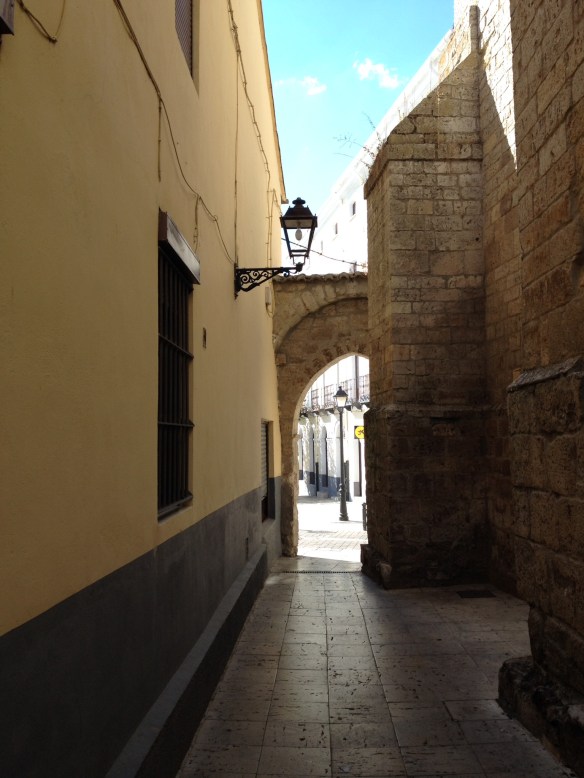
I love walking through the towns early in the morning. They look like a movie set. With the old stone buildings and the town center with the church and plaza, it’s always a surprise when someone passes you in contemporary clothing or a car drives by.

First thing in the morning, we come upon the famous Fuente del Vino: a free wine spigot for pilgrims from one of the local wineries. We decline, but the Europeans make up for us!

We are in the Rioja wine country and pass through miles of vineyards. As we’re walking, we think we hear music. Around the bend, in the middle of nowhere, there is a husband and wife playing the violin and accordion for donations.

Tonight, we are staying at Pensione Los Arcos. Jose, the manager, not only welcomes us, but gives us his cell phone number in case we need anything. We enjoy discussing the day’s adventures with people from Sweden, Australia and Utah.

Sept. 22- To Logroño: 17 miles, 7 and one-half hours

The flat city pavement and the flat dirt road give us a false sense of security. While we knew to expect inclines and descents today, we are surprised to find that there were so many and that they were so steep.

I try to enjoy the beautiful vistas and keep my mind off the inevitable. The large blocks of farmland in beiges, browns and greens look like suede in the sunlight. A farmer and his dogs guide a flock of sheep on a steep parcel of land. A trail through the forest was a welcome respite from the sun.

We happen to land here on one of the biggest festival days of the year- the Harvest Festival. The plaza is teaming with people and filled with musicians and dancers. It’s so exciting to be a part of it!

Tonight, we’re staying at the Alburgue La Bilbaina. While it’s a great location and very clean, we could have done without the many old, uneven, ceramic tile steps that lead up to our room.


,


The Camino: Sept. 16 – 18, 2016


Photo Camino Start 2

Sept. 16- To Roncesvalles: 16 miles (adjusted to 20 miles for inclines), nine hours

Dale! (let’s do it!). Day One will be the longest and the hardest, but the most spectacular. We join others leaving at the same time, wish them “Buen Camino” (have a good walk!) and chat on our way up the incline. As we begin the walk through the Pyrenees, the group becomes quiet, spellbound by the spectacular views and the silence. Only the sound of an occasional cowbell reminds us that we are not alone.

The day is sunny and the steep downhills and inclines seem doable. But, it soon starts to rain and the uneven terrain becomes treacherous. The rocks and mud on the trail make the trail so slippery that it takes our full concentration to decide the right spot for each step.

More experienced pilgrims share their knowledge with us. They show us how to hold our hiking poles when going up or down and how to slalom down a very steep descent (zigzag from side to side). By the end of the day we will have walked straight up 4,000 feet!

Our hands are so cold that it takes a minute before we can hold the pen to sign in at the Albergue de Peregrinos. We are so tired and so grateful they have a restaurant and buy two dinner tickets for a three-course meal and wine, a bargain at 10 euros. This massive building used to be a monastery. It’s very basic, clean and the bunk beds are set up dormitory style. The dryer is not working well, so we string a clothes line across my lower bunk. Everything dries overnight and I have privacy in my little club house.

Day One ends on a good note. The dinner was delicious and it was great fun to meet people from Brazil, Spain and Italy.

Sept. 17- To Zubrini: 14 miles, six hours

It’s raining again! Again, the downhills are steep and we realize we are in for another day like yesterday, only at a slightly lesser altitude.

We won’t be able to see much of Zubiri because of the weather, so we hunker down in the lounge of the El Patio de Avellano Alburgue and chat with others. This one is much nicer than the previous one; smaller and more modern with laundry service. A lovely Australian woman shares her secret of asking Reception to book her next evening’s accommodations. She’s already done the research, so we decide to follow her to her next few stops.

We enjoy another great Alburgue dinner. Tonight, our dinner partners are from Korea, France and New Zealand. I am fascinated by the women traveling alone and ask them so many questions. They all agree that the Camino is unlike any other trip. Yes, they are solo, but they seldom feel alone.

Sept. 18- To Pamplona: 13 miles, six hours

The rain has stopped, but has left behind so much mud. It’s slippery going, whether we’re walking up or down. We take a break to view an old church that’s being renovated. They will also stamp our pilgrim passport for a small donation. We meet a gentleman from South Africa who is in charge of the project and is so excited to share his many stories with us.

I really feel like eating an apple and mention it a few times during the day. Then, just around the bend, in the middle of nowhere, is a man selling fruit on the side of the road. It was one of the best apples I ever had. The Camino provides!

I find that rather than letting my mind wander, I am in deep concentration all day, watching my footing. A New Yorker, who walks with me a bit, agrees. She says it’s a gift to have all the cobwebs cleared out of our minds and it will make us sharper thinkers in the end.

We arrive in Pamplona early enough to sightsee. Famous for the running of the bulls each July, the high wall around the old town and the massive stone buildings give the city a certain charm. We enjoy a great Menu del Dia (menu of the day: three courses plus wine) and call it a day.


Camino Prep: Sept. 14 – 15, 2016

image

It took us all day to reach St. Jean Pied de Port, France, a medieval town founded in 716, but it was worth the trip. When we finally reached the Maison Donamaria B & B, Jean Francois and his dog Zubi were waiting outside to welcome us.

We planned to stay two nights to rest up before we set off. The highlight was checking in at the Pilgrim Office and  receiving our pilgrim passport, which will be stamped at each place we stay along the way, and a shell, the official symbol of the Camino, to tie on our backpack.

We took in all the sights of the town and agreed we felt as if time had stood still…until we headed back to our B & B and were taken aback to see a Roomba cleaning the hall outside our room.


How the Camino Found Us

blog-photo-shoes

For over 1000 years, pilgrims (peregrinos) have been drawn to the Shrine of the Apostle St. James in northern Spain’s medieval city of Santiago de Compostela. The routes know as “caminos” or ways originate all over Europe.

Today, hikers and cyclists travel the same paths as those before them, with little change. As tradition dictates, it is “your Camino.” Travelers carry a backpack and follow the route at their own speed. At the end of each day, they can seek out one of the albergues (pilgrim hostels), a five-star hotel or anything in between. Meals can be prepared communally or purchased. It is said that “the Camino provides” and the pilgrim always seems to be cared for on his journey. A pilgrim passport is stamped along the way. Completing 100 kilometers (62 miles) of the Camino will earn the pilgrim the coveted Compostela certificate, once they reach Santiago.

I’m not sure exactly when Mr. Wiz* actually started to become interested in this adventure. It might have been when he first saw the movie “The Way,” a wonderful father/son story about the Camino, starring Martin Sheen and written and directed by his son, Emilio Estevez. Initially, I chalked up his sudden interest to just another bucket list item, but he was utterly captivated. When he first presented the idea to me that we should plan to walk 500 miles through Spain together on a 1000-year old route, carrying backpacks and planning where to stay as we traveled along, I was intrigued.

I am not known for my sports prowess, but standing at the top of that mountain, after trying out my first hiking boots gave me a wonderful sense of exhilaration. And as Mr. Wiz helped me down from the three foot, plaster mountain in the shoe department of the REI store, I felt downright giddy.

In preparation for the 15 miles per day that we planned to walk, we trained by walking…and walking and walking. Whether we were chatting, focusing on the new parts of town we were encountering or side-by-side in our own thoughts, I was surprised how enjoyable it was. I had finally found a sport that I was good at: walking!

Researching the Camino and planning how to make it happen became our new hobby. Fortunately, pilgrims before us have chronicled their personal journeys down to every detail. So, except for the question of whether we would ask our employers for six weeks off or plan to retire early, we felt quite unintimidated. Mr. Wiz “bit the bullet” and announced he would retire exactly 20 years to the day he had started and I followed right behind him.

We signed up for Spanish classes. Between Mr. Wiz’s memory and my pronunciation skills, we did quite well. My dad would have been so happy to know that I would soon be exploring the home of his ancestors.

Excel spreadsheets were initiated and updated, research continued and plans were set:

  • Sept. 13, 2016: fly from Austin to Paris.
  • Sept. 14: From Paris, take the bus to Montparnasse Train Station, then the train to St. Jean Pied de Port, which is the starting point for the most popular route via the Pyrenees and northern Spain.
  • Sept. 14 & 15: Stay in St. Jean.
  • Sept. 16: Start the Camino. We are giving ourselves 33 days plus 2 rest days to walk the 500 miles.
  • Oct. 22: Meet Big A* and JC* in Porto, Portugal.
  • Oct. 25: Take the train to Lisbon, Portugal.
  • Oct. 29: Return to Austin.

I’m not concerned with what I won’t have with me (stylish outfits, jewelry, makeup, nail polish, hair dryer). I have a feeling that the Camino will provide us with exactly what we will need.


*See “Cast of Characters” in About Section


Three Strikes: A Good Measure of Tolerance

There is a three strikes law for repeat offenders. A baseball batter receives three strikes during his time at bat, which then leads to an “out.” I didn’t make up the rules, I’ve just adopted them for my own use.

When you are trying to make a decision as to how to handle a situation, don’t agonize over it. Use the three strikes rule. Rather than accepting the same outcome over and over again, this provides you with a measure to use as a guide. Feel free to share your credo or keep it to yourself, whichever seems appropriate:

  • If your child is doing something unacceptable, explain what they are doing and what they need to do to rectify the situation. Tell them they have one strike against them and that three for the same issue will result in some type of penalty. This gives them a chance to work on wiping the slate clean and lets them know where they stand.
  • If your partner is doing something that is getting on your nerves.
  • If a friend keeps standing you up at the last minute when you make plans together.
  • If you experience long waits in the waiting room of any professionals that you make an appointment with.
  • If recent conversations with your boss or co-worker are confusing to you as to your relationship and where you stand with them.

Using this philosophy to determine how long you intend to accept a situation will help you to finalize issues; no repeat offenders, no lingering at bat!


Lessons From Within

You are never alone. Inside you is your special, individual self that craves your attention. Try taking the time to cultivate that relationship. Take 10 minutes a day and turn yourself “inside out”:

  1. What makes you tick? Find a quiet spot and think about who you are, where you are in your life, your goals and your dreams.
  2. Who are you? Look in the mirror and really see yourself.
  3. Entertain yourself. Plan little treats to look forward to.
  4. Negotiate with yourself. Plan your day so that you accomplish your goals with a bit of fun mixed in.
  5. When you are alone, talk to yourself out loud; tell yourself “You are looking good!” or “It’s going to be a great day!.”
  6. Like yourself. Try not to put yourself down. Think about what makes you special, what makes you, you.

Being comfortable spending time alone, does not make you a loner. It enhances your vision of who and what you are and helps you to reconnect with yourself. If we can learn to enjoy our own company, we are free to be more independent.

How are some women able to make the decision to start their own business, move to a foreign country or become a single mom? They have the power of that special relationship, the one that will never let them down. They have learned how to be their own best friend. Looking deep inside and getting to know ourselves will strengthen our life lines to everything we connect with.