The Camino: Sept. 16 – 18, 2016


Photo Camino Start 2

Sept. 16- To Roncesvalles: 16 miles (adjusted to 20 miles for inclines), nine hours

Dale! (let’s do it!). Day One will be the longest and the hardest, but the most spectacular. We join others leaving at the same time, wish them “Buen Camino” (have a good walk!) and chat on our way up the incline. As we begin the walk through the Pyrenees, the group becomes quiet, spellbound by the spectacular views and the silence. Only the sound of an occasional cowbell reminds us that we are not alone.

The day is sunny and the steep downhills and inclines seem doable. But, it soon starts to rain and the uneven terrain becomes treacherous. The rocks and mud on the trail make the trail so slippery that it takes our full concentration to decide the right spot for each step.

More experienced pilgrims share their knowledge with us. They show us how to hold our hiking poles when going up or down and how to slalom down a very steep descent (zigzag from side to side). By the end of the day we will have walked straight up 4,000 feet!

Our hands are so cold that it takes a minute before we can hold the pen to sign in at the Albergue de Peregrinos. We are so tired and so grateful they have a restaurant and buy two dinner tickets for a three-course meal and wine, a bargain at 10 euros. This massive building used to be a monastery. It’s very basic, clean and the bunk beds are set up dormitory style. The dryer is not working well, so we string a clothes line across my lower bunk. Everything dries overnight and I have privacy in my little club house.

Day One ends on a good note. The dinner was delicious and it was great fun to meet people from Brazil, Spain and Italy.

Sept. 17- To Zubrini: 14 miles, six hours

It’s raining again! Again, the downhills are steep and we realize we are in for another day like yesterday, only at a slightly lesser altitude.

We won’t be able to see much of Zubiri because of the weather, so we hunker down in the lounge of the El Patio de Avellano Alburgue and chat with others. This one is much nicer than the previous one; smaller and more modern with laundry service. A lovely Australian woman shares her secret of asking Reception to book her next evening’s accommodations. She’s already done the research, so we decide to follow her to her next few stops.

We enjoy another great Alburgue dinner. Tonight, our dinner partners are from Korea, France and New Zealand. I am fascinated by the women traveling alone and ask them so many questions. They all agree that the Camino is unlike any other trip. Yes, they are solo, but they seldom feel alone.

Sept. 18- To Pamplona: 13 miles, six hours

The rain has stopped, but has left behind so much mud. It’s slippery going, whether we’re walking up or down. We take a break to view an old church that’s being renovated. They will also stamp our pilgrim passport for a small donation. We meet a gentleman from South Africa who is in charge of the project and is so excited to share his many stories with us.

I really feel like eating an apple and mention it a few times during the day. Then, just around the bend, in the middle of nowhere, is a man selling fruit on the side of the road. It was one of the best apples I ever had. The Camino provides!

I find that rather than letting my mind wander, I am in deep concentration all day, watching my footing. A New Yorker, who walks with me a bit, agrees. She says it’s a gift to have all the cobwebs cleared out of our minds and it will make us sharper thinkers in the end.

We arrive in Pamplona early enough to sightsee. Famous for the running of the bulls each July, the high wall around the old town and the massive stone buildings give the city a certain charm. We enjoy a great Menu del Dia (menu of the day: three courses plus wine) and call it a day.


Camino Prep: Sept. 14 – 15, 2016

image

It took us all day to reach St. Jean Pied de Port, France, a medieval town founded in 716, but it was worth the trip. When we finally reached the Maison Donamaria B & B, Jean Francois and his dog Zubi were waiting outside to welcome us.

We planned to stay two nights to rest up before we set off. The highlight was checking in at the Pilgrim Office and  receiving our pilgrim passport, which will be stamped at each place we stay along the way, and a shell, the official symbol of the Camino, to tie on our backpack.

We took in all the sights of the town and agreed we felt as if time had stood still…until we headed back to our B & B and were taken aback to see a Roomba cleaning the hall outside our room.


How the Camino Found Us

blog-photo-shoes

For over 1000 years, pilgrims (peregrinos) have been drawn to the Shrine of the Apostle St. James in northern Spain’s medieval city of Santiago de Compostela. The routes know as “caminos” or ways originate all over Europe.

Today, hikers and cyclists travel the same paths as those before them, with little change. As tradition dictates, it is “your Camino.” Travelers carry a backpack and follow the route at their own speed. At the end of each day, they can seek out one of the albergues (pilgrim hostels), a five-star hotel or anything in between. Meals can be prepared communally or purchased. It is said that “the Camino provides” and the pilgrim always seems to be cared for on his journey. A pilgrim passport is stamped along the way. Completing 100 kilometers (62 miles) of the Camino will earn the pilgrim the coveted Compostela certificate, once they reach Santiago.

I’m not sure exactly when Mr. Wiz* actually started to become interested in this adventure. It might have been when he first saw the movie “The Way,” a wonderful father/son story about the Camino, starring Martin Sheen and written and directed by his son, Emilio Estevez. Initially, I chalked up his sudden interest to just another bucket list item, but he was utterly captivated. When he first presented the idea to me that we should plan to walk 500 miles through Spain together on a 1000-year old route, carrying backpacks and planning where to stay as we traveled along, I was intrigued.

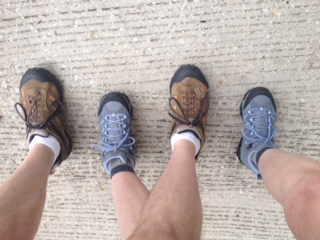
I am not known for my sports prowess, but standing at the top of that mountain, after trying out my first hiking boots gave me a wonderful sense of exhilaration. And as Mr. Wiz helped me down from the three foot, plaster mountain in the shoe department of the REI store, I felt downright giddy.

In preparation for the 15 miles per day that we planned to walk, we trained by walking…and walking and walking. Whether we were chatting, focusing on the new parts of town we were encountering or side-by-side in our own thoughts, I was surprised how enjoyable it was. I had finally found a sport that I was good at: walking!

Researching the Camino and planning how to make it happen became our new hobby. Fortunately, pilgrims before us have chronicled their personal journeys down to every detail. So, except for the question of whether we would ask our employers for six weeks off or plan to retire early, we felt quite unintimidated. Mr. Wiz “bit the bullet” and announced he would retire exactly 20 years to the day he had started and I followed right behind him.

We signed up for Spanish classes. Between Mr. Wiz’s memory and my pronunciation skills, we did quite well. My dad would have been so happy to know that I would soon be exploring the home of his ancestors.

Excel spreadsheets were initiated and updated, research continued and plans were set:

  • Sept. 13, 2016: fly from Austin to Paris.
  • Sept. 14: From Paris, take the bus to Montparnasse Train Station, then the train to St. Jean Pied de Port, which is the starting point for the most popular route via the Pyrenees and northern Spain.
  • Sept. 14 & 15: Stay in St. Jean.
  • Sept. 16: Start the Camino. We are giving ourselves 33 days plus 2 rest days to walk the 500 miles.
  • Oct. 22: Meet Big A* and JC* in Porto, Portugal.
  • Oct. 25: Take the train to Lisbon, Portugal.
  • Oct. 29: Return to Austin.

I’m not concerned with what I won’t have with me (stylish outfits, jewelry, makeup, nail polish, hair dryer). I have a feeling that the Camino will provide us with exactly what we will need.


*See “Cast of Characters” in About Section



Three Strikes: A Good Measure of Tolerance

There is a three strikes law for repeat offenders. A baseball batter receives three strikes during his time at bat, which then leads to an “out.” I didn’t make up the rules, I’ve just adopted them for my own use.

When you are trying to make a decision as to how to handle a situation, don’t agonize over it. Use the three strikes rule. Rather than accepting the same outcome over and over again, this provides you with a measure to use as a guide. Feel free to share your credo or keep it to yourself, whichever seems appropriate:

  • If your child is doing something unacceptable, explain what they are doing and what they need to do to rectify the situation. Tell them they have one strike against them and that three for the same issue will result in some type of penalty. This gives them a chance to work on wiping the slate clean and lets them know where they stand.
  • If your partner is doing something that is getting on your nerves.
  • If a friend keeps standing you up at the last minute when you make plans together.
  • If you experience long waits in the waiting room of any professionals that you make an appointment with.
  • If recent conversations with your boss or co-worker are confusing to you as to your relationship and where you stand with them.

Using this philosophy to determine how long you intend to accept a situation will help you to finalize issues; no repeat offenders, no lingering at bat!


Lessons From Within

You are never alone. Inside you is your special, individual self that craves your attention. Try taking the time to cultivate that relationship. Take 10 minutes a day and turn yourself “inside out”:

  1. What makes you tick? Find a quiet spot and think about who you are, where you are in your life, your goals and your dreams.
  2. Who are you? Look in the mirror and really see yourself.
  3. Entertain yourself. Plan little treats to look forward to.
  4. Negotiate with yourself. Plan your day so that you accomplish your goals with a bit of fun mixed in.
  5. When you are alone, talk to yourself out loud; tell yourself “You are looking good!” or “It’s going to be a great day!.”
  6. Like yourself. Try not to put yourself down. Think about what makes you special, what makes you, you.

Being comfortable spending time alone, does not make you a loner. It enhances your vision of who and what you are and helps you to reconnect with yourself. If we can learn to enjoy our own company, we are free to be more independent.

How are some women able to make the decision to start their own business, move to a foreign country or become a single mom? They have the power of that special relationship, the one that will never let them down. They have learned how to be their own best friend. Looking deep inside and getting to know ourselves will strengthen our life lines to everything we connect with.