Do I Need More Pippi in My Longstocking?

Our only similarity is that we were both born with red hair. From the first time I met her, she was my idol. She is fiercely independent, unconventional, playful and unpredictable. Her pigtails fly in the wind, her grin widens and her freckled face flushes, as she races from one adventure to the next with her best friends: her horse, her monkey and the two children that live next door to her at her home, Villa Villekula. 

Pippi Longstocking- full name Pippilotta Delicatessa Windowshade Mackrelmint Longstocking- is the figment of the imagination of Swedish author Astrid Lindgren. Recuperating from an illness, Astrid’s daughter asked her mom for a story and named the main character Pippi. Initially rejected by publishers, the books have since been translated into 76 languages and made into television shows and movies. 

As a little girl reading the books, my eyes would widen, and my heart would race; how exciting to be so free! Little did I know that my personality had already evolved, as observed by JC*. She quickly realized that, rather than inheriting her easygoing nature, my tendencies for perfection and order were thanks to my dad. 

She knew she had her hands full but guided me along with such patience. By the time she received the call that I was in the nurse’s office by second period on my first day of junior high, she was resigned to the fact that I was a bit different from other children. Apparently, I did not see the humor in being handed one of the first computerized class schedules, having only a few minutes to arrive before the bell rang and being mistakenly assigned to the boy’s bathroom, rather than a classroom. 

In my efforts to be a bit more spontaneous, I have made some major strides: 

  • I visited a model home and did not rearrange anything. 
  • I polished my fingernails a completely different color than my toenails.
  • On a whim, I changed my grocery shopping day from Friday to Thursday.
  • I double snoozed my alarm.
  • I impulsively ate four Triscuits with lunch, rather than my usual three and did not worry about biting cracker number four precisely on its horizontal markings.   
  • I went on a trip without any pre-planning, waking up each day and deciding on my next adventure. Wait a minute; that was a friend of mine that did that, not me!

Oh, to be a bit eccentric! What fun it would be to make paper airplanes out of my to do lists with my avant-garde pals. Regrettably, I am only able to participate as a spectator, realizing that the only flow I can go with is if it has first been documented on an Excel spreadsheet. 

At first, I thought that living vicariously through others was unfortunate. Then I realized that family and friends are as fascinated with my quirks as I am with theirs. They loosen me up, I keep them on track and together, we walk through life one unique step at a time.

*JC:  My lovely mom and my best girlfriend. She received the name “JC” years ago – her initials – back when I hired her to be my interim secretary, and I did not feel comfortable saying “Any messages, Mommy?

Author’s Note:
If you enjoyed this post, I invite you to like it and share it. 
Don’t forget to go to the Home Page to follow me and receive posts via email.

Oct. 30 – Nov. 3: Ribadiso to Santiago

Oct. 30: Ribadiso – 18 miles
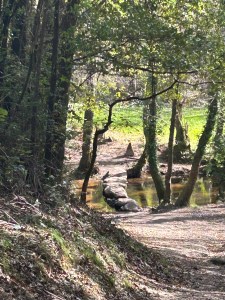
The wooded areas help mask the noisy highway we periodically cross. We are walking the usual mileage today, but for some reason, it seems much longer, and I am exhausted. 

The only thing that keeps me going is running into the sweet New Zealand family, joining them for a Coke, and finishing the last few miles together. The mom has such a lovely, serene way about her. She is originally from Ireland and said that even though the people are friendly in the small town her husband grew up in, it’s so remote and she feels so distant from her family. Her frown turns into a smile as she shares that they plan to meet her sister in Rome after the Camino.
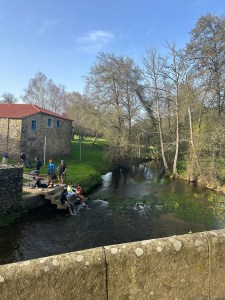
We arrive in Ribadiso and walk over the medieval bridge to the sound of pilgrims laughing and splashing in the river. We ask them if the water’s cold, and they all answer in unison with a resounding “Yes!”  

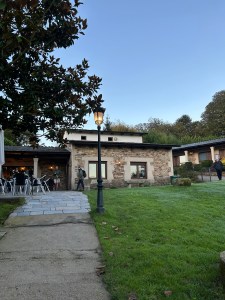
With its lovely pool, Pensión Ribadiso would be even nicer on a warmer day. The room is welcoming with its wood-beamed ceiling, and it’s wonderful to have a washer and dryer on the premises. 

Luckily for us, there is a restaurant right across the street, so we don’t have to walk back up the hill. We meet a pilgrim from South America who confides in us that he’s not used to the early 8 p.m. dinners here in Spain. At home, he dines at 10 p.m.!

Oct 31: O Pedrouzo- 16 miles
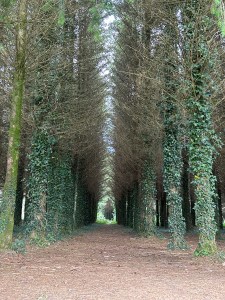
It’s better to get the steep climb out of the way early! From then on, we’re in and out of eucalyptus forests, and we take in the scent of eucalyptus with every breath. We’re getting to the end of our walk, and I’m hoping I have successfully cleaned out all the cobwebs in the corners of my brain. Chatting with strangers, you may or may not ever see again, has a magical quality. Walking and talking side by side, rather than facing each other, may explain why the words seem easier. Spending time walking alone is a wonderful gift to give yourself.

The town has a worn look to it. The sidewalks are full of shops and restaurants, trying hard to look their best. The streets are one loud cacophony of cars, trucks, and pilgrims. Pensión Residential Platas is not impressive, but it’s clean, and the young woman at the front desk has a warm smile.

We remembered our first time here in 2016. After walking in a torrential downpour, we were not looking forward to heading out again to dinner. When we returned downstairs, we noticed pilgrims eating in the breakfast room. They told us we could place an order at the local pizza place that would deliver. This time, we decide to seek out that same restaurant and celebrate that, for one evening, we are in a No (French) Fry Zone and order the same meal. 

Nov. 1 – 3: Santiago – 15 miles
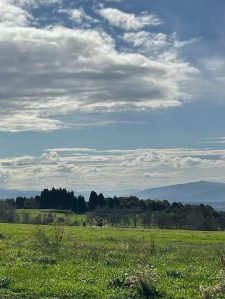
Walking through the forest is a lovely way to start the day. Its denseness makes us feel at peace,

As John Brierley eloquently states in his Camino guidebook “It’s a long slog up to Mount Goza.” An elevated area overlooking the city, it doesn’t have much to offer except for a few pilgrim sculptures and a view of the sprawling complex offering 400 beds in dormitory-style blockhouses.

We head downhill and down the stairs and are welcomed by asphalt. The city noise, the wide streets, and the traffic startle us. Some passersby on the street smile and give us a thumbs-up, as if to say, “Almost there, keep going!” 

We are happy to find a restaurant serving Caldo Gallego. The restaurant is empty, but a few minutes later, large groups are seated around us, ready to enjoy a long, late afternoon lunch. The sounds of conversation and laughter make for good company. 

In the distance, we can see the spires of the Cathedral, but we are not fooled into thinking we are close by. Block after block, we trudge on, gazing into non-descript store windows and focusing all our concentration on crossing the busy streets. 

Finally, we come to “Porta do Camiño, the famous gate and entrance to the wonderful, old city. Almost immediately, the streets narrow and turn to cobblestone. Every shop and restaurant window intrigues us and we are brimming with anticipation.

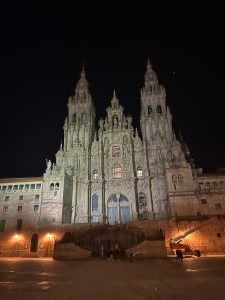
As we enter the dark tunnel, the familiar sound of the bagpiper welcomes us. Once again, we wonder -are musicians stationed there 24/7 to greet every pilgrim? Just a few more steps and we are in the Cathedral Plaza. While the majestic Cathedral sparkles overhead in the sunlight, pilgrims, mingled with tourists and townspeople, are crying, hugging, laughing, or too overwhelmed to do anything more than lay on the ground with their eyes closed.  

This is our fourth time experiencing Santiago, but it never gets old. We hug and shed some tears; tears of joy for a successful arrival and tears of sadness for the trip coming to an end. We look up to see our friend, the solitary pilgrim from Colorado, running towards us. 

With a tear-stained face, he tells us that, since he arrived in Santiago, he had seen everyone he had encountered along the way,, except us and now, here we were! He speaks happily and rapidly, nothing like the man we first met, and I am so happy for him and his newfound metamorphosis.
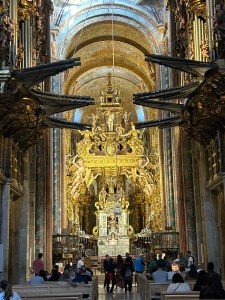
The Cathedral, a World UNESCO Heritage Site, was completed in 1211. Housing the remains of Saint James, it inspired pilgrimages, which ended at this iconic location. The highlight of the pilgrim mass is the Botafumiero. Six attendants dramatically swing it up and over the heads of the parishioners. 

We take the time to view our favorite areas

  • Stepping down into the crypt of Saint James and taking a minute to kneel and say a prayer.
  • Visiting the Praza de Quintana, near the Cathedral, at night to view the shadow of a pilgrim projected on the wall, a trick of the lights reflecting off the square. 

Unfortunately, you can now only view these areas from afar:

  • The weathered spot in the solid marble – a finger hole – created by the millions of grateful pilgrims that touched the spot after a safe arrival.  
  • Touching our foreheads to the sculpture of Maestro Mateo, one of the Cathedral’s master builders, to receive some of his artistic genius. 

The Hotel Rua Villar is an elegant townhouse, just steps from the Cathedral. Our room looks out to the main street, but there is nothing except a large terrace across from us, making it very private. I look forward to taking time each day to sit and write in their lovely library. 
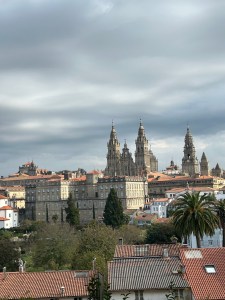
We head to the pilgrim office to obtain our Compostela, the Camino certificate of completion, and enjoy walking all over Santiago. As we stroll Old Town, Alameda Park, and the Mercado de Abastos food market, I wonder if we will see our pilgrim friends again. 

Before we leave Santiago, we run into the Norwegian couple and the New Zealand family, tearfully hugging and reminiscing. I watch for the Australian couple, thinking I will see them any minute, but I never do. I wish I could’ve told them how wonderful it was to have met them. After stewing about it, I realize that time well spent was in that moment, and rather than worry about what was not, I should be grateful for what was.

As we prepare to depart Santiago, we have a big decision to make. Do we continue our Camino by walking to A Coruña, and Ferrol or travel by train and become tourists? 
Oct. 27 – 29: Barbadelo to Palas de Rei

Oct. 27: Barbadelo – 16 miles
Today, with no mist, we can appreciate the beautiful forest. The ups and downs go on forever, as do the amazing vistas. The water crossings – never my favorite – take all my concentration. I stop halfway through, realizing the next rock is more rounded than the others and I’ll have to balance myself before making my way to the next one. There’s nothing to do but move forward. I finish the day’s walk with even more of a spring in my step, proud of myself for overcoming the challenging day. 

We’re surprised to come upon an English couple who are artists and have built their studio and home on the Camino. We were impressed to see a poster advertising a show they had at Windsor Castle, and we stopped to chat a bit. 

Some words to ponder while we relax

Out of nowhere, we see an area with a sitting area and food offered for a donation. This resting place looks to be larger and more organized than the similar stops we’ve come across before. It even has an area for sound therapy, meditation, and a labyrinth. We are greeted warmly by a young woman from California, who takes our order for café con leches. She tells us she happened to stop here on a rainy day. She said something told her to stay and she’s been here for a couple of days volunteering. 

Casa Barbadelo’s
rustic feel was very welcoming


We first came across the cabins at Casa Barbadelo in 2016. We were sorry we didn’t stay back then and decided to reserve it this time. Set up more like a motel, with outside access to the rooms, they are rustic but quite nice. We are staying right next door to the Norwegian couple we keep crossing paths with and we finally get the chance to have dinner together. 

He is a tall man, with blond wavy hair down to his shoulders that any woman would kill for. She is blond and petite. They live near the Arctic border and have a house in Spain that they will head to after the Camino. An Australian pilgrim joins us and tells us about his adventures on the Kumano Kodo, the Japanese Camino, and hiking in Nepal. 

We invite a woman from Nevada, who’s about to dine alone, to also join us. She tells us she likes to hike all over the U.S. by herself. Her car is always packed and ready to go, in case the spirit moves her. It takes most pilgrims about a month to walk the French route, but she nonchalantly mentions she’s a slow walker and it’s already taken her two months to get to this point. 

We enjoyed the lively conversation while soft music plays in the background. We are excited to see that rice is offered on this menu. This is different from the French fries served at each meal! The entrée, a thin, delicious steak with a mushroom sauce, rounds out a perfect evening! 

Oct. 28: Portomarin – 15 miles

We could have sat here all afternoon!


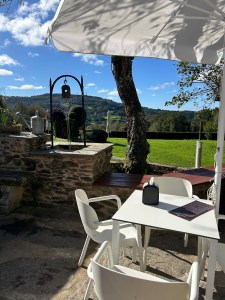
It’s a beautiful day and the woodland path is gravel, a nice change of pace for our feet. We walked along forest paths and tree-lined lanes until we came to a beautiful spot. With a lovely outdoor patio, soft music playing, and outstanding views, it seemed this contemporary restaurant, Mercadoiro, was waiting for us to stop there for lunch. It’s no surprise that we vote their Caldo Gallego the best we’ve enjoyed on the Camino, to date. 

Happy and content, we continue onward. Up ahead, we see pilgrims all lined up in single file and now, we remember why. One by one, each person heads down a rocky gorge that sits deep into the earth. When it’s my turn, I take a moment to consider if I should shimmy down on my posterior or walk down on foot. It’s so steep, my hiking poles will be of no help. I stand there for what seems like minutes, wishing no one was behind me and wondering what would happen if just one person behind us lost their footing. Would they knock us all down like bowling pins?

A moment later, a young Spanish man turns around to face me. He smiles, holds out his hands, and walks me down and out of the gorge. I can’t thank him enough. I tell him he is “muy fuerte” (very strong) and hug him and his wife goodbye. 

And if this wasn’t enough for one day, we next crossed a long bridge. What made it so uncomfortable was that the barriers are unusually low on both the river and traffic side. We put our heads down and walk as fast as we can before vertigo has a chance to set in.

The last leg of today’s journey


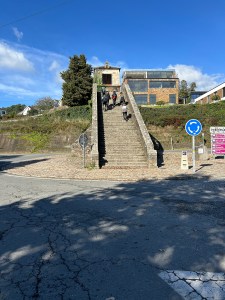
We’re almost in town, except for the steep staircase that now stands before us. At this point, all we can do is laugh and head upward, taking turns announcing out loud what we might eat and drink tonight after a hot shower. 

A lovely spot at Vista Alegre

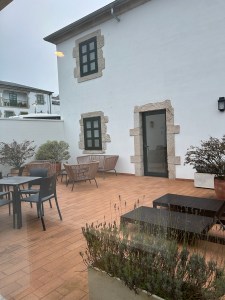
Is that the Vista Alegre Hotel or is it a mirage? The white structure has an almost Moroccan feel, with its welcoming carved wooden door and arched stone entrance. Our lovely contemporary all-white room is crisp and bright. We are sorry we don’t have the time to relax on our floor’s outdoor sitting area or visit the spa. 

We step out of our room and just at the same moment, our Australian friend is exiting the room right next to us. After a good laugh, she tells us she’s headed to join her husband. He says he’s found a lovely spot for a drink, and she invites us along. We all sit at a table by the river and chat. After a walk around town and a nice meal, we’ve forgotten all it took to get here today. 

Oct. 29: Palas de Rei – 17 miles

Sometimes walking alone can be so therapeutic


The weather is cool today, with just enough sun to warm us. We walk in and out of forests and fields, but soon realize those long, low inclines fool us and seem to go on forever. We come upon another rocky gorge. It’s smaller and, this time, we’re the only ones walking down it, so we can take our time and maneuver more comfortably. Feeling great after another delicious Caldo Gallego lunch stop, we realize we are only halfway to our destination. 

We immediately liked our room at Pensión Pardellas, with its stone wall, balcony, and artistic black-and-white area photos on the walls. The shower is great too, an added plus. 

Mr. Wiz reminds me that in 2018 we had a drink at Castro, so we decided to treat ourselves to dinner at this lovely restaurant. On the way, we pass our Norwegian and Australian friends on the street. Both have decided they’re exhausted and plan to shop for food and eat in their rooms. 

We happened to sit next to an Australian couple celebrating the husband’s birthday. After some Camino chatter, he mentioned he had lived and worked in Ferrol. We’ve considered stopping there, are delighted to receive some inside information, and thank them as they leave. 

It seems hunger has won out over exhaustion and our Australian friends are seated at the only available table, which happens to be right next to us! We toast to Camino coincidences, and I’m convinced we would be friends if we didn’t live a continent away from each other. 

Sept. 28 – Oct 2: Navia to Ribadeo

Sept. 28: Navia – 14 miles
I’m so busy chatting with a pilgrim from Michigan, all I know is that the terrain is flat. The young woman from Taiwan we greet each day is suffering from blisters. We give her some of the extra bandages Michael received at the clinic. I tell her (as best I can) that my name for her is “Fuerte” (strong); she’s traveled here alone, speaks no Spanish and very little English. 

One minute I’m considering taking off my jacket and infatuated with the group of trees that look like the talking trees from “The Wizard of Oz.” The next minute the wind picks up and it’s raining hard. My pants are drenched and stuck to me, but my feet are dry inside my shoes, I’m dry inside my coat and I’m inside myself, thinking and plodding along.

Casona Naviega is a renovated stately mansion in the English country style. I walk around the common areas, marveling at the furnishings and, when no one is looking, I gracefully glide down the staircase pretending to be welcoming my party guests. 

Casa Xusto sitting room

Sept. 29: La Caridad – 8 miles
After a lovely breakfast, with Spanish guitar music playing softly in the background, and a conversation with a woman from S. Africa who’s on the Camino, it’s not easy to open the door and head back out into the rain. Luckily, we’ve planned a short day.

Even though our pants are drenched again, this time our shoes are soaked, but we’re chatting away. We try taking turns singing Broadway show tunes, but quickly realize we only know the first line and the chorus of each song.

We arrive at Hotel Rural Casa Xusto early and are warmly greeted by Pepe, who takes such good care of us. He reminds us there will be a festival in town starting today and suggests making us a dinner reservation. For a fair price he will wash our wet/dirty clothes and deliver them in the evening. Then, while we’re waiting for our room to be ready, he brings us a beer and some jamón.

Jamón is a staple of Spanish cuisine. It’s similar to Italian prosciutto, but with a more intense flavor. The pork hind leg of the Spanish pig is dry cured in salt. Serrano is the more typical type. Ibérico, from black pigs, is the most expensive meat in the world, with a leg costing in the range of $4500. A sign of status is to impress your guests with your jamón displayed on a stand, ready for slicing.

Originally a 200 year old barn with a residence above, the usual stone, wooden beams and antique furnishings take on an enchanting, almost magical feel here. There’s a beautiful sitting area outside our room that we have all to ourselves. We fall asleep to the sounds of music, singing and fireworks. 

Sept. 30. – Oct. 2: Ribadeo- 16 miles
Today is our last day walking in the province of Asturias. 

We delay putting our wet shoes on as long as we can. Michael has a good laugh and wants no part of my invention. I take the small plastic bags that the bathroom glasses are wrapped in, put them over my socks and my feet stay dry all day.

The path today is fairly flat on rural farm roads. When our guidebook says that the route splits after the white house with the palm tree, we wonder- what happens if they decide to repaint the house?! 

We stop to view the ocean and continue along on a boardwalk. Then, we come to a pedestrian bridge, the likes of which we’ve never seen before. On one side is a high fence and the expressway and on the other side is a lower fence and the Calabrian Sea below. The bridge is just over a half mile long, but seems to go on forever and, with every truck passing in the right lane, we feel it reverberate. With heads down, we have no choice but to keep moving.

All along, we’ve been reserving rooms weeks ahead with no problems. After researching for hours at a time, we finally realize there’s absolutely no place to stay at our next stop until Monday, Oct. 3!  “Es lo que es!” (It is what it is!). “Monta las olas!” ( Ride the wave!) Ribadeo is our first town in the province of Galicia and the last town on the coast before we head inland; the perfect place to stop for an extra night! 

We explore the churches, historic buildings and neighborhoods in this seaside tourist town. Our hotel, La Casona de Lazúrtegui, is a casona-light; “casona” is mansion in Spanish. The rooms are plain, but the building has character and the lovely salon becomes our personal living room. 

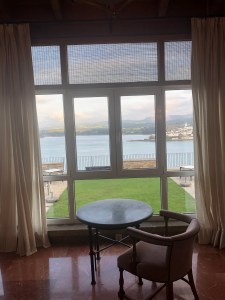
As it turns out, this hotel is not available on Oct. 2, so we’re “forced” to stay at Parador de Ribadeo Lugo. Paradors are managed by a state-run company and located in historic Spanish buildings such as fortresses, monasteries, castles or prestigious homes. This historic home sits at the mouth of the Eo River and we spend the day here relaxing, inside and out, enjoying cocktails and dinner while taking in the views.

Sept. 24 – 27: Muros de Nalón to Luarca

Sept. 24: Muros de Nalón – 16 miles
We breakfast with a couple from England and a man from Poland who left his front door in May and has been walking ever since! It’s a pleasant walk through villages and dirt trails in the forest…until the rain starts.

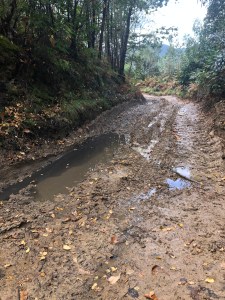
We find ourselves sloshing through mud and over rocks and gnarled tree roots.  Navigating puddles and trenches takes total concentration and we are laser focused for what seems like hours. I’m not sure what’s more slippery; the ascents or the descents. The rain seems to be enjoying the game it’s playing with us. Every time we get too warm and take off our rain jackets, it starts up again.

We welcome the drizzle and the change from muddy forest to road. We chat with a woman from the Netherlands who regales us with stories about each of her Camino adventures over the last ten years. It’s a League of Nations, as we stand at a crossroads with pilgrims from all different countries trying to ascertain the correct route. The yellow arrows and the shells posted along the way are our guides. At the start, the base of the shell pointed the correct way, but now they are displayed both ways!

Casa Carmina has not opened for the day yet, so we wait on a bench across the street with some other pilgrims. The mother/daughter owners are a well-oiled machine, welcoming us early out of the drizzle and getting us settled. Rather than a room of bunk beds, we opt for a private room at this albergue. The weather clears and we enjoy some wine, sitting outside on their lovely grounds. We chat with a young woman from the Netherlands, who started cycling from the northern most part of her country and plans to end up at the southern most point of Portugal. And to make it even more of an experience, she’s camping along the way!

Sept. 25: Soto de Lunas – 14 miles
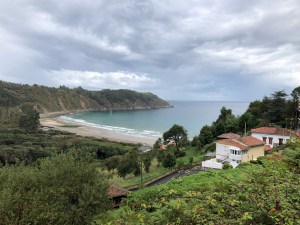
Another difficult day awaits us! It’s a repeat of yesterday and we’re fixated on every muddy step, with steep ups and downs. In between, we are treated to peeks of the ocean and walks through small towns.

There’s a convivial gathering in the crowded bar and dining room as we enter Hotel Valle de Luiñas. We are welcomed warmly at this lovely rural inn and told our bags have not arrived yet. We had planned to enjoy Sunday dinner here, so we wash our faces and hands and quickly sit down. With our muddy pants and boots hidden under the white tablecloth, we decide we don’t look too bad from the waist up.

The first one in the shower each day is responsible for giving the shower report. Is it slippery? Which are the hot/cold faucets? Sometimes they are opposite.  Does it leak? I purposely let Michael go first today.

Sept. 26: Cadavedo – 16 miles
The good news: the hotel is right on the Camino path. The bad news: our guidebook rated yesterday a two in difficulty and rates today a three! Right away, we come to a long tunnel which is so dark, we can’t see a thing. By the light of our phones we walk cautiously, trying to ascertain the terrain.

By days end, we will have tackled five water crossings, each with its own unique characteristics. Whether we’re balancing from rock to slick rock, deciding the sturdiest place to step on a tree root or wondering if it’s best to go straight through or around the perimeter, we can count on our our hiking poles to get us to the other side. The narrow path that follows takes us up a steep incline, but the view of the ocean at the top makes it all worthwhile.

We’re so happy to have arrived that we don’t mind climbing the grand staircase at Hotel Rural Casa Roja, a charming renovated country home. We never tire of the stone walls and beamed ceilings that these places all have in common. It’s not much of a town, but with lovely sitting areas, inside and out, we make sure to take advantage of both. But, not before buying a bottle of wine at the market conveniently located across the street.

Sept. 27: Luarca – 11 miles
We begin with jackets on, only to take them off a few minutes later. There’s no rain in the forecast, the temperature quickly rises from the 60’s to the 70’s and it’s cloudy; perfect for walking.

The forest path is steep, but surprisingly dry. The makeshift steps, made up of twisted tree roots and rocks, force us to contemplate every step, but rather than tiring me out, it leaves me with a peaceful feeling. Walking through the small farm towns is a welcome pleasure. The old stone dwellings that look as if they’ve seen better days seem to be magically transformed into homes with just the addition of their blooming flower boxes.

Luarca is an older seaside town. What makes it unique are the white homes balancing on the cliffs that encircle the Bay of Biscay. I am fascinated to see how they are connected and still standing! The streets are so incredibly steep, I wonder how they get around on icy/snowy days. Meanwhile, two “señoras” (older women) are arm in arm, talking and laughing, as they bypass us and make their way quickly down the street!

Built in 1906, the Hotel Villa de Luarca was a residence and our room looks out to a lovely little courtyard filled with flowers. Most towns close up in the late afternoon and as soon as they reopen again for the evening, the bars, restaurants and plazas quickly all come alive. After a quick walking tour of the historic quarter after dinner, it’s time for these two peregrinos to call  it a night.