When family and friends heard we were heading back to the Camino, their first question was “Why?!” They wondered what it was about walking miles, on all kinds of terrain, in all types of weather, and for days on end that made it alluring.
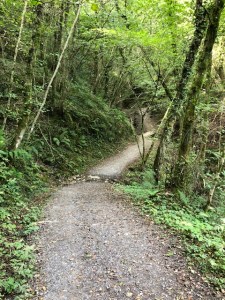
The good terrain

The not-so-good terrain
What is the Camino?
In the ninth century, a local bishop ordered a church to be built to house the remains of St. James, when they were discovered in the northwestern Spanish town of Galicia. Over time, the church grew into the grand cathedral of today, and the city became known as Santiago de Compostela – “St. James under a field of stars.”
Throughout the Middle Ages, people started their pilgrimages from their homes, which created the many routes still used today. Yellow arrows mark the routes to help pilgrims navigate. Along the way, churches, restaurants, and places to stay, stamp a pilgrim’s passport to prove they have walked the minimum 100 kilometers/62 miles required to receive the coveted certificate, or “Compostela,” from the pilgrim office in Santiago.
There are many reasons why people choose to walk the Camino. It evokes a physical, mental, spiritual, and mystical experience unlike any other.
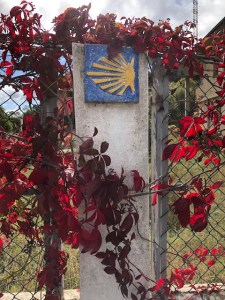
You never know where you’ll find a yellow arrow
It’s Your Camino
Though walking is the most popular way to travel the Camino, some ride a bicycle or travel on horseback. You can travel as much or as little as you would like each day. If you tire, buses and taxis are available, and there are companies offering daily backpack transport.
You can choose to stay in a “donativo” – a mat on a church floor for a donation, a five-star hotel, and anywhere in between, such as an “albergue” – a pilgrim hostel or a “casa rural” – a guesthouse. You can make a reservation ahead of time or see where the wind takes you when you arrive in a town. To keep you energized, the three-course pilgrim meals are delicious and offered at a bargain.
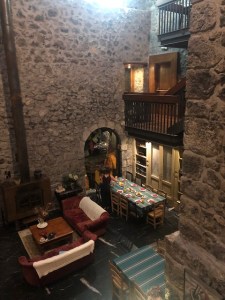
Hotel Antsotegi in Etxebarria was an old iron mill turned hotel
The Olé of Spain
There’s an exuberance and an elegance to life in the Spanish cities. Working to live, rather than living to work, allows time for family and friends. Music and culture are relished, every meal is savored, and life is lived at a slower pace.
Spaniards still enjoy the tradition of the paseo. They dress up for their stroll through a town’s main street or plaza to greet family and friends. No doubt there will be stops along the way for a café con leche y dulce – espresso coffee with hot milk and a sweet – or vino y tapas – wine and appetizers.
The small towns have a charm of their own. As if traveling back in time, a car driving through the street is almost startling. At times, you may be walking through a herd of sheep or visiting a small church, and the simplicity of the moment leads you to ponder your own life.

Estella, Spain was founded in 1090
Pilgrim Power
“Buen Camino!” Each day, pilgrims wish each other a good walk as they pass each other by.
We are all heading to the same place – the Cathedral in Santiago de Compostela – which creates instant camaraderie. There seems to be no interest in who you are at home. Here, everyone is equal.
Encountering pilgrims from all over the world, you begin to realize there are very few differences between you. Very quickly, they are no longer strangers. Your interaction might be days/weeks together or just a few words in passing. Pilgrim families are created, and members may keep in touch for a lifetime. Sometimes just a quick exchange can become crucial to helping you think through an issue in your life.
You feel a positive energy around you each day. The genuine hospitality encountered by people from all walks of life throughout Spain seems to rub off on the pilgrims, who, in turn, are there for their fellow travelers. Whether it’s with a hug, a band-aid, directions, or just a listening ear, there’s a loving spirit that makes you wonder why people aren’t always like this.
Me, Myself and I
You feel an ongoing gratitude for the simplicity of each day, its daily rhythm, and the chance to reboot, as you discover the Spanish culture in slow motion. It’s easier to listen to yourself when it’s quiet and the peaceful solitude of walking alone is a nice balance.
The freedom from everyday obligations and the luxury of being unplugged from the stimuli of our daily lives gives you more time to focus on the world around you. Traveling with only the belongings that fit in your backpack makes you feel lighter. You sometimes feel as if you were turned inside out, with your senses heightened and your mind clear and open.
The mud and sweat are understandable parts of the walk. As your journey ends and you enter the plaza of the Cathedral in Santiago de Compostela, you wonder if your tears are because you conquered the goals of this demanding trip or because your journey has come to an end.
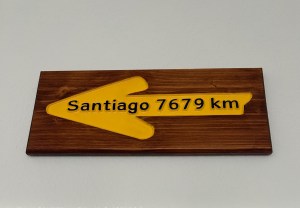 This sign shows the distance from Georgetown, Texas to Santiago de Compostela, Spain
“Live for the moments you can’t put into words.”
“The end is just the beginning”
Authors Unknown
For more information on the Camino:
Watch the movie that resurrected the Camino in the United States in 2010. “The Way” starred Martin Sheen and was written, directed, and produced by his son, Emilio Estevez.
Listen to Dan Mullins’ podcast “My Camino the Podcast” which showcases Camino stories from pilgrims from over the world.
Go to the American Pilgrims on the Camino website which shares information, supports American pilgrims, and subsidizes Camino-related projects with grant money from its dues.
Author’s Note:
IIf you enjoyed this post, please scroll down, like it, and feel free to share it!


Sounds enchanting. Reminds you Life’s journey is one step
LikeLike
Yes, Sue – exactly! That is the best lesson learned on the Camino!
LikeLike
Yes, Sue – exactly! That’s the best lesson you receive on the Camino!
LikeLike