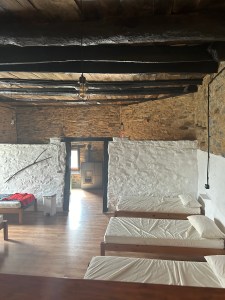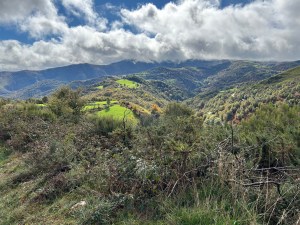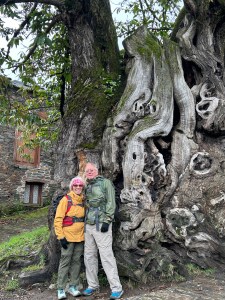
Nov. 3 – 8: A Coruña, Ferrol, and Santiago 

Nov. 3 – 4:  A Coruña
Rather than continue as pilgrims, we’ve decided to become tourists for the last part of the trip. That doesn’t preclude us from walking across town to the Santiago train station to catch our train to A Coruña. 

I’m not the best one to ask about scenic train rides. No sooner do I find my seat than, with heavy eyelids, I am lulled to sleep by the train’s soothing rocking. My usual “That was a quick trip” comment always makes Mr. Wiz laugh, but this time in less than one hour, we’ve arrived. 

As we walk to our hotel, I am reminded of how much I love Sundays in Spain. Families are out in masse, on their paseo – a leisurely stroll through city streets. The well-dressed, multi-generational groups stop along the way for a meal or a drink and some tapas. As they wait for the streetlight to change, an elderly man and his son clasp hands, as long as they can, before the son must let go and cross with his family. Three women of different generations walk, arm in arm, talking and laughing together. The lively chatter and the children’s giggles somehow brighten the already sun-drenched day.

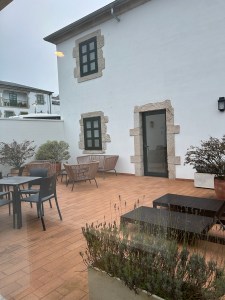
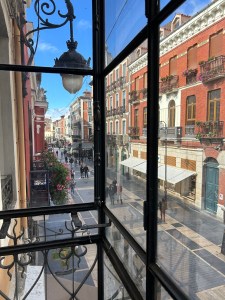
The Hotel Galeria Coruña is in the center of the historic district, surrounded by shops and restaurants. Even though its medieval stone streets are busy, no traffic is allowed, and it gives the area a relaxed feel. The boutique hotel is modern and trendy, with its white décor, back-lit shelves, and bathroom fog mirrors in each room. 
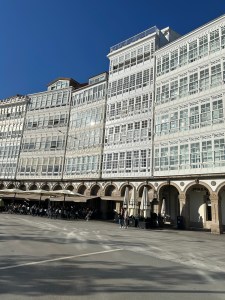
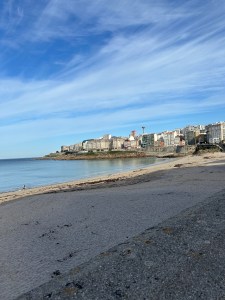
On the Avenida de Marina, the long seafront promenade is lined with bars and restaurants, all with outdoor seating that offer magnificent views of the Atlantic Ocean. The series of large, glazed white apartment buildings, with their enclosed glass balconies, line the Avenida and add elegance to the “Glass City,” the name A Coruña is known by. 
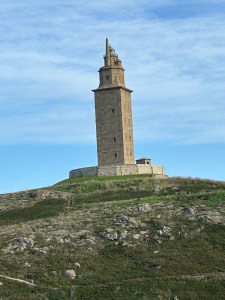
We head out on the promenade to the Tower of Hercules, the oldest working lighthouse in the world, built in the late first century and a UNESCO World Heritage Site. We take our time in the lovely sculpture garden and enjoy a walk on the beach. 
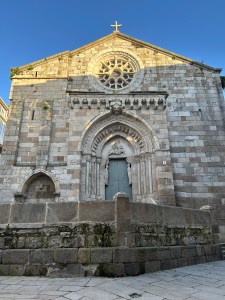
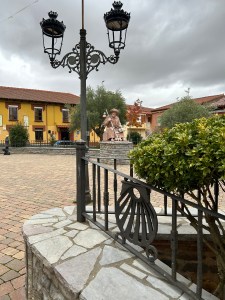
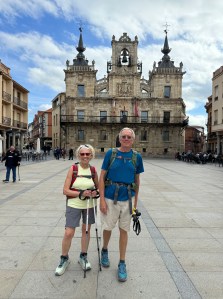
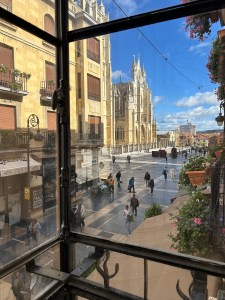
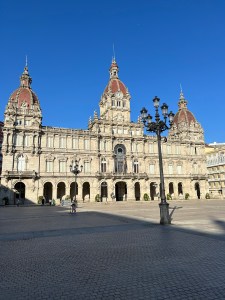
Interspersed with a glass of wine and some people-watching on the promenade, we explored the 12th-century Santiago Church and visited the Picasso Route, viewing the places where Pablo Picasso spent time while living here. We strolled the Plaza de Maria Pita, which pays homage to the A Coruña Mayor and heroine who helped defend Spain against the English Armada in 1589 – first picture above.

Discovering something interesting around every nook and cranny gives us quite an appetite and we both stop short at the sight of a group, sitting outside and eating grilled beef served on a wooden platter. Usually, we are vegetarians – or should I say flexitarians, since we do occasionally eat meat. Today is one of those days we can’t help but venture in. 
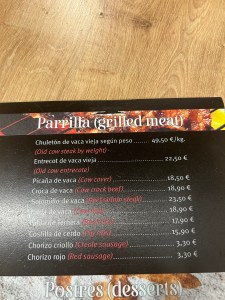
It’s 3 p.m. and this will be our main meal of the day. Otherwise, we will need to wait until 8:30 p.m. The Padron peppers and the “Pulpo“(octopus) appetizers are delicious, but when it comes to deciphering the meat side of the menu, we are stymied by words that are not translatable. If we weren’t so hungry, this would be quite funny. We resort to the good old reliable strategy of pointing to what someone else is eating. We enjoy every morsel and toast to following our intuition, especially when it’s combined with the scent of grilled meat, and getting to know in A Coruña.

Nov. 5 – 6: Ferrol
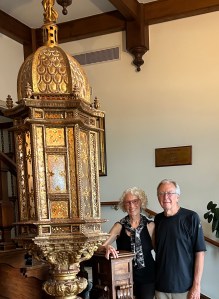
It’s a short bus ride to Ferrol and we arrive in under an hour. As we walk into town and head to our hotel, we know now why Ferrol, is known in the Galician region as their “Black Sheep.” It is not an attractive city, but the more we get to know it, the more we find there is also some charm left over from its heyday. 
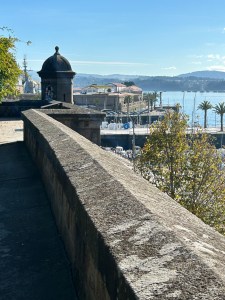
Originally a fishing village, their secure harbor, protected from the sea by rocky hills, was responsible for developing the city into a naval base, a shipbuilding center, and the Royal Navy Arsenal. At one time, the city prospered as Spain’s maritime capital, but as the Navy fleet was transferred elsewhere, the lower military presence led to a downturn in the population and the economy. This accounts for the remnants of its “Golden Age’ in the shopping district, where one out of 10 of the elegant high-end stores remain, secluded around those shops that are now for lease. 
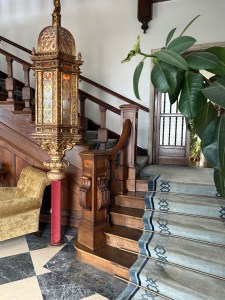
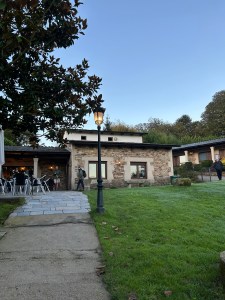
Our hotel, the Parador de Ferrol stands out as a majestic example of a genteel time gone by. The stately Galician mansion, built in 1928, features a grand staircase, nautical antiques, and lovely guest rooms with views of the port. 

What is a Parador?
Paradors are luxury hotels owned and run by the Spanish government. Usually converted historic buildings, monasteries, and castles, they must meet strict criteria and maintain a high standard of quality. 

On this trip to Spain, I had noticed even more than past years, the decrepit state of the buildings in the small towns and wondered why the townspeople did not get together and work to do something to elevate their hometown. It wasn’t until I arrived in Ferrol that I received the answer I had been looking for. 

In chatting with the hotel front desk personnel, they mentioned that the large signs displayed throughout Ferrol’s historic district announce a complete renovation is underway, restoring the area to its original splendor. Unfortunately, due to mismanagement and delays with restoration paperwork approvals, the entire district remains in ruins. Since they are protected buildings, nothing can be touched without the proper state approvals.

With a heavy heart for the frustrated residents, we continue to seek out and find wonderful spots around town. The “Jardines de Herrera” is a lovely garden owned by the military. The Magdalena district, with its upscale homes, is the sight of two cathedrals and one special restaurant. 
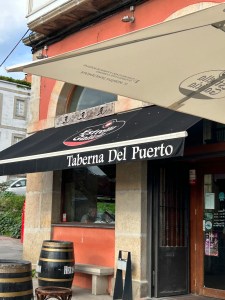
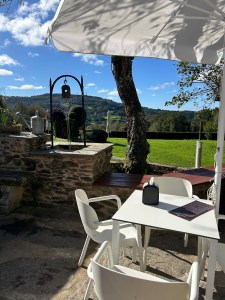
As we stroll by the water, we snag the last outdoor table at Taberna del Puerto for a late lunch. Sliced Heirloom tomatoes with extra-virgin olive oil, grilled Padron peppers, pork served with a savory/sweet sauce accompanied with French fries was one of those meals that you later dream about! So much so that when the server offered dessert, we ordered more Heirloom tomatoes!

Nov. 7 – 8: Santiago

We are warmly welcomed back to the Hotel Rua Villar, and we thank them again for holding some of our belongings, so we could travel lighter. The lovely room they have reserved for us has a wood beamed ceiling, a bathtub, and a glass enclosed sitting area that overlooks the plaza. I can see myself enjoying some writing time there, but not for too long, since Santiago awaits us. 

We set out for a stroll and hear impromptu applause as we near the Cathedral Plaza. A young Korean pilgrim is on his knees proposing to his girlfriend, who has just accepted. What a lovely way to start our day!

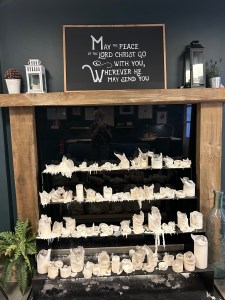
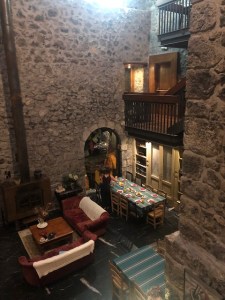
We’ve never taken the time to stop at the Pilgrim House Welcome Center and decide to do so today. Opened in 2014, it provides support and resources to pilgrims having just completed the Camino. The space consists of a living room, kitchenette, quiet reflection room and a patio. 

They offer the following services (some with a small, suggested donation):
– free Wi-Fi
– computer access
– laundry service
– backpack storage
– boarding pass printing
– group or private Camino debriefing session

We didn’t plan on spending so much time there, but we strike up a conversation with the kind, soft-spoken manager and enjoy hearing about her life. After walking the Camino 17 years ago, she and her husband moved to Spain. Both had backgrounds in the nonprofit sector and were hired to develop the center, which took years of paperwork. 

Now with four children, they are planning to move back to the U.S. We were surprised to hear that Santiago has some of the worst weather in Spain, with rain most of the winter. We chatted about their current lifestyle, how the family will experience culture shock when they move to Maryland, and wished them all the best. 

After enjoying some Caldo Gallego, pork, and potatoes at a local’s restaurant, we decide our last evening calls for a nightcap at our favorite bar. Our walk is longer than we expected, as we travel the maze of Old Town streets, but they are filled with people eating, drinking, laughing, and talking as if it were a special celebration. This is Santiago every night!

We decline the free tapas we are offered by the bartender, so he brings us some corn nuts. The roasted snack has accompanied us throughout our walk, and we laugh to think they may, very well, also be the secret to a successful relationship. They are so incredibly crunchy that they drown out sound for the few seconds you are chewing. There are many situations when this comes in very handy! 

Where to next?

Oct. 27 – 29: Barbadelo to Palas de Rei

Oct. 27: Barbadelo – 16 miles
Today, with no mist, we can appreciate the beautiful forest. The ups and downs go on forever, as do the amazing vistas. The water crossings – never my favorite – take all my concentration. I stop halfway through, realizing the next rock is more rounded than the others and I’ll have to balance myself before making my way to the next one. There’s nothing to do but move forward. I finish the day’s walk with even more of a spring in my step, proud of myself for overcoming the challenging day. 

We’re surprised to come upon an English couple who are artists and have built their studio and home on the Camino. We were impressed to see a poster advertising a show they had at Windsor Castle, and we stopped to chat a bit. 

Some words to ponder while we relax

Out of nowhere, we see an area with a sitting area and food offered for a donation. This resting place looks to be larger and more organized than the similar stops we’ve come across before. It even has an area for sound therapy, meditation, and a labyrinth. We are greeted warmly by a young woman from California, who takes our order for café con leches. She tells us she happened to stop here on a rainy day. She said something told her to stay and she’s been here for a couple of days volunteering. 

Casa Barbadelo’s
rustic feel was very welcoming


We first came across the cabins at Casa Barbadelo in 2016. We were sorry we didn’t stay back then and decided to reserve it this time. Set up more like a motel, with outside access to the rooms, they are rustic but quite nice. We are staying right next door to the Norwegian couple we keep crossing paths with and we finally get the chance to have dinner together. 

He is a tall man, with blond wavy hair down to his shoulders that any woman would kill for. She is blond and petite. They live near the Arctic border and have a house in Spain that they will head to after the Camino. An Australian pilgrim joins us and tells us about his adventures on the Kumano Kodo, the Japanese Camino, and hiking in Nepal. 

We invite a woman from Nevada, who’s about to dine alone, to also join us. She tells us she likes to hike all over the U.S. by herself. Her car is always packed and ready to go, in case the spirit moves her. It takes most pilgrims about a month to walk the French route, but she nonchalantly mentions she’s a slow walker and it’s already taken her two months to get to this point. 

We enjoyed the lively conversation while soft music plays in the background. We are excited to see that rice is offered on this menu. This is different from the French fries served at each meal! The entrée, a thin, delicious steak with a mushroom sauce, rounds out a perfect evening! 

Oct. 28: Portomarin – 15 miles

We could have sat here all afternoon!


It’s a beautiful day and the woodland path is gravel, a nice change of pace for our feet. We walked along forest paths and tree-lined lanes until we came to a beautiful spot. With a lovely outdoor patio, soft music playing, and outstanding views, it seemed this contemporary restaurant, Mercadoiro, was waiting for us to stop there for lunch. It’s no surprise that we vote their Caldo Gallego the best we’ve enjoyed on the Camino, to date. 

Happy and content, we continue onward. Up ahead, we see pilgrims all lined up in single file and now, we remember why. One by one, each person heads down a rocky gorge that sits deep into the earth. When it’s my turn, I take a moment to consider if I should shimmy down on my posterior or walk down on foot. It’s so steep, my hiking poles will be of no help. I stand there for what seems like minutes, wishing no one was behind me and wondering what would happen if just one person behind us lost their footing. Would they knock us all down like bowling pins?

A moment later, a young Spanish man turns around to face me. He smiles, holds out his hands, and walks me down and out of the gorge. I can’t thank him enough. I tell him he is “muy fuerte” (very strong) and hug him and his wife goodbye. 

And if this wasn’t enough for one day, we next crossed a long bridge. What made it so uncomfortable was that the barriers are unusually low on both the river and traffic side. We put our heads down and walk as fast as we can before vertigo has a chance to set in.

The last leg of today’s journey


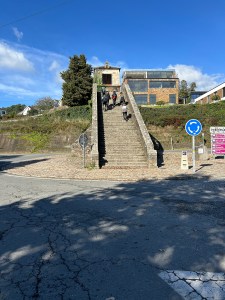
We’re almost in town, except for the steep staircase that now stands before us. At this point, all we can do is laugh and head upward, taking turns announcing out loud what we might eat and drink tonight after a hot shower. 

A lovely spot at Vista Alegre

Is that the Vista Alegre Hotel or is it a mirage? The white structure has an almost Moroccan feel, with its welcoming carved wooden door and arched stone entrance. Our lovely contemporary all-white room is crisp and bright. We are sorry we don’t have the time to relax on our floor’s outdoor sitting area or visit the spa. 

We step out of our room and just at the same moment, our Australian friend is exiting the room right next to us. After a good laugh, she tells us she’s headed to join her husband. He says he’s found a lovely spot for a drink, and she invites us along. We all sit at a table by the river and chat. After a walk around town and a nice meal, we’ve forgotten all it took to get here today. 

Oct. 29: Palas de Rei – 17 miles

Sometimes walking alone can be so therapeutic


The weather is cool today, with just enough sun to warm us. We walk in and out of forests and fields, but soon realize those long, low inclines fool us and seem to go on forever. We come upon another rocky gorge. It’s smaller and, this time, we’re the only ones walking down it, so we can take our time and maneuver more comfortably. Feeling great after another delicious Caldo Gallego lunch stop, we realize we are only halfway to our destination. 

We immediately liked our room at Pensión Pardellas, with its stone wall, balcony, and artistic black-and-white area photos on the walls. The shower is great too, an added plus. 

Mr. Wiz reminds me that in 2018 we had a drink at Castro, so we decided to treat ourselves to dinner at this lovely restaurant. On the way, we pass our Norwegian and Australian friends on the street. Both have decided they’re exhausted and plan to shop for food and eat in their rooms. 

We happened to sit next to an Australian couple celebrating the husband’s birthday. After some Camino chatter, he mentioned he had lived and worked in Ferrol. We’ve considered stopping there, are delighted to receive some inside information, and thank them as they leave. 

It seems hunger has won out over exhaustion and our Australian friends are seated at the only available table, which happens to be right next to us! We toast to Camino coincidences, and I’m convinced we would be friends if we didn’t live a continent away from each other. 

Oct. 23 – 26: Cacabelos to Triacastela

Mr. Wiz  walking non-stop!

Oct. 23: Cacabelos – 18 miles

That Mr. Wiz is a powerhouse! I tease him and call him “the camel” because I must remind him to stop for water and to eat! He puts his head down and those long legs just don’t stop going up and down the hills!

I’m having trouble recalling what I had to eat on the menu del dia two days ago and he remembers every detail of every town we visited in 2016 and 2018: where we ate, stayed, and stopped for a drink- incredible!

Downtown Cacabelos

There’s a lot of road walking today; not my favorite, but at least there’s a barrier between us and the cars and trucks that all seem to be going 100 mph! It always makes us smile when a car or truck sees us and blows their horn.

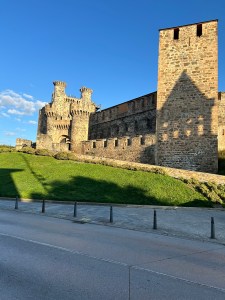
Today’s highlight is a stop at the “Castillo de los Templarios” (Templar Castle).

The stately Templar Castle

Who were the Knights Templar?
The Knights Templar were a Catholic military order. Founded in 1119, they protected pilgrims on their journeys. In the 12th century, they took possession of the fortress to use as a castle.

When they started to receive too much recognition and wealth, King Phillip forced the Pope to dissolve the order. The knights were arrested and tortured and their assets were stolen. Today, the magnificent castle remains as a study center and a library.

Cruz de Farro is located at the highest point of the French route

Cruz de Farro is a welcome sight. The simple iron cross on the hill has become a symbol of the Camino. The tradition is to bring a stone from home and leave it by the cross. It can symbolize leaving your troubles behind or commemorating someone important to you. Seeing the number of pilgrims kneeling, weeping or sitting quietly, along with the hundreds of rocks, notes, and photos on the ground is truly humbling and very emotional.

We voted these the ugliest trees in Spain

Our room at Hostal Santa Maria is so small that it takes some creativity to plan where to place anything. The town is not an attractive one, but the weather is so lovely that everyone is happy to be outside.

We stop and chat with a cheerful group of pilgrims. One Australian gentleman has such a kind way about him that I find myself immediately drawn to him. Later, I was told he is a priest and began walking in Switzerland 82 days ago. Unfortunately, I never got the chance to ask him why he was taking this journey and if he was finding what he was searching for.

Oct. 24: Trabadelo – 12 miles

A peaceful morning view

The early morning mist makes it feel much colder than it is. We head right to a narrow, rocky path and the single-file order precludes conversation.

I am very excited to be heading to Casa Susi!

Something to think about as we enter Casa Susi

Once upon a time, there was a tenacious, young woman from Australia named Susi. With an independent, adventurous spirit, she backpacked the world until she found the Camino (or until the Camino found her). Drawn to its sense of community and spirituality, she began work as a “hospitelero” (volunteer) at Albergues and began to dream about the one she would someday create.

The shell of the old barn on the Camino path in Trabadelo spoke to her. The fact that it had no water or electricity didn’t stop her. She worked tirelessly to prepare it for the upcoming season. As pilgrims came, some sensed her radiant spirit and stayed a day or two to help her finish one of her many projects. In turn, she offered them a bed and a wonderful meal, with vegetables from her, now abundant, garden which overlooked the river.

He was her 30th guest. A handsome architect from Pamplona, Fermin was soft-spoken with a warm smile. He was immediately captivated by this cheery, petite, powerhouse of a woman with the long blonde braid coquettishly tied to one side. Fermin likes to say that one project led to another, and he never left. Last summer, they were married in the Casa Susi garden and then again in Australia.

Everything  is well planned and organized at Casa Susi

Fermin welcomed us warmly. We were instructed to leave our boots and poles in the outer room. He offered us some herbal tea as we sat around the large wooden table and received information about our stay.

Luckily, no one snored!

A quiet spot in the garden

A door opened to a room with 10 beds and two bathrooms with showers. We were given paper-like sheets to use on the mattress and pillow and planned to sleep inside the sleeping bag liners – or sleep sacks – we had packed. A communal dinner would be served at 7:30 p.m. and we would meet Susi then. Dinner was prepared in the kitchen in their private living quarters upstairs. The cost of the bed and meal was only 27e each! Breakfast was self-service for an extra fee. In the meantime, we were free to relax inside or in the garden.

As it neared dinner time, the hungry pilgrims from California, Canada, Pittsburg, Korea, and Australia were excited to dine and finally meet Susi. As the wine was poured, Susi and Fermin welcomed us, told us a little about themselves, and then asked us to introduce ourselves and share why we were on the Camino.

Pilgrims always have interesting stories, but the one that touched us all was the 22-year-old young woman who tearfully confided she had just graduated from an intensely difficult college program and was confused as to why she had even chosen that course of study. She had already been walking 66 days from France and was exhausted mentally and physically.

After some hugs, Fermin and Susi served the first course: homemade pasta with pesto made with wild garlic Susi had foraged in the hills. Next, came a lovely salad along with peppers stuffed with vegetables, garbanzos, Moroccan spices, and a spiced yogurt topping. Dessert was a homemade lemon custard topped with plums.

I make a toast to the five, strong woman, at the table that are doing the Camino solo, and the meal ended with a round of applause for Susi, Fermin, their garden, and the wonderful gourmet dinner.

As I lay in my bed, I wondered what it would be like to host dinner for 12 every night; the planning, preparing, making conversation, cleaning up, and then doing it all again and again! When Susi and Fermin said they would close November 1, I assumed that meant a long vacation. Their plan was a weeklong trip to Malaga and then to Australia to work, with Susi as a florist and Fermin in construction. I fell asleep with a newfound respect for all the Albergue owners who dedicated their lives to caring for the pilgrims.

Oct. 25: O Cebreiro – 15 miles

It’s always an easy start when you walk through towns. Just when we’re grateful for no rain, it starts raining lightly, which it will do on and off all day today. This is the province of Galicia and O Cebreiro is known to be cold and damp, It’s still one of my favorite towns. With its charming stone village, scenic hiking trails, and good food and wine, many Spaniards agree with me and enjoy heading here for the weekend.

The lovely Valcarce Valley

We’re in for one of the steepest climbs today, navigating mud, wet leaves, and chestnuts, but the views of the Valcarce Valley will make it all worthwhile. The woods are quiet and beautiful. Sometimes the branches meet in the middle and create arches for us to walk through.

With just a touch of the mist hanging in the air, it gives the views a mystical feel. We are grateful for the quiet when, suddenly, we hear talking and laughing, as a group of what seems like hundreds of high school students take over the path. They walk along with us (actually, much faster!) until they head to buses to return down.

The Iglesia de Santa Maria Real dates back to the ninth century. It is the oldest
church associated with pilgrims and is also the resting place of Fr. Don Elias Valiña  Sampedro, who was responsible for helping to restore the Camino and whose idea it was to mark the route with yellow arrows (Camino shells are also used today).

Once again, our hotel La Venta Celta is small and plain, but it’s warm and we’re happy to arrive…that is, until we notice the shower is missing a door! With a smile, the lovely young woman explains that a large guest fell into it yesterday and they don’t have another room available. Rather than get upset, we ask for some extra towels for the floor and make it work. We see so many pilgrims we know at dinner, we decide to sit in the middle of the room, so we can chat with them all.

Oct. 26: Triacastela – 15 miles

Cold, but happy!

It’s raw out this morning! I open the door to check the weather and notice several pilgrims heading out in the dark with headlamps on. We prefer to have breakfast and wait for daylight.

Cows have the right of way in Spain

The rollercoaster hills are gravel today, which makes them a bit easier, but, not by much. I’m always surprised when we walk right through someone’s farm. Today, the señora seems nonplussed as she walks through the groups of pilgrims and gets her cows in line to head for the field. Meanwhile, we hustle to get ahead of them before they take over the road.

The chestnut tree is so ugly that it’s beautiful

We stop for a bowl of delicious lentil soup for lunch and everyone we know seems to have the same idea. Today is a long day, but for a few minutes, we are entertained by the 800-year-old chestnut tree that we pass. Gnarled and ashen gray, it has an artistic look about it. Every November, a festival is held in Galicia, where chestnuts are collected and celebrated. The fruit of the chestnut is enjoyed by both people and cattle.

Pension Albergue Lemos is a nice surprise. It’s the first stop in town, the room is modern with plenty of room and a hot shower. As a bonus, there is a washer and dryer available to use. With a big smile, the woman at reception surprises us by insisting she will do our laundry for us.

Oct. 19 – 22: Villar de Mazarife to Molinaseca

Welcome to Viilar de Mazarife!

Oct. 19: Villar de Mazarife – 14 miles 

It’s a cold start to the day, but the consensus is, it’s better than hot and sunny. We walk through an industrial district, scrubland and surprise- lots of ups and downs!

In the distance, we hear a lilting Irish voice. We’ve greeted this jolly soul daily, but today he catches up to us and joins us for some café con leche/té to warm up. Never married and living with his mother, he decided to sell his dairy farm, retire at 58, and see the world.

On his first Camino, he met a family traveling with their daughter via wheelchair. The daughter told him she had Multiple Sclerosis (MS), the brilliant mind of a 28-year-old, a great career, but the body of a 98-year old. When she added she was not going to let that stop her from her goals and dreams, he immediately joined her support team. He was proud that his practical farm sense came in handy, when he suggested they put a hot water bottle on her lap to keep her warm.

Our Irish friend snapped this photo of us

He spoke of the kindness of other pilgrims, taking turns pushing the wheelchair and sometimes even carrying it. He reluctantly said goodbye and headed home. Weeks later, he received a text, asking him if he’d like to meet them in Sarria and finish out the Camino. Two days later, he was on a plane back to Spain (you can do that when you live in Ireland) He said that experience changed his life and now, he can’t get enough of the Camino.

Bucolic setting on the way, but could not seem to translate the sign!

The Tio Pepe Hostal looks just like we left it in 2016. Once again, we have a first-floor room. It’s plain and clean, the shower’s great, but there’s no closet!  And, once again, Mr. Wiz takes a walk to check out the town and returns in five minutes; still not too many sights!

It’s cool and damp, so rather than sitting in the garden patio, pilgrims are all huddled around the bar getting to know each other. A pilgrim from Wyoming shares his free form style of never making any plans and going where the wind takes him.

Between travel cost and time (a 20 hour flight to Europe), an Australian couple tells us of how they planned to get their monies worth by first sailing the Greek Islands (his dream) and now are on the Camino (her choice). At dinner, we find out we have much in common: our sons are the same age, have the same name, are the same size (big!) and both played rugby.

The señora at Tio Pepe makes us a sandwich for lunch and insists it’s “gratis” (free). There are no condiments on a Spanish sandwich; just crusty bread, cheese and jamón.

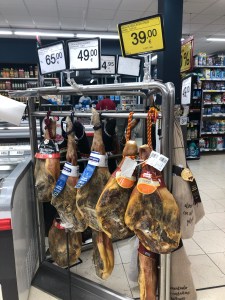
Jamön shopping!

What is jamón?
Jamón is a salt cured meat, made from the hind leg of a pig and is similar to prosciutto, but tastier. On holidays, Spanish families have their jamón proudly displayed in a special stand that clamps the ham in place and makes it accessible and easy to carve. The most expensive jamón comes from a special breed of black pigs who are only fed acorns and can cost.as much as $775 for 13 pounds.

A big group of pilgrims leave together this morning. Some are talking and laughing, some are singing and some hold back, in order to start the day quietly. 

We notice the pilgrim from Colorado, who we started out with, is becoming more talkative, as each day passes. He shares that he works alone as a grounds keeper, hasn’t been to Europe in 25 years, and opens up about his solitary liife.

It’s so unusual to see a child on the Camino that we can’t help but congratulate the 14-year old boy that’s walking with his parents. This sweet family from New Zealand also seem to be coming out of their shells.

And we thought we had a nice flat day ahead of us!

Little do we know that the flat path will soon give way to a series of never ending inclines and descents, the loose rock making us pay attention to every step. Is that a mirage?! In the middle of nowhere, a woman has set up chairs and a display of fruits, snacks, and drinks, only asking for a donation in return. Sharing a Coke and the reprieve of a walk through a town finally gets us to our destination.

Oct. 20: Astorga- 20 miles

Astorga welcomed us to their plaza with sunny weather

A lovely quiet meal at El Pasaje

Astorga is a lively city that packs shops, bars, restaurants, and historical buildings all within its medieval walls. The Imprenta Musical Alojamiento has a great check-in system, explained via cell phone in your choice of languages and the room is nice. We’re too tired and hungry to take the time to lounge on our floor’s outdoor sitting area, so we hurry and shower and head to the plaza. We find a restaurant on the second floor, so we can see the merrymaking going on, on the plaza, but cannot hear it.

Oct. 21: Rabanal del Camino- 15 miles
We’re heading up to the mountains and the area known for its unpredictable weather. It’s a long day and pilgrims share an occasional “Hola” (Hi!) and keep their focus on the trail. As we enter the town of El Gonzo, I remember how Camino author, Brierley, rightly describes it as “a hauntingly crumbling village.” It’s only saving grace is the famous cowboy bar, known for not allowing any photos (though no one knows why).

Rabanal del Camino continues its centuries old tradition of caring for pilgrims before they take the steep path up Monte Irago. An order of Bavarian monks have taken up residence in the restored church and the sound of Gregorian chants continues. We stop in at the church and are surprised to find a Korean woman standing alone near the altar, playing her flute. The sound bouncing off the centuries old walls is mesmerizing. We don’t want to interrupt her, so we get her attention and hold our hand to our hearts and quietly leave.

La Posada de Gaspar hasn’t changed a bit

While the town is nothing to write home about, we remember staying at the Posada de Gaspar in 2016, with its wooden beams and stone walls. Once again, we shower and scurry to, hopefully, find a restaurant open before 8 p.m.; not easy in Spain! 

What is a Spaniards’ dining schedule? 
– Breakfast: café con leche/té and a sweet roll or “tostada” (crusty bread) with either butter/jam, tomato, or jamón
– Late morning: another café/té and maybe a sweet roll?
– Lunch: large meal, usually in courses with wine/beer
– Early evening: café/té/wine/beer and some sweets or tapas
– Dinner: restaurants open again at 8-8:30 p.m. 

We try to start the day with some protein and seek out a restaurant that serves eggs and ham. We usually don’t eat much bread, but sometimes when that’s what all you’re served, you eat it! For lunch, we enjoy our favorite: a big bowl of “Caldo Gallego.”

What is a “Caldo Gallego”?
“Caldo Gallego” or Galician broth is a soup made with white beans, turnip greens and potatoes. The broth is flavored either with a type of salt pork called unto, “chorizo” (Spanish sausage), or smoked ham. 

If we happen to arrive in a town early enough, we take advantage of the late lunch, the three course pilgrim’s meal. Usually that doesn’t happen, so we try to find someplace that opens before 8 p.m., which is starting to get close to our bed time! 

Oh, and one more thing about food: it’s amazing that the price listed is the price you pay- no tax and no tip! Servers are paid a higher wage and no tips are expected.

Oct. 22- Molinaseca- 18 miles
Today we head up to the highest point of our journey, remembering to be cautious on the descents as well. It’s a grueling day, but the views are spectacular.

So peaceful in the mountains

We pass the abandoned town of Manjarin, which actually now has a population of one! Tomás, a Spaniard with a devotion to pilgrims, has provided 36 mattresses, an outside toilet, some hot water, and a simple meal for a donation. 

The medieval bridge

A medieval bridge leads you into the town of Molinaseca, once the home of the Queen of Castilla and León. I sit in a bench and watch a woman walk down the middle of the street in this charming stone village. She’s carrying a bouquet of just picked flowers and by the way she’s dressed, it could be any year back in time. Just then, a car horn honks and I’m brought back to reality.

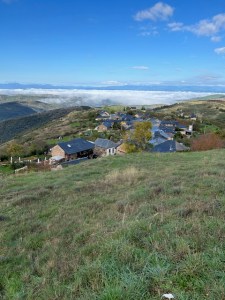
The hills embrace the town of Molinaseca

Just as lovely as it was in 2018, we vote the Hotel el Palacio one of the best hotels on the Camino, with its stone exterior, glass enclosed balcony, wooden floors, shutters and built in wardrobe.

There seems to be only two restaurants in town and we are lucky to get a table at one. A group of ten pilgrims asks if we could move our table next to their two tables, so they can all sit together and we enjoy visiting with them while we have our dessert.

Oct. 14 – 18 : Moratinos to León

Seems like we’ll  never arrive in Moratinos!

Oct. 14: Moratinos- 20 miles
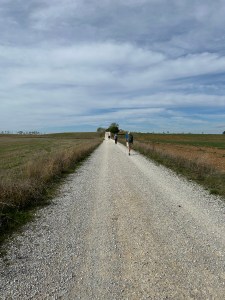
It’s a quiet morning. As pilgrims head out, many are starting their day in thought. It’s another cool day and besides focusing on the rocky, dirt path, there’s not much scenery to embrace; just miles of farmland. I become fascinated with the ant hills along the way. Some almost look like castles and each one has a hole in the center. I wonder what a mini camera would show?
This helps me pass the time and also clean out the cobwebs in the corners of my brain at the same time!

We’re startled to see a food truck ahead of us- in the middle of nowhere! Our breakfast was light, so we stop and have a “tostado con tomato,” a hunk of crunchy bread, but this time instead of chopped tomato, the bread is sprinkled with olive oil and loaded with slices of fresh tomato- delicious! We compliment the young entrepreneurial couple and they tell us they do quite well, stationing themselves along the Camino, and that they also live in the back of their camper.

With a devotion to pilgrim hospitality, Italians Bruno and Ana built Albergue San Bruno. It’s a large house, unconventional in design, with a couple of levels that house both dorms with beds and private rooms. With various doors and halls, I can only figure out how to get to our room and back downstairs. We hurry and shower, so we can relax out in their garden.

All the hungry pilgrims are hovering around the door, waiting for the communal dinner to start at 7 p.m. We share a table with two sisters from the Netherlands, a man from France and a couple from Kansas. Bruno and Ana don chef’s hats and formally welcome us all. They tell us they will close for the season November 1 and return to Italy, but not to rest, to work! Over wine, salad, pasta carbonara and cake, we are entertained by the Frenchman, who tells us after his first Camino, he quit his corporate job two weeks after he arrived home and changed his career path.

Oct. 15: El Burgo Ranero – 18 miles
It’s not raining yet, but we can feel it coming. The fact that we’re heading to a new Albergue for lunch takes our minds off walking the “Soulless Senda” for awhile. 

The sun disappears quickly, the wind picks up, the sky darkens and and we stop and jump into our raincoats, but the rain only lasts for a few minutes. We’ve been through this before with the weather teasing us, so we decide to just leave our raincoats on.

Tonight we’re staying in a gas station! I know what you’re thinking, but the Hotel Castillo de Burgo is actually behind the gas station. We are warmly greeted and the room is quite nice, modern and clean. The restaurant is open all evening, the dining room has white tablecloths, and the staff seems happy to be working there. What more could you ask for?!

Downtown Mansilla


A surprise around every corner in Mansillas

Oct. 16 – Mansilla de los Mulas – 13 miles
There’s not much in the way of scenery today, so it’s a jgood time to reflect. In his Camino guidebook, Brierley notes “Classified as the longest extant stretch of Roman road left in Spain today, we follow in the footsteps of Emperor Augustus himself.” Out of the silence, the sound of our shoes crushing the gravel and the click of our hiking poles, as they tap the ground, creates an almost Zen-like rhythm that carrys us the rest of the way.

Our room at Pensión de Blanca (plain and clean) has three beds, so we have plenty of room to spread out. The owner pulls out a map and with a magic marker, gives us directions to everything in town, but tonight we already know where we’re dining. 

It’s not very often that Brierley gives a restaurant review, so when he recommends La Curiosa, we head there early and have a glass of wine to secure a spot. The first floor is almost museum-like, with collections of everything from old typewriters, books, tin cans and advertisements arranged just so on shelves. Upstairs, we are pleasantly surprised by the large windows and white tablecloths. We chat with women from Madrid, Chicago, and Arizona, all walking alone, and when the hosts asks if we would like to sit together, we all say “ Why not?”

While enjoying the delicious smoked trout salad, veal with blue cheese and local goat cheese drizzled with local honey, we are on edge, listening to the Chicago woman’s story of how she was scammed by a white collar squatter. Since the squatter was already living in the same New York City building, our friend assumed the usual background checks, etc. were unnecessary. Two years later, with legal assistance, she was finally able to get her tenant evicted, but had only collected $2500 from her- one months rent!

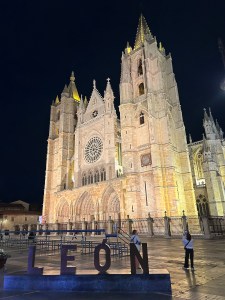
So happy to be in León!


The cathedral sparkles at night


Our favorite white wine is the Galician Albariño

Oct. 17 & 18: León – 13 miles
We’re happy it’s cool and not raining. We’re so anxious to get to León, one of our favorite cities, we don’t even mind that we’re walking parallel to the busy highway most of the day.

León has been a pilgrim stop since the 10th century. Today, with a population of almost 450,000, the bustling city has a vibrant, joyful feel. I’m not sure when people go to work or children go to school, because it seems that the revelry continues all day and all night in the Plaza Mayor and down every narrow side street in the walled city. It’s the perfect place for a rest day.

Though we don’t seem to have the constitution of the locals, who don’t mind sitting outside in cold weather, we very quickly realize the custom of ordering one drink, which is served with a complimentary tapas, and then moving on another bar until you’ve had your dinner.

We are served a small plate full of warm, just fried calamari – delicious! Across the bar, I notice a couple chatting. As the man, picks up the calamari, it seems to be a long, never ending piece. I make eye contact with the woman and we laugh, she making the gesture of wrapping it around her neck and me, holding my hands up, like a lasso. It’s one of those quick lovely moments. All this for 6e for two glasses of wine and tapas!

View from our room’s patio

Called “ the house of light” because of its famed stained glass windows, the Santa María de León Cathedral is now a UNESCO World Heritage sight. Our hotel, Hostal Albany Ancha, is in a great location, not too far from the church. The room has a brick wall, interesting metal light fixtures, a glass enclosed patio, but no closet! In Spain, you learn quickly- “Es lo que es” (it is what it is)!

Mud, Sweat, and Tears: Why the Camino Keeps Luring Us Back

When family and friends heard we were heading back to the Camino, their first question was “Why?!” They wondered what it was about walking miles, on all kinds of terrain, in all types of weather, and for days on end that made it alluring.

The good terrain

The not-so-good terrain

What is the Camino?

In the ninth century, a local bishop ordered a church to be built to house the remains of St. James, when they were discovered in the northwestern Spanish town of Galicia. Over time, the church grew into the grand cathedral of today, and the city became known as Santiago de Compostela – “St. James under a field of stars.”

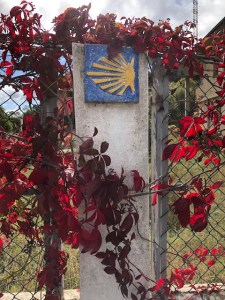
Throughout the Middle Ages, people started their pilgrimages from their homes, which created the many routes still used today. Yellow arrows mark the routes to help pilgrims navigate. Along the way, churches, restaurants, and places to stay, stamp a pilgrim’s passport to prove they have walked the minimum 100 kilometers/62 miles required to receive the coveted certificate, or “Compostela,” from the pilgrim office in Santiago.

There are many reasons why people choose to walk the Camino. It evokes a physical, mental, spiritual, and mystical experience unlike any other.

You never know where you’ll find a yellow arrow

It’s Your Camino

Though walking is the most popular way to travel the Camino, some ride a bicycle or travel on horseback. You can travel as much or as little as you would like each day. If you tire, buses and taxis are available, and there are companies offering daily backpack transport.

You can choose to stay in a “donativo” – a mat on a church floor for a donation, a five-star hotel, and anywhere in between, such as an “albergue” – a pilgrim hostel or a “casa rural” – a guesthouse. You can make a reservation ahead of time or see where the wind takes you when you arrive in a town. To keep you energized, the three-course pilgrim meals are delicious and offered at a bargain.

Hotel Antsotegi in Etxebarria was an old iron mill turned hotel

The Olé of Spain

There’s an exuberance and an elegance to life in the Spanish cities. Working to live, rather than living to work, allows time for family and friends. Music and culture are relished, every meal is savored, and life is lived at a slower pace.

Spaniards still enjoy the tradition of the paseo. They dress up for their stroll through a town’s main street or plaza to greet family and friends. No doubt there will be stops along the way for a café con leche y dulce – espresso coffee with hot milk and a sweet – or vino y tapas – wine and appetizers.

The small towns have a charm of their own. As if traveling back in time, a car driving through the street is almost startling. At times, you may be walking through a herd of sheep or visiting a small church, and the simplicity of the moment leads you to ponder your own life.

Estella, Spain was founded in 1090

Pilgrim Power

“Buen Camino!” Each day, pilgrims wish each other a good walk as they pass each other by.

We are all heading to the same place – the Cathedral in Santiago de Compostela – which creates instant camaraderie. There seems to be no interest in who you are at home. Here, everyone is equal.

Encountering pilgrims from all over the world, you begin to realize there are very few differences between you. Very quickly, they are no longer strangers. Your interaction might be days/weeks together or just a few words in passing. Pilgrim families are created, and members may keep in touch for a lifetime. Sometimes just a quick exchange can become crucial to helping you think through an issue in your life.

You feel a positive energy around you each day. The genuine hospitality encountered by people from all walks of life throughout Spain seems to rub off on the pilgrims, who, in turn, are there for their fellow travelers. Whether it’s with a hug, a band-aid, directions, or just a listening ear, there’s a loving spirit that makes you wonder why people aren’t always like this.

Me, Myself and I

You feel an ongoing gratitude for the simplicity of each day, its daily rhythm, and the chance to reboot, as you discover the Spanish culture in slow motion. It’s easier to listen to yourself when it’s quiet and the peaceful solitude of walking alone is a nice balance.

The freedom from everyday obligations and the luxury of being unplugged from the stimuli of our daily lives gives you more time to focus on the world around you. Traveling with only the belongings that fit in your backpack makes you feel lighter. You sometimes feel as if you were turned inside out, with your senses heightened and your mind clear and open.

The mud and sweat are understandable parts of the walk. As your journey ends and you enter the plaza of the Cathedral in Santiago de Compostela, you wonder if your tears are because you conquered the goals of this demanding trip or because your journey has come to an end.

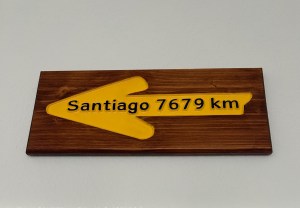
This sign shows the distance from Georgetown, Texas to Santiago de Compostela, Spain

“Live for the moments you can’t put into words.”
“The end is just the beginning”
Authors Unknown

For more information on the Camino:
Watch the movie that resurrected the Camino in the United States in 2010. “The Way” starred Martin Sheen and was written, directed, and produced by his son, Emilio Estevez.

Listen to Dan Mullins’ podcast “My Camino the Podcast” which showcases Camino stories from pilgrims from over the world.

Go to the American Pilgrims on the Camino website which shares information, supports American pilgrims, and subsidizes Camino-related projects with grant money from its dues.

Author’s Note:
IIf you enjoyed this post, please scroll down, like it, and feel free to share it!

Sept. 8 – 12: Guernica to Castro Urdiales

Sept. 8: Guernica- 17 miles
Today we walk in rural countryside through forests and alongside flowing streams. It’s very hilly, but the sound of the rushing water is soothing and a stop at the the Zenarruza monastery provides a cool, peaceful place to rest.

We are heading towards what we think is the hotel, but once again, there is no signage. It’s been a long walk through the town and we’re hot, tired and very grateful to have arrived at Hotel Gernika. The classic hotel has an air of old world elegance and air conditioning! After showering, we enjoy a glass of wine in their beautiful solarium and wonder how we will be able to handle U.S. prices for a glass of wine, when we return, after paying anywhere from €1.60 to €3 here (exchange rate to U.S. dollar is almost equal).

Guernica is considered the spiritual center of the Basque Country and was the site of the aerial bombings of its civilians in 1937 during the Spanish Civil War. In downtown Guernica, large black and white blowups of photos of the damaged city are front and center, serving as a reminder of the atrocities on that memorable day.

Sept. 9 – 10: Bilbao- 19 miles
From the city streets, we quickly find ourselves on an intense, narrow path through the woods. The ascents and descents are much more treacherous due to the slippery wet rocks and the mud. For miles, the smell of the eucalyptus trees is our only comfort and the only sound we can hear is our heavy breathing.

It wasn’t easy to find a mid price hotel in such a big city, so we splurge and stay at the Hotel Abando. Unlike all the other hotels to date, the staff hardly looks up when we arrive, is not very welcoming and is no help at all in finding us a laundromat. We are so happy to hear from our Danish friend, with an invitation to try a restaurant that has been recommended to him, we forget about our hotel experience. Our new mantra is “Es lo que es,”- it is what it is.

We spend most of our rest day at the Guggenheim Museum. Designed by Frank Gehry, its cutting edge design also reflects in its modern art exhibits. The main exhibit entitled “Motion- Autos, Art, Architecture” celebrates forty of the most distinctive cars in relation to beauty, rarity and technical progress. My favorite part of the exhibit is a vision of the future of cities presented by a number of universities from across the world.


Sept. 11: Santurzi – 12-1/2 miles
The bad news: today’s walk is along a river, industrial areas and rundown towns. The good news: it’s all flat! Not having to worry about every step you take gives us more time to a relax and think.

As we enter Santurzi, the juxtaposition of the two sides of the city is startling. The old neighborhoods we’re walking through transcend into a couple of blocks of modern condos and lovely mansions before our eyes.

The UHR Palacio de Orio is magnificent, but we’re disappointed the rooms are rather plain. We take some time to explore its nooks and crannies and imagine it in its heyday.

Sept. 12: Castro Urdiales- 18-1/2 miles
The city streets soon lead to a walking/bike path. There’s not much to see, but we’re grateful it’s flat…for now. We follow the yellow arrows (the official Camino way markings) past a very unusual site; cows grazing on a vertical pasture so steep that it appears they are hanging on with their hooves. This keeps us entertained until we arrive on a boardwalk that follows along the Atlantic Ocean, the crashing waves lulling us into a walking rhythm. Then, it’s up 120 stone steps and then we’re looking down at the ocean.

We follow a shortcut to the road. Luckily, there’s little traffic and a small shoulder we can walk on, single file. The gas station we stop at does not sell water, but a kind gentleman hears our plight and insists we take his cold bottle of water. They say the Camino provides and today we are blessed with more than one example.

We’re all set to walk the short distance to our hotel. Our app says only one and a half miles, but it also says it will take 43 minutes. What?! We’re done! We stop at a bar, order two beers and ask the bartender to please call a taxi, while we sit outside and wait. A few minutes later, she runs out to tell us a bus will be arriving in three minutes right down then block that can take us. With stealth like precision, we dump the water out of our water bottles, fill them with beer and run for the bus.

It takes me a minute or two to realize that all the passengers at the front of the bus are discussing where our hotel is and where we should get off. We are told to exit, thank everyone and are escorted by a woman passenger, who insists on walking us to our destination, after her long shift at as a waitress. We part company, but not after hugs all around.

Castro Urdiales is a popular seaside resort on the Bay of Biscay. The Las Rocas Playa Hotel’s large windows frame the lovely white stucco, red tiled roofed homes that line the street to the beach, mostly second homes. The hotel’s tranquil ivory and beige color scheme reminds us that our walking for the day is almost done. Just a quick visit to the beach (with just enough time to get our legs wet), then we’re enjoying dinner in their dining room, looking out those big windows and wishing we could stay just a bit longer.


Walking the Walk, Again…

Photo Walking the WalkA favorite keepsake, a sign that shows the distance from Georgetown, Texas to Santiago, Spain- 4772 miles.

For thousands of years, pilgrims have traveled the ancient paths to the cathedral in Santiago, Spain, where the remains of St. James lay to rest. The Camino de Santiago de Compostela – St. James under a field of stars – evokes physical, spiritual and mystical qualities. 

Inspired by the 2011 movie “The Way,” starring Martin Sheen, we walked the Camino Frances, the most popular route that begins in France, in 2016 and 2018. 

Funny how, back in 2016, we didn’t understand why so many “crazy pilgrims” kept returning year after year. Now, here we are setting out to walk the Camino del Norte, along the northern coast. 

Where else could you find such simplicity, a peaceful rhythm to each day, the camaraderie of strangers and be given the opportunity to pray with your feet? 

Tell Your Worries to Take a Hike (Literally)

Photo Take a Hike

Mud; that’s all I remember about my first hiking experience. It was not a pleasant one (read “Coming Clean on a Dirty Little Secret: My First Hike Fiasco”). That’s the beauty of being a late bloomer; being just a tad behind the curve allows me the opportunity to watch and learn from others.

Years later, when Mr. Wiz* invited me to join him on the Camino, I had a decision to make. Do I stay behind, afraid to try something out of my comfort zone? Or, do I join him on this adventure and walk 500 miles through Spain? After some research, I decided that if pilgrims had been walking the Way of Saint James to the cathedral in Santiago de Compostela (where tradition has it that his remains are buried) since medieval times, this was something not to miss.

I still remember the day the REI salesperson tied me into my first pair of hiking boots. As I stood at the top of that mountain, I felt positively giddy; no matter that it was the four-foot plastic mountain in the middle of the shoe department.

Walking for 33 days changes you; with nothing to be concerned about except your immediate surroundings, life slows down. It’s amazing what can go on while your feet are moving. Spending hours watching them maneuver rocky paths cleans out all those cobwebs in your brain. Sharing stories and feelings with someone you’ve just met exhilarates you. Walking in silence is meditation in motion.

The sounds of rustling leaves, rushing water or a bird singing, the feeling that comes from taking a big deep breath on a cool day and that wonderful ache you feel from pushing your body just a little bit more; this is Mother Nature’s way of putting her arms around you.

Too much wild life can take its toll. Let’s try to balance the party animal in us all with some tranquility. Being down to earth rewards us with the mental, spiritual and physical aspects of life that we might have missed out on, had we not stopped to smell the roses.

So, when all else fails, get out there and walk! Worries and stress are no match for flora and fauna. Uncomplicate those complications, hop over those hurdles, break down those barriers; it’s amazing how solutions can miraculously appear if you just let your feet lead the way and take one step at a time.


*Who’s who? See “Cast of Characters” on the “About” page.


Post-Camino: The Next Steps

Photo Post Camino

Wanderlust is a wonderful thing. The adventure of exploring new cultures never gets old. It takes you out of yourself, broadens your horizons and leaves you with the gift of memories that are your souvenirs to conjure up at any time.

There is something very cool about traveling with a backpack (something I thought I would never do). I felt like a nomad; out in the world, with my arms free and feeling as free as a bird.

After five weeks, I’m not tired of living out of a backpack and assorted sizes of Ziplock bags. With only a few changes of clothing, the feeling of wearing a uniform each day was liberating. The simple pleasures of a hotel room with a bathtub or locating my one pair of earrings (after a few glasses of wine and forgetting in which bag I had placed them for safe keeping the night before) would make my day.

With my daily focus on my destination, what I would eat and where I would stay, it left me time to pay attention to the details of nature around me that I might ordinarily miss. It gave me an opportunity to associate with my fellow pilgrims and really listen to what they had to say.

It is said that you should focus on “my Camino”; no two are meant to be the same. My knee injury, though not what I had planned, gave me more time alone. Whether sitting in the room or outside with my foot up, I had more occasion for introspection. I finally gave in to the frustration of the healing process and found the peace that was awaiting me each day.

Always drawn to the mystical side, I longed for a sign, a message that might sum up my journey. Leave it to me to find it written on a bathroom stall in Finisterre, Spain: “…Fill your life with experiences, not things; have stories to tell, not stuff to show…”

And with that, I wish you a buen Camino!