Oct. 23 – 26: Cacabelos to Triacastela

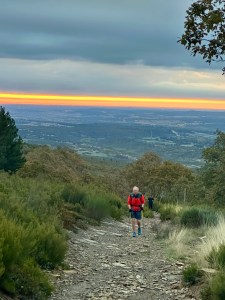
Mr. Wiz  walking non-stop!

Oct. 23: Cacabelos – 18 miles

That Mr. Wiz is a powerhouse! I tease him and call him “the camel” because I must remind him to stop for water and to eat! He puts his head down and those long legs just don’t stop going up and down the hills!

I’m having trouble recalling what I had to eat on the menu del dia two days ago and he remembers every detail of every town we visited in 2016 and 2018: where we ate, stayed, and stopped for a drink- incredible!

Downtown Cacabelos

There’s a lot of road walking today; not my favorite, but at least there’s a barrier between us and the cars and trucks that all seem to be going 100 mph! It always makes us smile when a car or truck sees us and blows their horn.

Today’s highlight is a stop at the “Castillo de los Templarios” (Templar Castle).
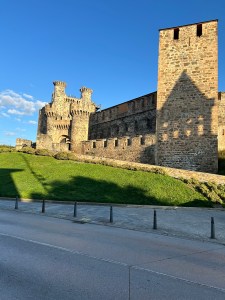
The stately Templar Castle

Who were the Knights Templar?
The Knights Templar were a Catholic military order. Founded in 1119, they protected pilgrims on their journeys. In the 12th century, they took possession of the fortress to use as a castle.

When they started to receive too much recognition and wealth, King Phillip forced the Pope to dissolve the order. The knights were arrested and tortured and their assets were stolen. Today, the magnificent castle remains as a study center and a library.

Cruz de Farro is located at the highest point of the French route

Cruz de Farro is a welcome sight. The simple iron cross on the hill has become a symbol of the Camino. The tradition is to bring a stone from home and leave it by the cross. It can symbolize leaving your troubles behind or commemorating someone important to you. Seeing the number of pilgrims kneeling, weeping or sitting quietly, along with the hundreds of rocks, notes, and photos on the ground is truly humbling and very emotional.

We voted these the ugliest trees in Spain

Our room at Hostal Santa Maria is so small that it takes some creativity to plan where to place anything. The town is not an attractive one, but the weather is so lovely that everyone is happy to be outside.

We stop and chat with a cheerful group of pilgrims. One Australian gentleman has such a kind way about him that I find myself immediately drawn to him. Later, I was told he is a priest and began walking in Switzerland 82 days ago. Unfortunately, I never got the chance to ask him why he was taking this journey and if he was finding what he was searching for.

Oct. 24: Trabadelo – 12 miles

A peaceful morning view

The early morning mist makes it feel much colder than it is. We head right to a narrow, rocky path and the single-file order precludes conversation.

I am very excited to be heading to Casa Susi!
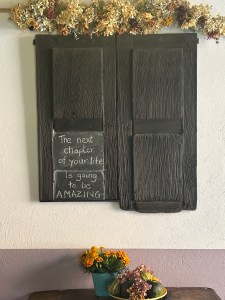
Something to think about as we enter Casa Susi

Once upon a time, there was a tenacious, young woman from Australia named Susi. With an independent, adventurous spirit, she backpacked the world until she found the Camino (or until the Camino found her). Drawn to its sense of community and spirituality, she began work as a “hospitelero” (volunteer) at Albergues and began to dream about the one she would someday create.

The shell of the old barn on the Camino path in Trabadelo spoke to her. The fact that it had no water or electricity didn’t stop her. She worked tirelessly to prepare it for the upcoming season. As pilgrims came, some sensed her radiant spirit and stayed a day or two to help her finish one of her many projects. In turn, she offered them a bed and a wonderful meal, with vegetables from her, now abundant, garden which overlooked the river.

He was her 30th guest. A handsome architect from Pamplona, Fermin was soft-spoken with a warm smile. He was immediately captivated by this cheery, petite, powerhouse of a woman with the long blonde braid coquettishly tied to one side. Fermin likes to say that one project led to another, and he never left. Last summer, they were married in the Casa Susi garden and then again in Australia.

Everything  is well planned and organized at Casa Susi

Fermin welcomed us warmly. We were instructed to leave our boots and poles in the outer room. He offered us some herbal tea as we sat around the large wooden table and received information about our stay.
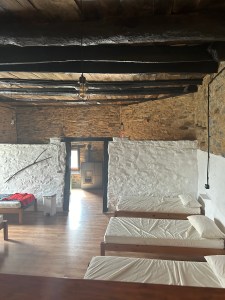
Luckily, no one snored!

A quiet spot in the garden

A door opened to a room with 10 beds and two bathrooms with showers. We were given paper-like sheets to use on the mattress and pillow and planned to sleep inside the sleeping bag liners – or sleep sacks – we had packed. A communal dinner would be served at 7:30 p.m. and we would meet Susi then. Dinner was prepared in the kitchen in their private living quarters upstairs. The cost of the bed and meal was only 27e each! Breakfast was self-service for an extra fee. In the meantime, we were free to relax inside or in the garden.

As it neared dinner time, the hungry pilgrims from California, Canada, Pittsburg, Korea, and Australia were excited to dine and finally meet Susi. As the wine was poured, Susi and Fermin welcomed us, told us a little about themselves, and then asked us to introduce ourselves and share why we were on the Camino.

Pilgrims always have interesting stories, but the one that touched us all was the 22-year-old young woman who tearfully confided she had just graduated from an intensely difficult college program and was confused as to why she had even chosen that course of study. She had already been walking 66 days from France and was exhausted mentally and physically.

After some hugs, Fermin and Susi served the first course: homemade pasta with pesto made with wild garlic Susi had foraged in the hills. Next, came a lovely salad along with peppers stuffed with vegetables, garbanzos, Moroccan spices, and a spiced yogurt topping. Dessert was a homemade lemon custard topped with plums.

I make a toast to the five, strong woman, at the table that are doing the Camino solo, and the meal ended with a round of applause for Susi, Fermin, their garden, and the wonderful gourmet dinner.

As I lay in my bed, I wondered what it would be like to host dinner for 12 every night; the planning, preparing, making conversation, cleaning up, and then doing it all again and again! When Susi and Fermin said they would close November 1, I assumed that meant a long vacation. Their plan was a weeklong trip to Malaga and then to Australia to work, with Susi as a florist and Fermin in construction. I fell asleep with a newfound respect for all the Albergue owners who dedicated their lives to caring for the pilgrims.

Oct. 25: O Cebreiro – 15 miles

It’s always an easy start when you walk through towns. Just when we’re grateful for no rain, it starts raining lightly, which it will do on and off all day today. This is the province of Galicia and O Cebreiro is known to be cold and damp, It’s still one of my favorite towns. With its charming stone village, scenic hiking trails, and good food and wine, many Spaniards agree with me and enjoy heading here for the weekend.
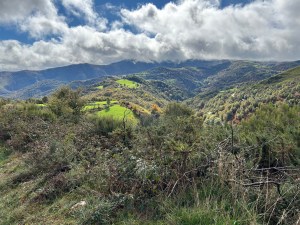
The lovely Valcarce Valley

We’re in for one of the steepest climbs today, navigating mud, wet leaves, and chestnuts, but the views of the Valcarce Valley will make it all worthwhile. The woods are quiet and beautiful. Sometimes the branches meet in the middle and create arches for us to walk through.

With just a touch of the mist hanging in the air, it gives the views a mystical feel. We are grateful for the quiet when, suddenly, we hear talking and laughing, as a group of what seems like hundreds of high school students take over the path. They walk along with us (actually, much faster!) until they head to buses to return down.

The Iglesia de Santa Maria Real dates back to the ninth century. It is the oldest
church associated with pilgrims and is also the resting place of Fr. Don Elias Valiña  Sampedro, who was responsible for helping to restore the Camino and whose idea it was to mark the route with yellow arrows (Camino shells are also used today).

Once again, our hotel La Venta Celta is small and plain, but it’s warm and we’re happy to arrive…that is, until we notice the shower is missing a door! With a smile, the lovely young woman explains that a large guest fell into it yesterday and they don’t have another room available. Rather than get upset, we ask for some extra towels for the floor and make it work. We see so many pilgrims we know at dinner, we decide to sit in the middle of the room, so we can chat with them all.

Oct. 26: Triacastela – 15 miles

Cold, but happy!

It’s raw out this morning! I open the door to check the weather and notice several pilgrims heading out in the dark with headlamps on. We prefer to have breakfast and wait for daylight.

Cows have the right of way in Spain

The rollercoaster hills are gravel today, which makes them a bit easier, but, not by much. I’m always surprised when we walk right through someone’s farm. Today, the señora seems nonplussed as she walks through the groups of pilgrims and gets her cows in line to head for the field. Meanwhile, we hustle to get ahead of them before they take over the road.
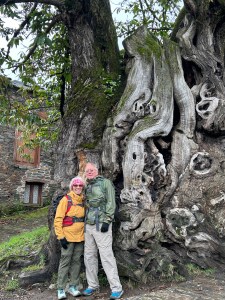
The chestnut tree is so ugly that it’s beautiful

We stop for a bowl of delicious lentil soup for lunch and everyone we know seems to have the same idea. Today is a long day, but for a few minutes, we are entertained by the 800-year-old chestnut tree that we pass. Gnarled and ashen gray, it has an artistic look about it. Every November, a festival is held in Galicia, where chestnuts are collected and celebrated. The fruit of the chestnut is enjoyed by both people and cattle.

Pension Albergue Lemos is a nice surprise. It’s the first stop in town, the room is modern with plenty of room and a hot shower. As a bonus, there is a washer and dryer available to use. With a big smile, the woman at reception surprises us by insisting she will do our laundry for us.
Oct. 14 – 18 : Moratinos to León

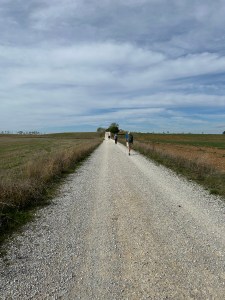
Seems like we’ll  never arrive in Moratinos!

Oct. 14: Moratinos- 20 miles
It’s a quiet morning. As pilgrims head out, many are starting their day in thought. It’s another cool day and besides focusing on the rocky, dirt path, there’s not much scenery to embrace; just miles of farmland. I become fascinated with the ant hills along the way. Some almost look like castles and each one has a hole in the center. I wonder what a mini camera would show?
This helps me pass the time and also clean out the cobwebs in the corners of my brain at the same time!

We’re startled to see a food truck ahead of us- in the middle of nowhere! Our breakfast was light, so we stop and have a “tostado con tomato,” a hunk of crunchy bread, but this time instead of chopped tomato, the bread is sprinkled with olive oil and loaded with slices of fresh tomato- delicious! We compliment the young entrepreneurial couple and they tell us they do quite well, stationing themselves along the Camino, and that they also live in the back of their camper.

With a devotion to pilgrim hospitality, Italians Bruno and Ana built Albergue San Bruno. It’s a large house, unconventional in design, with a couple of levels that house both dorms with beds and private rooms. With various doors and halls, I can only figure out how to get to our room and back downstairs. We hurry and shower, so we can relax out in their garden.

All the hungry pilgrims are hovering around the door, waiting for the communal dinner to start at 7 p.m. We share a table with two sisters from the Netherlands, a man from France and a couple from Kansas. Bruno and Ana don chef’s hats and formally welcome us all. They tell us they will close for the season November 1 and return to Italy, but not to rest, to work! Over wine, salad, pasta carbonara and cake, we are entertained by the Frenchman, who tells us after his first Camino, he quit his corporate job two weeks after he arrived home and changed his career path.

Oct. 15: El Burgo Ranero – 18 miles
It’s not raining yet, but we can feel it coming. The fact that we’re heading to a new Albergue for lunch takes our minds off walking the “Soulless Senda” for awhile. 

The sun disappears quickly, the wind picks up, the sky darkens and and we stop and jump into our raincoats, but the rain only lasts for a few minutes. We’ve been through this before with the weather teasing us, so we decide to just leave our raincoats on.

Tonight we’re staying in a gas station! I know what you’re thinking, but the Hotel Castillo de Burgo is actually behind the gas station. We are warmly greeted and the room is quite nice, modern and clean. The restaurant is open all evening, the dining room has white tablecloths, and the staff seems happy to be working there. What more could you ask for?!

Downtown Mansilla


A surprise around every corner in Mansillas

Oct. 16 – Mansilla de los Mulas – 13 miles
There’s not much in the way of scenery today, so it’s a jgood time to reflect. In his Camino guidebook, Brierley notes “Classified as the longest extant stretch of Roman road left in Spain today, we follow in the footsteps of Emperor Augustus himself.” Out of the silence, the sound of our shoes crushing the gravel and the click of our hiking poles, as they tap the ground, creates an almost Zen-like rhythm that carrys us the rest of the way.

Our room at Pensión de Blanca (plain and clean) has three beds, so we have plenty of room to spread out. The owner pulls out a map and with a magic marker, gives us directions to everything in town, but tonight we already know where we’re dining. 

It’s not very often that Brierley gives a restaurant review, so when he recommends La Curiosa, we head there early and have a glass of wine to secure a spot. The first floor is almost museum-like, with collections of everything from old typewriters, books, tin cans and advertisements arranged just so on shelves. Upstairs, we are pleasantly surprised by the large windows and white tablecloths. We chat with women from Madrid, Chicago, and Arizona, all walking alone, and when the hosts asks if we would like to sit together, we all say “ Why not?”

While enjoying the delicious smoked trout salad, veal with blue cheese and local goat cheese drizzled with local honey, we are on edge, listening to the Chicago woman’s story of how she was scammed by a white collar squatter. Since the squatter was already living in the same New York City building, our friend assumed the usual background checks, etc. were unnecessary. Two years later, with legal assistance, she was finally able to get her tenant evicted, but had only collected $2500 from her- one months rent!

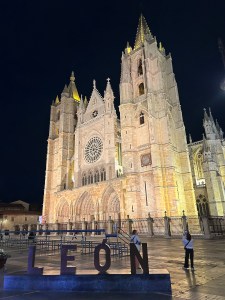
So happy to be in León!


The cathedral sparkles at night


Our favorite white wine is the Galician Albariño

Oct. 17 & 18: León – 13 miles
We’re happy it’s cool and not raining. We’re so anxious to get to León, one of our favorite cities, we don’t even mind that we’re walking parallel to the busy highway most of the day.

León has been a pilgrim stop since the 10th century. Today, with a population of almost 450,000, the bustling city has a vibrant, joyful feel. I’m not sure when people go to work or children go to school, because it seems that the revelry continues all day and all night in the Plaza Mayor and down every narrow side street in the walled city. It’s the perfect place for a rest day.

Though we don’t seem to have the constitution of the locals, who don’t mind sitting outside in cold weather, we very quickly realize the custom of ordering one drink, which is served with a complimentary tapas, and then moving on another bar until you’ve had your dinner.

We are served a small plate full of warm, just fried calamari – delicious! Across the bar, I notice a couple chatting. As the man, picks up the calamari, it seems to be a long, never ending piece. I make eye contact with the woman and we laugh, she making the gesture of wrapping it around her neck and me, holding my hands up, like a lasso. It’s one of those quick lovely moments. All this for 6e for two glasses of wine and tapas!

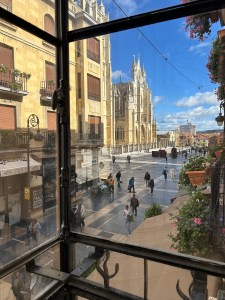
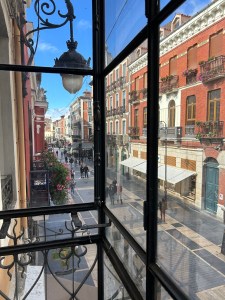
View from our room’s patio

Called “ the house of light” because of its famed stained glass windows, the Santa María de León Cathedral is now a UNESCO World Heritage sight. Our hotel, Hostal Albany Ancha, is in a great location, not too far from the church. The room has a brick wall, interesting metal light fixtures, a glass enclosed patio, but no closet! In Spain, you learn quickly- “Es lo que es” (it is what it is)!

Sept. 3 – 7: San Sebastián to Extebarria

Sept. 3-4: San Sebastián
It’s taken the usual 24 hours for me to get over the sudden panic that sets in when you don’t feel your jewelry on your hands or wrists, They’ve all been left home for safe keeping, along with nail polish and most of my makeup, It will take another day for me to settle into the “Camino me.”

San Sebastián is one of those cities blessed with a beach in its center, The Bay of Biscay, the lovely parks and the lively Old Town make it sparkle. The joy and exuberance of the locals overflows from the bars and restaurants into the streets, as families and friends gather, standing or sitting on steps, and children play quietly nearby. Nary a sweatsuit to be seen, there’s an air of sophistication in everyone’s dress, even down to the babies,

We choose to stay at the Hotel Distrito Oeste, since it’s closer to the Camino start and walking distance to the square. Located in a quiet neighborhood, it’s white, stark, minimalist style is relaxing. The staff is very friendly and accommodating, even taking the time to explain why the whole city is dressed in the colors of their favorite boat racing teams this weekend.

Sept. 5: Zarautz- 13.5 miles
One minute we are walking through a lovely neighborhood and all of a sudden we find ourselves on a single path in the woods going straight up! Every once in a while, the Bay of Biscay peeks out, but there’s only time for a quick glance, Our total focus is on navigating the ups and downs and the rocks and boulders. For what seems like hours, we are in a meditative state, only looking up to say “Buen Camino” (good walk) to other pilgrims as they pass by. Lunch is a much welcome respite and we enjoy dining with a pilgrim from Washington D.C.

Zarautz is a beach town and a surfing mecca in the Basque region. The Pension Tixki Polit is rather basic, but the staff overwhelms us when they agree to do our laundry, but will not accept payment. We settle on purchasing them cold Coca Colas and everyone is happy.

The hotel is located right on the Musika Plaza. Every town, regardless of size, has a plaza, which brings people together with food, drink and music. We are surprised the revelry has continued so late on a Monday night, until we’re told tomorrow is a holiday in celebration of the 500th anniversary of a famous voyage to the new world by an explorer of Basque origin.

Sept 6: Itziar- 12 miles
We breakfast with a young Danish man, who convinces us an app is better than the book we are relying on and kindly sets us up with a Camino travel app. We start the day on a walking path along the Atlantic Ocean, this time able to take in the incredible views and greet passersby with a smile and an “Hola” (hello/hi).

We head up, in and out of the woods, sometimes withj spectacular views of the ocean or verdant farmlands, whose squares of various colors of green beam in the sunlight. This is about the time I remember the saying we came up with on our last Camino- In Spain, what comes up must go up!

We share our joke with a couple from Ireland and find we are staying at the same hotel. With no sign outside, we cross our fingers and hope this first building at the beginning of town is our final destination. Turns out, it is the Hotel Kanala!

Again, though the rooms are rather plain, the lovely welcome we receive and the inviting bar and dining room make up for it. There’s nothing nearby, so we’re in for the night and dine with our new Irish friends.

We are surprised by the elegant meal, from the delicious amuse bouche we begin with to the end of the meal, where what looks like a small mint on a plate becomes a warm towel once the waiter pours a bit of hot water on it.

Sept. 7: Extebarria- 17 miles
The single path of moss covered rocks and the trees canopied above make it look like an enchanted forest. All day, it’s a gradual incline that just keeps inclining! The click of our hiking poles on the ground, an occasional rooster crow or a cow bell is all we hear.

When we ask a woman for directions to our hotel, she insists on walking us there, probably thinking these hot, tired peregrinos (pilgrims) need a break. We warmly thank her and come upon an incredible stone building in the countryside.

The Hotel Antsotegi was a 600 year old foundry, now renovated into a country inn. The massive stone walls, wooden beams and rustic furniture make you want to stay and relax there a while, but we had to be content with the festive dinner we shared with our new friends from Ireland and Denmark, who all happened to be staying there, too. Who knows if we’ll ever see each other again, but tonight, we’re a Camino family.

Walking the Walk, Again…

Photo Walking the WalkA favorite keepsake, a sign that shows the distance from Georgetown, Texas to Santiago, Spain- 4772 miles.
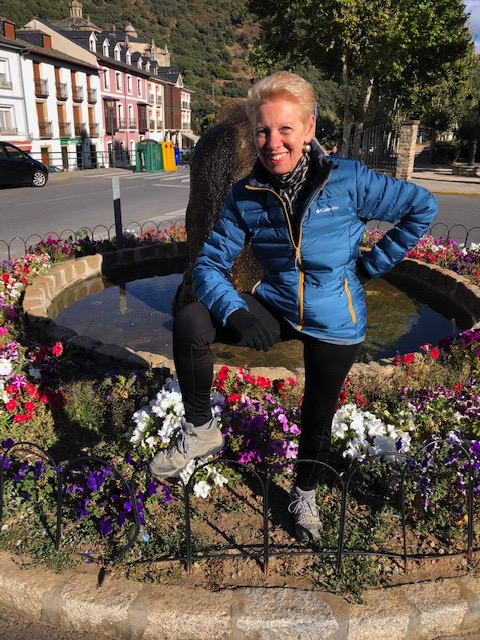
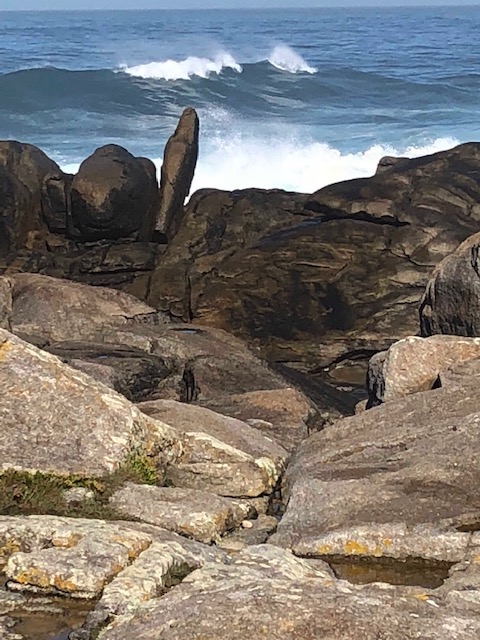
For thousands of years, pilgrims have traveled the ancient paths to the cathedral in Santiago, Spain, where the remains of St. James lay to rest. The Camino de Santiago de Compostela – St. James under a field of stars – evokes physical, spiritual and mystical qualities. 

Inspired by the 2011 movie “The Way,” starring Martin Sheen, we walked the Camino Frances, the most popular route that begins in France, in 2016 and 2018. 

Funny how, back in 2016, we didn’t understand why so many “crazy pilgrims” kept returning year after year. Now, here we are setting out to walk the Camino del Norte, along the northern coast. 

Where else could you find such simplicity, a peaceful rhythm to each day, the camaraderie of strangers and be given the opportunity to pray with your feet? 

Sole Searching

Photo HIking Boots

Me and my Merrell Moab Ventilators in Villafranca del Bierzo, Spain

Let’s just say that I am not known for my sports prowess and leave it at that. It wasn’t until 2016 that I finally found my sport; walking! Standing at the top of that mountain, after trying on my first hiking boots gave me a wonderful sense of exhilaration. And as I stepped down from the four-foot, plaster mountain in the shoe department of the REI store, I felt downright giddy.

Thus, began an intimate relationship with my hiking boots. I remember those first few awkward days as we got to know each other. I’d tie them over and over, trying for a not too tight, but not too loose a fit. I broke them in, walking the city streets of Chicago. Little did they know that they were soon destined to walk 500 miles through Spain on the Camino de Santiago, the 1000- year-old route to the Shrine of the Apostle St. James in northern Spain’s medieval city of Santiago de Compostela.

Skittish at first of the uphills, downhills, rocky terrain and water crossings, I finally settled into a rhythm whereby my boots seemed to be leading me. They helped me to define my comfort zone. I likened this to a car with new tires and the confidence you feel as their traction assists you in navigating the road.

If those boots could talk! They’ve staggered through rainstorms, forced to listen to us taking turns singing Broadway show tunes to pass the time, then left overnight, stuffed fat with newspaper. They’ve been caked in mud and sat alone, not allowed entry into our hotel room. Regardless, they always know that once they arrive home, they will be well scrubbed and placed on their side in their original shoebox, toe to heel, until their next adventure.

Lately, circumstances have dictated that those boots become a basic necessity, once again, as I walk miles each day. Whatever the weather (or my temperament), as soon as I fit my foot snugly into each one, I feel a sudden sense of exhilaration. It’s amazing what can go on while your feet are moving. The recurring sound of my boots hitting the pavement, crunching leaves or trudging through dirt paths, creates a Zen backdrop.

Ever the shoe lover, I must confess that even the pride and joy of my collection, my Allen Edmonds brown and white spectators, don’t give me the lift that my boots do. My hiking boots may seem like the ugly duckling compared to their classic elegance, but they serve their purpose and serve it well.

Thankful that I have finally outgrown my 30 years of clumsiness, I welcome this new phase of my life, resigned to let my feet lead the way and take one step at a time.


Author’s Note:
If you enjoyed this post, please scroll down and like it and feel free to share it!

Post-Camino: The Next Steps

Photo Post Camino

Wanderlust is a wonderful thing. The adventure of exploring new cultures never gets old. It takes you out of yourself, broadens your horizons and leaves you with the gift of memories that are your souvenirs to conjure up at any time.

There is something very cool about traveling with a backpack (something I thought I would never do). I felt like a nomad; out in the world, with my arms free and feeling as free as a bird.

After five weeks, I’m not tired of living out of a backpack and assorted sizes of Ziplock bags. With only a few changes of clothing, the feeling of wearing a uniform each day was liberating. The simple pleasures of a hotel room with a bathtub or locating my one pair of earrings (after a few glasses of wine and forgetting in which bag I had placed them for safe keeping the night before) would make my day.

With my daily focus on my destination, what I would eat and where I would stay, it left me time to pay attention to the details of nature around me that I might ordinarily miss. It gave me an opportunity to associate with my fellow pilgrims and really listen to what they had to say.

It is said that you should focus on “my Camino”; no two are meant to be the same. My knee injury, though not what I had planned, gave me more time alone. Whether sitting in the room or outside with my foot up, I had more occasion for introspection. I finally gave in to the frustration of the healing process and found the peace that was awaiting me each day.

Always drawn to the mystical side, I longed for a sign, a message that might sum up my journey. Leave it to me to find it written on a bathroom stall in Finisterre, Spain: “…Fill your life with experiences, not things; have stories to tell, not stuff to show…”

And with that, I wish you a buen Camino!


Oct. 16 – 19: Muxia and Finesterre

Photo Muxia

Oct. 16: Muxia

We’ve come all this way, so it seems only right to continue to the very end. It’s a beautiful day and we leave on the early bus for Muxia. With a population of 5000, this sleepy seaside town, along with our hotel Habitat CM Muxia, are really nothing special, serving only as the backdrop for the stunning natural beauty of its beaches.

This is the official end of the Camino, so we head out to find the Camino marker noting 00.00 kilometers and are struck by the view before us; the waves crashing against the rocks, its sound both thunderous and serene. There is an ominous feel to this beauty; this area is part of the treacherous Costa de Morte (Coast of Death), known for its many shipwrecks.

We peek into a window of Our Lady of the Boat Church. Struck by lightning on Christmas Day 2013, only the outside has been fully restored and it lacks an interior roof. According to legend, it was on this site that the Virgin Mary met St. James and encouraged him to preach throughout Galicia. It is believed that by a miracle of God, the body of St. James was carried by boat to Muxia, then taken to Santiago.

I am drawn to the area’s spiritual and mystical side and am anxious to find the rocking stone (Pedra de Abalar). Balanced just right, it sits straight up and rocks with the wind. It is said that it has magical powers; touching it can provide spiritual and physical healing.

We find a rock to sit on and soon I am deep in thought, mesmerized by the sound of the ocean. Time seems to stand still. I think about the many pilgrims before me that have sat in this same spot and reflected on their physical, mental and mystical journey with only the screeching of the seagulls to distract them back to reality.

Oct. 17: Muxia

There’s not much to do in a beach town on a rainy day, so it’s a good time to do some writing, reading and plan our upcoming itinerary. We’ll have some time left before we are to meet Big A* in Madrid, so we grab a window seat at our hotel’s café, order some tea and get to work.

By evening, our work is completed and we toast with a glass of wine in the same window seat and decide to venture over to the harbor for dinner. Known for its fishing industry, it is said that the boats you view while you are dining have just unloaded the fish you are dining on for dinner. Once again, we choose a window seat and after much discussion with the waiter (whose dream is travel to the U.S. and drive Route 66) select just the right seafood dishes and white wine to complement them.

Photo Finisterre

Oct. 18: Finesterre

Finesterre is Latin for “end of the earth.” Back when the world was still thought of as flat, this was considered its end. Like Muxia, this town also has a population of 5000 and is also a fishing port, but there is something so much more charming and robust about this city. It has a thriving city center and streets that meander up and down, along the ocean. The Hotel Langosteira has a great vibe. Its whimsical décor features colors of the sea; mosaic tiles in the shape of fish design the walls and even the key chains are wooden fish. Our porch has a view of the ocean and we already plan to make sure we’re up early to see the sun rise.

We get our bearings by walking from one side of the town to the other, scoping out places for dinner by the water.

Oct. 19

We head to the lighthouse, the area’s beacon since 1853, and pause at the bronze boot statue. Perched on a rock, it’s a symbol to all pilgrims of the end of the journey. Signs request that pilgrims no longer practice the ancient ritual of burning an article of clothing here as a symbol of new beginnings, but up ahead we notice a tight group of people standing in circle holding hands and smoke billowing out from the center.

I wish we would have known about the O Semaforo Hotel balanced on the cliffs, but we settle for a beer on their patio overlooking the ocean. While we are initially surprised at the number of tour buses and pilgrims here, as we climb up to the boulders that surround the ocean, there is unexpected silence. Unlike the rough seas of Muxia, here the ocean is tranquil, lapping at the sun dappled rocks, lulling you into awe and leaving you speechless.

I situate myself on a flat rock and sit cross legged with my eyes closed and my hands in prayer at my heart. Out of nowhere, I hear the sound of a flute; a young man has chosen this spot to play for tips. His melody is harmonizing with the sound of the waves and I experience such peace. For a moment, I feel as if I am outside my body and wonder if this is what practicing meditation correctly feels like. The word “peace” keeps coming to mind and I tell myself that I don’t want to forget this feeling when I go back to my busy life. Eyes now open, I feel energized, yet so serene.

We walk back through town and head to the beach. We’ve read of a famous restaurant right on the beach and decide to splurge on a late lunch at Tira do Cordel, enjoying the razor clams and grilled fish. Afterward, we walk the length of the beach, searching for shells and dipping our feet in the water.

It’s been a long day. As we head back to our hotel, I notice two older pilgrims walking toward us. The one that looks like Santa Claus (except that he’s wearing sandals and shorts) stops in front of me and hands me something. I hesitate and shake my head no, but he insists and says “…Yes, for you…” He walks on and I look down to see what he has given me. It is a card with a hand drawn picture of a dove in royal blue paint. Across the bottom are the words “…Peace, Paz…”


*Who’s who? See “Cast of Characters” on the “About” page.

Oct. 13 – 15: O Pedrouzo to Santiago de Compostela

Photo Santiago

We made it to Santiago!

Oct. 13: O Pedrouzo to Santiago- 13 miles, 5 1/2 hours

As we make our way to Santiago, the wonderful scent of the eucalyptus forest and the old, gnarled trees, that resemble the talking trees in the “Wizard of Oz,” distract us from the fact that the inclines and descents today are quite steep.

A city sign announces that we’ve made it to Santiago and we’re getting excited, even though we still have a 45 minute walk on asphalt to the historic city center. One minute we are walking through a dark tunnel serenaded by a bagpiper and the next minute, we exit into the light of day with the Cathedral welcoming us in all its glory. We hug hard and long in the Praza do Obradoiro (the golden square), amongst the other pilgrims who are laughing, crying and/or laying on the ground and looking up at the cathedral. It’s a very emotional moment; we are glad to have arrived, but sorry to see it end.

Santiago is the capital of Galicia and a UNESCO World Heritage Site. And if welcoming pilgrims and tourists isn’t enough excitement for one city, there is also a festival being celebrated. Tents selling grilled meats, artisan bread and foods share space with clothing and jewelry. The streets are filled with jubilant crowds and bagpipe music fills the air. Baby grand pianos have been placed all over town with an invitation to sit down and play.

The Hostal Aires Nunes is just two blocks from the Cathedral on a quiet back street. Our room is decorated in the Spanish version of country French: stone archways, wooden beams on the ceiling, iron chandeliers and a lovely glassed-in sun porch outfitted with two chairs and a table.

What a nice surprise to run into the pilgrim couple from Tacoma, Washington that we met last night when eating pizza. We enjoy another dinner together and plan to meet again tomorrow too.

Oct. 14

We arrive at the Cathedral early to get a seat for the noon pilgrim mass. According to legend, St. James, one of Christ’s Twelve Apostles, was buried in a nearby forest by his disciples. In 1075, a sanctuary began to be erected around his relics resulting in today’s monumental Cathedral. The highlight of the mass is the swinging of the Botafumiero, the largest incense burner in the world. Originally, its purpose was to fumigate the sweaty and disease-ridden pilgrims. Six attendants continue the ritual of the swinging which reaches a speed of over 40 miles per hour.

Unfortunately, we are not able to touch the central column of the Door of Glory; too many hands before us have eroded the marble, so it is now covered with plexiglass. We do, however, maneuver through the crowds to the crypt under the altar to view the relics of St. James and offer up a prayer.

Next, we head to the Pilgrim Office to obtain our Compostela (certificate of completion). The line snakes around and we’re told it’s an hour wait, but running into our pilgrim friend from Lake George, New York makes the time fly by.

She tells us of the older man that she had first met on her flight to Spain. His wife had recently died and he felt so lost and alone. She then confided that she had also lost her spouse, so understood his pain. What a surprise it was to see him exit the same hotel elevator that she was entering in Santiago, now over a month later. They dined together that night and he seemed like a different person, recounting how he had learned so much from the pilgrims he had encountered along the way. The emotionally charged conversation also taught her a thing or two and she felt as if she had come full circle along with him.

We hugged and a minute later, she was lost in the crowd. I stood there with tears in my eyes, wanting to hold on to this newfound relationship, then realizing that I had none of her contact information. This is the essence of the Camino; the deep connections that you make with pilgrims from all walks of life and from all over the world that are even more precious because they are in the moment.

Oct. 15

The weekend crowds are gone, so we head back into the Cathedral to do a little more exploring. Today, we are able to view the church in all its glory and the Baroque altar glittering with gold stands in full view. All through Spain, whether the smallest of villages or the larger towns, the amount of money that the Catholic church has spent on its churches through the years is astounding. It’s hard for me to fathom that I am one of the many pilgrims that have arrived here since the Middle Ages, taking time to reflect at the end of the journey just as they did all those years ago.

After a walk through the public market and a lunch of grilled pulpo (octopus), we spend the afternoon exploring the narrow, winding, cobblestone streets. Then, it’s time to meet the pilgrim couple from Tacoma and toast both husbands, who will soon be celebrating a special birthday, just one day apart.

No one seems to want to go home after the Camino. Our friends are off to Porto, Portugal and we are headed to the “end of the earth.”


Oct. 10 -12: Palas de Rei to O Pedrouzo

437A6CB9-4AF2-49AA-9C9A-995586119D03

You never know what you’ll find around the next corner.

Oct. 10: Palas de Rei- 16 miles, seven hours

It always surprises me when a pilgrim walks by me smoking, but in Europe cigarettes are part of the culture. It’s very common to see generations of the same family all smoking together at the local cafe.

As we travel through woods and farmlands, I sense that the inclines and descents are steeper than yesterday. We’re traveling through dairy country and corn cribs are everywhere. They look like little houses on stilts and are used to dry and store the corn used to feed the animals. To make the time go by, we play a game, calling out the oldest (one said 1856 on it), newest, most decorated and most likely to fall apart if blown on. I tell Mr. Wiz* that I’d like one for my birthday. I hope he knows I’m kidding.

Pensíon Palas is a bit outside of the city and we’re glad to finally arrive. It’s nothing special; plain, but clean. We head into town and see our Canadian friend, who asks us to join her for a glass of wine. We enjoy hearing about her adventurous life, starting with boarding school in Belgium, then living abroad in different cities. She excuses herself in order to enjoy her bathtub (most rooms only come with a shower) and we head to dinner.

Oct. 11: Arzúa- 16 miles, seven hours

The forecast says rain and we trudge up and down through farmland all day long. Just as we’re heading for the steepest part of our trek, we meet a pilgrim from Lake George, New York. We pass the time with my stories of the many happy childhood vacations there. The Caldo Gallego we find for lunch is good and hot and it hits the spot. It’s my favorite soup, made with onions, white beans, potatoes, kale and/or cabbage.

Just as we see the sign for the turn-off to Casa Garea, the rain turns to drizzle. As we head into the eucalyptus forest, the wonderful scent and the singing birds help us to forget for the moment that we feel like two wet rags.

The buildings are old, but the beamed ceilings, stone and starched white linen curtains give it a homey feel. After settling in, we enjoy a glass of wine in the common area. Our Lake George friend greets us with a big smile and announces that this is the first time on the Camino that she will have a private room. We tease her that she will not be able to return to the albergue bunk beds. When we notice a single place setting at one of the dining room tables, we invite her to join us for dinner and a good time is had by all.

Oct. 12: O Pedrouzo- 15 miles, seven hours

It’s drizzling, but we head back through the eucalyptus forest to return to the Camino route with a spring in our step, thinking of the bacon and egg breakfast we plan to treat ourselves to.

The rain is playing a game with us all day; every time we decide we’re too hot and take off our raincoats, it starts to drizzle again. In the end, we decide that the cool mist feels better.

We’re walking right through farms all afternoon, so much so that at one point a farmer asks us all to stop, so his cows can cross the road to his other pasture. The drizzle turns to a pouring rain and the cows are the only ones that seem content.

Pension LO is only a couple of years old. It’s all white decor and contemporary feel are a welcome change. I like the quote that decorates the wall above our bed in script: “The best things in life are the people we love, the places we’ve been and the memories we’ve made along… the Way.”

Only breakfast is served in their dining room and we are not looking forward to having to head to town for dinner in the driving rain. The woman at reception asks us if we’d like to order pizza from a local takeout place, the two couples eating in the dining room give us a thumbs-up on the food they are enjoying and we are so happy that we don’t need to venture out. We enjoy a cozy evening, dining and chatting with the couples from California and Washington state.

*Who’s who? See “Cast of Characters” on the “About” page.

Oct. 7 – 9: Sarria to Portomarín

571B5230-58AE-4216-BDE8-AC7BCD81F49C

Oct. 7: Sarria

Our next stop should be O’Cebreiro, but there are no rooms available anywhere (we even try three towns before and after), so we opt to bus to Sarria. As the Camino gains in popularity, it’s becomes harder to be spontaneous. Then again, we could have followed the three pilgrims who left at 5 a.m., walked in the dark for three and a half hours, then waited in front of the municipal albergue for two hours until they opened (they don’t accept reservations) and did make it to O’Cebreiro.

We are on the bus to Lugo, but the bus arrives late and we miss our connection. Rather than wait four hours, we find that there is a train leaving sooner and decide to walk over to the train station. Two women pilgrims from South Africa ask if they can tag along. Chatting with them in the bus station makes the time go by and we are soon on our way.

Hotel Alfonso IX can’t seem to decide if it’s a modern or an Old World hotel, so it’s somewhere in the middle. It’s a perfect day to sit on their outside patio right on the river and enjoy a glass of wine. We soon strike up a conversation with a pilgrim from Canada. This woman has grit; not only is she a single mom, she’s traveling alone and got bedbugs her very first night on the Camino!

A word here about bedbugs; we’ve heard a lot of horror stories along the way, but have never personally experienced any. When we travel, we are in the habit of checking every hotel bed, regardless of the hotel’s level. As soon as we enter the room, we strip the bed and check it from top to bottom, looking for any black dots. If none, we are good to go.

Oct. 8: Sarria

First priority on our rest day is to get our laundry done. The laundromats are a pleasure to visit; clean, with bowls of hard candies, tissues and copies of the latest tabloid magazines for their guests. The magazines help us practice our Spanish, even though we don’t know any of the people that are featured.

One of the other pilgrims doing laundry introduces himself. He is a professor at the University of Alabama with a Ph.D. in divinity studies and is taking a survey about spirituality while on the Camino. Would we mind completing a survey? We are happy to do it and it helps the time to pass quickly. He jots down his email and says he’d be willing to share his findings once the data has been analyzed.

Oct. 9: Portomarín – 14 miles, 6 1/2 hours

Nothing like starting the day with a steep vertical incline, but we know we are headed to a breakfast of eggs, bacon and thick hunks of bread, so we power up and keep moving.

The path will be more crowded now, all the way to Santiago. Pilgrims that walk these last 100 km will also be entitled to a Compostela, the document of completion. We chat with pilgrims from Canada, Seattle and California and all agree that we can tell the newbies by their clean boots. Somehow, between the barking dogs, mooing cows and throngs of new pilgrims, we seem to lose the crowd, find ourselves all alone and appreciate the silence. The faint sound of bagpipes coming from the woods sounds magical. We come around a turn and in the middle of nowhere stands a young man dressed in traditional garb, playing proudly, for tips.

We are not enjoying crossing over this long bridge. The guard rails are very low on each side and we try to stay right in the middle, not looking down at the river below on the one side or the oncoming traffic on the other.

We are so happy that our hotel is the first one in town. Vistalegre is a brand-new contemporary hotel, only four months old. Though it’s all white, the mix of textures (stone and tile) give it a sophisticated look and the sound of the water sculpture from the glass enclosed garden is a lovely touch. The rooms are not very big, but we vote the shower the best on the Camino.

Later, we run into an older pilgrim from Michigan that we first met at the beginning of the walk. He was initially so shy and withdrawn that we always made it a point to say hello and walk with him a bit. Now, here he was, greeting us heartily, laughing and chatting away. He introduces us to his new friend, another pilgrim who is about his age. It is wonderful to see them interact, despite the fact that neither one speaks the others language. It is said that the Camino provides and once again, it’s beautiful to see it unfold.