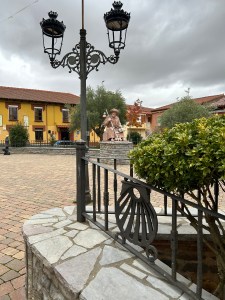
Welcome to Viilar de Mazarife!
Oct. 19: Villar de Mazarife – 14 miles
It’s a cold start to the day, but the consensus is, it’s better than hot and sunny. We walk through an industrial district, scrubland and surprise- lots of ups and downs!
In the distance, we hear a lilting Irish voice. We’ve greeted this jolly soul daily, but today he catches up to us and joins us for some café con leche/té to warm up. Never married and living with his mother, he decided to sell his dairy farm, retire at 58, and see the world.
On his first Camino, he met a family traveling with their daughter via wheelchair. The daughter told him she had Multiple Sclerosis (MS), the brilliant mind of a 28-year-old, a great career, but the body of a 98-year old. When she added she was not going to let that stop her from her goals and dreams, he immediately joined her support team. He was proud that his practical farm sense came in handy, when he suggested they put a hot water bottle on her lap to keep her warm.

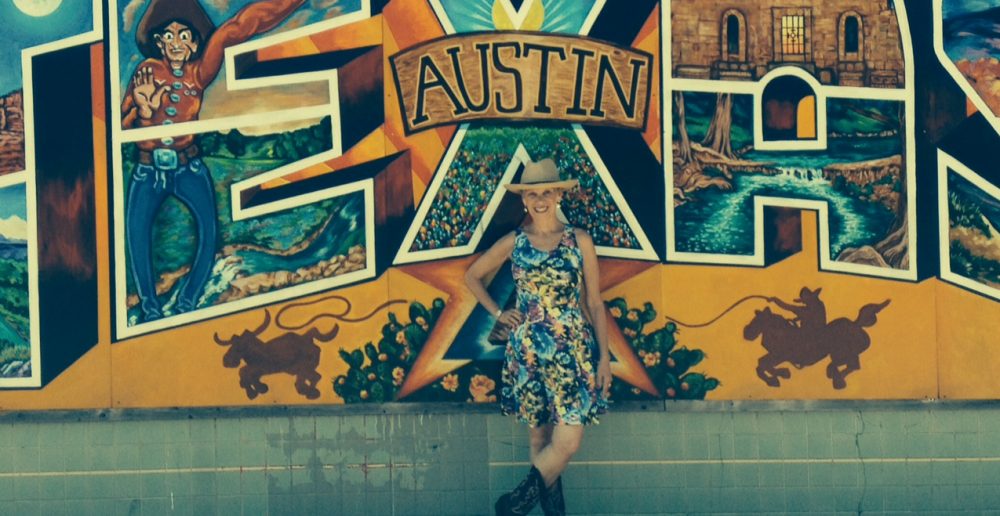
Our Irish friend snapped this photo of us
He spoke of the kindness of other pilgrims, taking turns pushing the wheelchair and sometimes even carrying it. He reluctantly said goodbye and headed home. Weeks later, he received a text, asking him if he’d like to meet them in Sarria and finish out the Camino. Two days later, he was on a plane back to Spain (you can do that when you live in Ireland) He said that experience changed his life and now, he can’t get enough of the Camino.
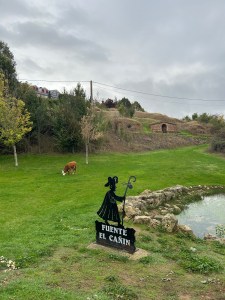
Bucolic setting on the way, but could not seem to translate the sign!
The Tio Pepe Hostal looks just like we left it in 2016. Once again, we have a first-floor room. It’s plain and clean, the shower’s great, but there’s no closet! And, once again, Mr. Wiz takes a walk to check out the town and returns in five minutes; still not too many sights!
It’s cool and damp, so rather than sitting in the garden patio, pilgrims are all huddled around the bar getting to know each other. A pilgrim from Wyoming shares his free form style of never making any plans and going where the wind takes him.
Between travel cost and time (a 20 hour flight to Europe), an Australian couple tells us of how they planned to get their monies worth by first sailing the Greek Islands (his dream) and now are on the Camino (her choice). At dinner, we find out we have much in common: our sons are the same age, have the same name, are the same size (big!) and both played rugby.
The señora at Tio Pepe makes us a sandwich for lunch and insists it’s “gratis” (free). There are no condiments on a Spanish sandwich; just crusty bread, cheese and jamón.
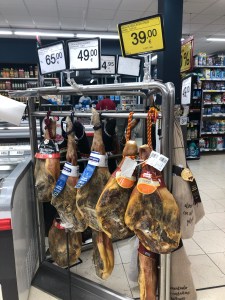
Jamön shopping!
What is jamón?
Jamón is a salt cured meat, made from the hind leg of a pig and is similar to prosciutto, but tastier. On holidays, Spanish families have their jamón proudly displayed in a special stand that clamps the ham in place and makes it accessible and easy to carve. The most expensive jamón comes from a special breed of black pigs who are only fed acorns and can cost.as much as $775 for 13 pounds.
A big group of pilgrims leave together this morning. Some are talking and laughing, some are singing and some hold back, in order to start the day quietly.
We notice the pilgrim from Colorado, who we started out with, is becoming more talkative, as each day passes. He shares that he works alone as a grounds keeper, hasn’t been to Europe in 25 years, and opens up about his solitary liife.
It’s so unusual to see a child on the Camino that we can’t help but congratulate the 14-year old boy that’s walking with his parents. This sweet family from New Zealand also seem to be coming out of their shells.
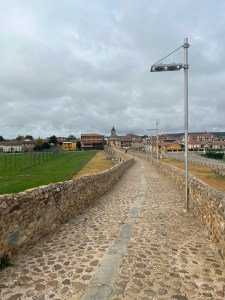
And we thought we had a nice flat day ahead of us!
Little do we know that the flat path will soon give way to a series of never ending inclines and descents, the loose rock making us pay attention to every step. Is that a mirage?! In the middle of nowhere, a woman has set up chairs and a display of fruits, snacks, and drinks, only asking for a donation in return. Sharing a Coke and the reprieve of a walk through a town finally gets us to our destination.
Oct. 20: Astorga- 20 miles
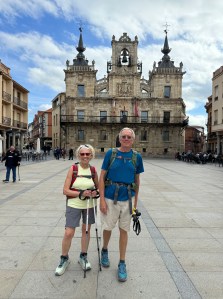
Astorga welcomed us to their plaza with sunny weather

A lovely quiet meal at El Pasaje
Astorga is a lively city that packs shops, bars, restaurants, and historical buildings all within its medieval walls. The Imprenta Musical Alojamiento has a great check-in system, explained via cell phone in your choice of languages and the room is nice. We’re too tired and hungry to take the time to lounge on our floor’s outdoor sitting area, so we hurry and shower and head to the plaza. We find a restaurant on the second floor, so we can see the merrymaking going on, on the plaza, but cannot hear it.
Oct. 21: Rabanal del Camino- 15 miles
We’re heading up to the mountains and the area known for its unpredictable weather. It’s a long day and pilgrims share an occasional “Hola” (Hi!) and keep their focus on the trail. As we enter the town of El Gonzo, I remember how Camino author, Brierley, rightly describes it as “a hauntingly crumbling village.” It’s only saving grace is the famous cowboy bar, known for not allowing any photos (though no one knows why).
Rabanal del Camino continues its centuries old tradition of caring for pilgrims before they take the steep path up Monte Irago. An order of Bavarian monks have taken up residence in the restored church and the sound of Gregorian chants continues. We stop in at the church and are surprised to find a Korean woman standing alone near the altar, playing her flute. The sound bouncing off the centuries old walls is mesmerizing. We don’t want to interrupt her, so we get her attention and hold our hand to our hearts and quietly leave.

La Posada de Gaspar hasn’t changed a bit
While the town is nothing to write home about, we remember staying at the Posada de Gaspar in 2016, with its wooden beams and stone walls. Once again, we shower and scurry to, hopefully, find a restaurant open before 8 p.m.; not easy in Spain!
What is a Spaniards’ dining schedule?
– Breakfast: café con leche/té and a sweet roll or “tostada” (crusty bread) with either butter/jam, tomato, or jamón
– Late morning: another café/té and maybe a sweet roll?
– Lunch: large meal, usually in courses with wine/beer
– Early evening: café/té/wine/beer and some sweets or tapas
– Dinner: restaurants open again at 8-8:30 p.m.
We try to start the day with some protein and seek out a restaurant that serves eggs and ham. We usually don’t eat much bread, but sometimes when that’s what all you’re served, you eat it! For lunch, we enjoy our favorite: a big bowl of “Caldo Gallego.”
What is a “Caldo Gallego”?
“Caldo Gallego” or Galician broth is a soup made with white beans, turnip greens and potatoes. The broth is flavored either with a type of salt pork called unto, “chorizo” (Spanish sausage), or smoked ham.
If we happen to arrive in a town early enough, we take advantage of the late lunch, the three course pilgrim’s meal. Usually that doesn’t happen, so we try to find someplace that opens before 8 p.m., which is starting to get close to our bed time!
Oh, and one more thing about food: it’s amazing that the price listed is the price you pay- no tax and no tip! Servers are paid a higher wage and no tips are expected.
Oct. 22- Molinaseca- 18 miles
Today we head up to the highest point of our journey, remembering to be cautious on the descents as well. It’s a grueling day, but the views are spectacular.

So peaceful in the mountains
We pass the abandoned town of Manjarin, which actually now has a population of one! Tomás, a Spaniard with a devotion to pilgrims, has provided 36 mattresses, an outside toilet, some hot water, and a simple meal for a donation.

The medieval bridge
A medieval bridge leads you into the town of Molinaseca, once the home of the Queen of Castilla and León. I sit in a bench and watch a woman walk down the middle of the street in this charming stone village. She’s carrying a bouquet of just picked flowers and by the way she’s dressed, it could be any year back in time. Just then, a car horn honks and I’m brought back to reality.
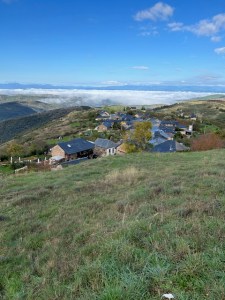
The hills embrace the town of Molinaseca
Just as lovely as it was in 2018, we vote the Hotel el Palacio one of the best hotels on the Camino, with its stone exterior, glass enclosed balcony, wooden floors, shutters and built in wardrobe.
There seems to be only two restaurants in town and we are lucky to get a table at one. A group of ten pilgrims asks if we could move our table next to their two tables, so they can all sit together and we enjoy visiting with them while we have our dessert.
 A Moxie Girl