Oct. 14 – 18 : Moratinos to León

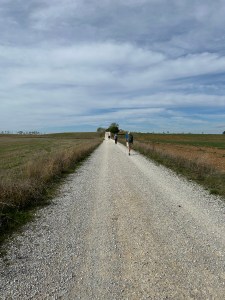
Seems like we’ll  never arrive in Moratinos!

Oct. 14: Moratinos- 20 miles
It’s a quiet morning. As pilgrims head out, many are starting their day in thought. It’s another cool day and besides focusing on the rocky, dirt path, there’s not much scenery to embrace; just miles of farmland. I become fascinated with the ant hills along the way. Some almost look like castles and each one has a hole in the center. I wonder what a mini camera would show?
This helps me pass the time and also clean out the cobwebs in the corners of my brain at the same time!

We’re startled to see a food truck ahead of us- in the middle of nowhere! Our breakfast was light, so we stop and have a “tostado con tomato,” a hunk of crunchy bread, but this time instead of chopped tomato, the bread is sprinkled with olive oil and loaded with slices of fresh tomato- delicious! We compliment the young entrepreneurial couple and they tell us they do quite well, stationing themselves along the Camino, and that they also live in the back of their camper.

With a devotion to pilgrim hospitality, Italians Bruno and Ana built Albergue San Bruno. It’s a large house, unconventional in design, with a couple of levels that house both dorms with beds and private rooms. With various doors and halls, I can only figure out how to get to our room and back downstairs. We hurry and shower, so we can relax out in their garden.

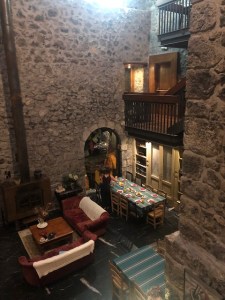
All the hungry pilgrims are hovering around the door, waiting for the communal dinner to start at 7 p.m. We share a table with two sisters from the Netherlands, a man from France and a couple from Kansas. Bruno and Ana don chef’s hats and formally welcome us all. They tell us they will close for the season November 1 and return to Italy, but not to rest, to work! Over wine, salad, pasta carbonara and cake, we are entertained by the Frenchman, who tells us after his first Camino, he quit his corporate job two weeks after he arrived home and changed his career path.

Oct. 15: El Burgo Ranero – 18 miles
It’s not raining yet, but we can feel it coming. The fact that we’re heading to a new Albergue for lunch takes our minds off walking the “Soulless Senda” for awhile. 

The sun disappears quickly, the wind picks up, the sky darkens and and we stop and jump into our raincoats, but the rain only lasts for a few minutes. We’ve been through this before with the weather teasing us, so we decide to just leave our raincoats on.

Tonight we’re staying in a gas station! I know what you’re thinking, but the Hotel Castillo de Burgo is actually behind the gas station. We are warmly greeted and the room is quite nice, modern and clean. The restaurant is open all evening, the dining room has white tablecloths, and the staff seems happy to be working there. What more could you ask for?!

Downtown Mansilla
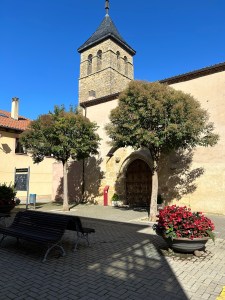
 

A surprise around every corner in Mansillas

Oct. 16 – Mansilla de los Mulas – 13 miles
There’s not much in the way of scenery today, so it’s a jgood time to reflect. In his Camino guidebook, Brierley notes “Classified as the longest extant stretch of Roman road left in Spain today, we follow in the footsteps of Emperor Augustus himself.” Out of the silence, the sound of our shoes crushing the gravel and the click of our hiking poles, as they tap the ground, creates an almost Zen-like rhythm that carrys us the rest of the way.

Our room at Pensión de Blanca (plain and clean) has three beds, so we have plenty of room to spread out. The owner pulls out a map and with a magic marker, gives us directions to everything in town, but tonight we already know where we’re dining. 

It’s not very often that Brierley gives a restaurant review, so when he recommends La Curiosa, we head there early and have a glass of wine to secure a spot. The first floor is almost museum-like, with collections of everything from old typewriters, books, tin cans and advertisements arranged just so on shelves. Upstairs, we are pleasantly surprised by the large windows and white tablecloths. We chat with women from Madrid, Chicago, and Arizona, all walking alone, and when the hosts asks if we would like to sit together, we all say “ Why not?”

While enjoying the delicious smoked trout salad, veal with blue cheese and local goat cheese drizzled with local honey, we are on edge, listening to the Chicago woman’s story of how she was scammed by a white collar squatter. Since the squatter was already living in the same New York City building, our friend assumed the usual background checks, etc. were unnecessary. Two years later, with legal assistance, she was finally able to get her tenant evicted, but had only collected $2500 from her- one months rent!

So happy to be in León!
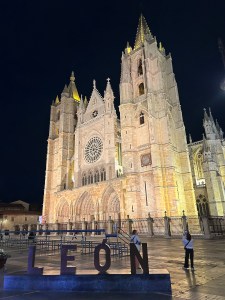

The cathedral sparkles at night
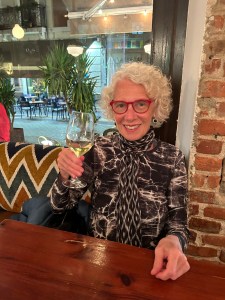
 

Our favorite white wine is the Galician Albariño

Oct. 17 & 18: León – 13 miles
We’re happy it’s cool and not raining. We’re so anxious to get to León, one of our favorite cities, we don’t even mind that we’re walking parallel to the busy highway most of the day.

León has been a pilgrim stop since the 10th century. Today, with a population of almost 450,000, the bustling city has a vibrant, joyful feel. I’m not sure when people go to work or children go to school, because it seems that the revelry continues all day and all night in the Plaza Mayor and down every narrow side street in the walled city. It’s the perfect place for a rest day.

Though we don’t seem to have the constitution of the locals, who don’t mind sitting outside in cold weather, we very quickly realize the custom of ordering one drink, which is served with a complimentary tapas, and then moving on another bar until you’ve had your dinner.

We are served a small plate full of warm, just fried calamari – delicious! Across the bar, I notice a couple chatting. As the man, picks up the calamari, it seems to be a long, never ending piece. I make eye contact with the woman and we laugh, she making the gesture of wrapping it around her neck and me, holding my hands up, like a lasso. It’s one of those quick lovely moments. All this for 6e for two glasses of wine and tapas!
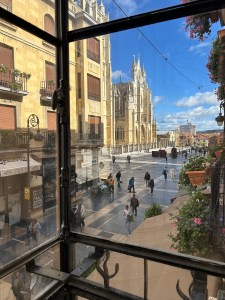
View from our room’s patio
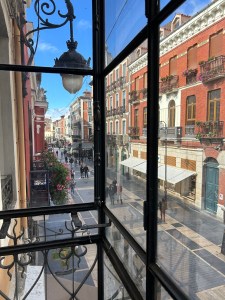
Called “ the house of light” because of its famed stained glass windows, the Santa María de León Cathedral is now a UNESCO World Heritage sight. Our hotel, Hostal Albany Ancha, is in a great location, not too far from the church. The room has a brick wall, interesting metal light fixtures, a glass enclosed patio, but no closet! In Spain, you learn quickly- “Es lo que es” (it is what it is)!
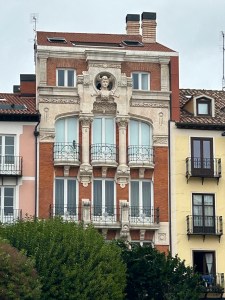
Oct. 8 – 13: Burgos to Carrión de los Condes

Our favorite building in Burgos

Please note:
– e = euro. The dollar and the euro are currently almost equal in value.
– Mr. Wiz = my husband, Michael, who is well versed on almost every subject and seems to know the answer to almost every question.

The French Route
Oct. 8: Madrid to Burgos
The Renfe high speed train station and plaza are jam packed. In typical Spanish fashion, people are talking, laughing, drinking, and eating. After our long travels, we opt for a quiet dinner at the nearby Charmartín Hotel dining room, We enjoy two glasses of wine each, along with a delicious three course dinner for 24 euros each. In Texas, $24 would barely cover two glasses of wine.

The entry to Hotel Rice Palacio Balsones

Hotel Rice Palacio de los Blasones, located in Old Town Burgos, a perfect location, is charming. Our room’s beamed ceilings, stone wall, and small balcony balance well with the contemporary furnishings.

Oct. 9: Burgos
Burgos still exhibits signs of its medieval splendor. The esplanade with its topiaries and sculptures, is the place where families and friends still dress up, meet (originally in horse and carriages, now strolling), and stop for a drink or a cafe con leche (espresso and steamed milk).

The capital of Leon and Castile for five centuries, its 12 entry gates and winding cobblestone streets give the city old world charm, but it’s the cathedral that is its highlight.

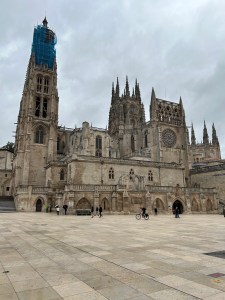
Cathedral de Santa Maria de Burgos

Construction on the Catedral de Santa Maria de Burgos began in 1221 and ended in 1567, bringing together famous architects and artists of the day to perfect the Gothic style of this UNESCO World Heritage Site.

What is a UNESCO World Heritage site?
In 1972, the United Nations Educational, Scientific, and Cultural Organization (UNESCO) adopted a treaty for “the identification, protection, and preservation of natural heritage around the world.” This agreement is unique in that 195 countries have pledged to secure the world’s most significant natural and cultural heritage from threats such as natural disasters, mass tourism, wars, and construction.

Rodrigo Diaz de Vivar, known as El Cid, is buried in the cathedral. The 11th century nobleman and military leader was born near Burgos and is Spain’s most celebrated national folk hero.

We arrive on the tail end of a hurricane. We haven’t started walking yet, so the heavy winds and occasional drizzle doesn’t affect us, but we later hear stories of some near accidents from walking and cycling pilgrims who were unaware of the storm’s magnitude.

Sunflowers and “suede” landscape

Oct. 10: Hornillos del Camino- 12 miles
“Dale!” (Let’s do it!) It’s cloudy and cool; perfect for walking. The sunflower fields go on forever, with the sunflowers proudly standing straight up, not realizing that their golden flowers have given way to dead, black ones. The fields are a patchwork of fall colors, all mowed down for the season into what looks like suede. 

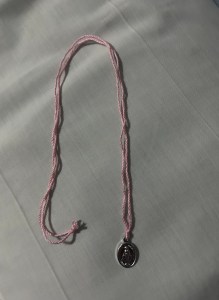
My necklace for the rest of the trip

We stop at a church to get a “sello,” a stamp on our pilgrim passport, which will be a lovely souvenir of places visited. The long line of pilgrims doesn’t deter the enthusiasm of the two nuns greeting each of us. When it’s my turn, the nun not only presents me with a medal to wear, she also blesses me and clasps my hand. I feel overwhelmed with emotion and vow to wear the necklace every day.

Flowers cheer up the building

Hornillos del Camino is a dilapidated town. With a population of 70, the decrepit buildings are a hodgepodge of different building materials. As with all of these old towns, they were once bustling commerce centers along the Camino and seem to come alive again with the arrival of pilgrims. They proudly continue their tradition of serving pilgrims and are grateful for the economy they bring.

La Casa del Abuelo is plain and old, but it’s clean and welcoming. Their sheets billow in the wind on the clothesline, interspersed with pilgrims’ clothes. The courtyard, with its unmatched tables and chairs, takes on an upbeat vibe, as pilgrims talk and laugh. A pilgrim from Idaho, with seven children and 14 grandchildren, regales us with his adventures of shooting feral hogs in Texas for $50 each and being welcomed into a motorcycle gang he had no interest in joining.

The sign on the bar says it’s closed for an hour and I assume the señora/owner is taking a rest. I happen to glance through the window and watch her lovingly feeding her mother and imagine how very full her days must be. When we leave, I tell her how special she is to care for family and for us and we hug.

A yellow arrow points the way to Castrojerez

Oct. 11: Castrojerez- 13 miles
We’ve just enjoyed our first, second breakfast; a Camino tradition. It’s a cool, quiet morning and the rocky trail keeps us focused on our footsteps. We stop at the Ruinas del Convento de San Antón, a monastery from the 14th century, which devoted itself to caring for pilgrims.

Castrojerez’s Main Street

With a population of 500, this sleepy town mirrors Hornillos. There’s not much to discover on our walk around town and we joke with a couple from Northern Ireland, asking each other if there’s something we’ve missed. The senior couple both live on the Irish Sea ( she swims in the see each morning!) and they met by chance on the beach only a year ago. We all agree, if we lived closer, we would be fast friends.

El Manzano, our alburgue, is plain and clean. We are glad for the savvy companies that deliver ready made pizzas, pastas, and paellas to these establishments, leaving their customers with just the task of heating them up and serving them hot and fresh to us. Our dinner entertainment is hearing the story of a family cycling the Camino with a 10 year old ( who is also biking) and his mother pulling an infant carrier. When they finish the Camino, they plan to camp in Morocco for six months.

The church in Castrojerez sparkled as we left in the early morning

All the way up, then all the way down!

Oct. 12: Fromista- 16 miles
We immediately start the day with a strenuous long, steep climb and an even steeper descent. Both seem never ending, but we are entertained by stories from couples that moved from St. Louis to the Virgin Islands and from Washington D.C to Sitka, Alaska. We make it a point to stop every two hours, take off our packs and hydrate, to help us keep going.

With a declining population of 840, Fromista also mirrors Hornillos, except for its Inglesia de San Martín, which is said to be the finest example of Romanesque architecture in Spain!

Spanish “bubblegum” body wash and shampoo!


Ready for a shower, we can’t seem to find any soap in our room at the Hotel Rural San Pedro, another plain and clean establishment. It seems the soap dispenser is in the shower and it makes us laugh. At home, we are so fussy about what shampoo and soap we use, but here the neon hot pink soap is just fine with us.

It’s a holiday, there are limited restaurant choices and pilgrims are hungry. Many of us line up outside a place that opens at 6 p.m. (and not the usual 8 p.m.), and are disappointed to find out a group of Korean travelers have reserved the entire restaurant. Thank goodness for the small bar that serves that same prepared food we enjoyed the day before.

San Zoilo: view from our room


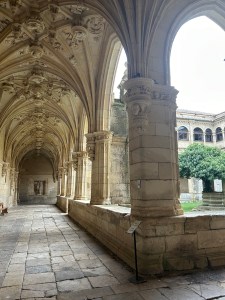
San Zoila cloisters

Oct. 13: Carrión de los Condes- 12 miles
Famous Camino guidebook author, John Brierley, calls this part of the walk the “soulless senda” or path. Whether it’s the two, narrow, side by side paths that run alongside nondescript fields or the highway, this becomes the perfect time for reflection and introspection.

This time, we found the staff aloof and preoccupied and later were disappointed to find out other pilgrims staying there were never invited to visit their lovely church, museum, and cloisters, nor were they told about the discounted dinner menu for guests of the hotel, which we asked about and did receive.

Mr. Wiz has taken it upon himself to be in charge of doing our laundry. The laundromat is busy and chaotic, with pilgrims from all parts of the world waiting their turn. We laugh with a woman from Canada who’s next and says she’s not sure if she should place her laundry bag in front of the machine or just sit in front of it. Mr. Wiz explains the process to anyone that looks confused and I ask him if he’s running for mayor or just wants a job running the place.


.


.


,


Mud, Sweat, and Tears: Why the Camino Keeps Luring Us Back

When family and friends heard we were heading back to the Camino, their first question was “Why?!” They wondered what it was about walking miles, on all kinds of terrain, in all types of weather, and for days on end that made it alluring.

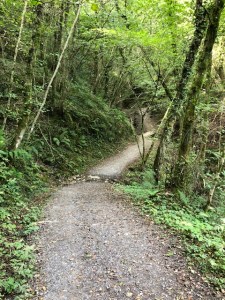
The good terrain

The not-so-good terrain

What is the Camino?

In the ninth century, a local bishop ordered a church to be built to house the remains of St. James, when they were discovered in the northwestern Spanish town of Galicia. Over time, the church grew into the grand cathedral of today, and the city became known as Santiago de Compostela – “St. James under a field of stars.”

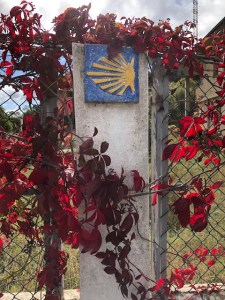
Throughout the Middle Ages, people started their pilgrimages from their homes, which created the many routes still used today. Yellow arrows mark the routes to help pilgrims navigate. Along the way, churches, restaurants, and places to stay, stamp a pilgrim’s passport to prove they have walked the minimum 100 kilometers/62 miles required to receive the coveted certificate, or “Compostela,” from the pilgrim office in Santiago.

There are many reasons why people choose to walk the Camino. It evokes a physical, mental, spiritual, and mystical experience unlike any other.

You never know where you’ll find a yellow arrow

It’s Your Camino

Though walking is the most popular way to travel the Camino, some ride a bicycle or travel on horseback. You can travel as much or as little as you would like each day. If you tire, buses and taxis are available, and there are companies offering daily backpack transport.

You can choose to stay in a “donativo” – a mat on a church floor for a donation, a five-star hotel, and anywhere in between, such as an “albergue” – a pilgrim hostel or a “casa rural” – a guesthouse. You can make a reservation ahead of time or see where the wind takes you when you arrive in a town. To keep you energized, the three-course pilgrim meals are delicious and offered at a bargain.

Hotel Antsotegi in Etxebarria was an old iron mill turned hotel

The Olé of Spain

There’s an exuberance and an elegance to life in the Spanish cities. Working to live, rather than living to work, allows time for family and friends. Music and culture are relished, every meal is savored, and life is lived at a slower pace.

Spaniards still enjoy the tradition of the paseo. They dress up for their stroll through a town’s main street or plaza to greet family and friends. No doubt there will be stops along the way for a café con leche y dulce – espresso coffee with hot milk and a sweet – or vino y tapas – wine and appetizers.

The small towns have a charm of their own. As if traveling back in time, a car driving through the street is almost startling. At times, you may be walking through a herd of sheep or visiting a small church, and the simplicity of the moment leads you to ponder your own life.

Estella, Spain was founded in 1090

Pilgrim Power

“Buen Camino!” Each day, pilgrims wish each other a good walk as they pass each other by.

We are all heading to the same place – the Cathedral in Santiago de Compostela – which creates instant camaraderie. There seems to be no interest in who you are at home. Here, everyone is equal.

Encountering pilgrims from all over the world, you begin to realize there are very few differences between you. Very quickly, they are no longer strangers. Your interaction might be days/weeks together or just a few words in passing. Pilgrim families are created, and members may keep in touch for a lifetime. Sometimes just a quick exchange can become crucial to helping you think through an issue in your life.

You feel a positive energy around you each day. The genuine hospitality encountered by people from all walks of life throughout Spain seems to rub off on the pilgrims, who, in turn, are there for their fellow travelers. Whether it’s with a hug, a band-aid, directions, or just a listening ear, there’s a loving spirit that makes you wonder why people aren’t always like this.

Me, Myself and I

You feel an ongoing gratitude for the simplicity of each day, its daily rhythm, and the chance to reboot, as you discover the Spanish culture in slow motion. It’s easier to listen to yourself when it’s quiet and the peaceful solitude of walking alone is a nice balance.

The freedom from everyday obligations and the luxury of being unplugged from the stimuli of our daily lives gives you more time to focus on the world around you. Traveling with only the belongings that fit in your backpack makes you feel lighter. You sometimes feel as if you were turned inside out, with your senses heightened and your mind clear and open.

The mud and sweat are understandable parts of the walk. As your journey ends and you enter the plaza of the Cathedral in Santiago de Compostela, you wonder if your tears are because you conquered the goals of this demanding trip or because your journey has come to an end.

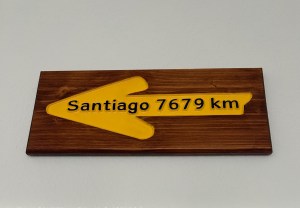
This sign shows the distance from Georgetown, Texas to Santiago de Compostela, Spain

“Live for the moments you can’t put into words.”
“The end is just the beginning”
Authors Unknown

For more information on the Camino:
Watch the movie that resurrected the Camino in the United States in 2010. “The Way” starred Martin Sheen and was written, directed, and produced by his son, Emilio Estevez.

Listen to Dan Mullins’ podcast “My Camino the Podcast” which showcases Camino stories from pilgrims from over the world.

Go to the American Pilgrims on the Camino website which shares information, supports American pilgrims, and subsidizes Camino-related projects with grant money from its dues.

Author’s Note:
IIf you enjoyed this post, please scroll down, like it, and feel free to share it!