Oct. 16 – 19: Muxia and Finesterre

Photo Muxia

Oct. 16: Muxia

We’ve come all this way, so it seems only right to continue to the very end. It’s a beautiful day and we leave on the early bus for Muxia. With a population of 5000, this sleepy seaside town, along with our hotel Habitat CM Muxia, are really nothing special, serving only as the backdrop for the stunning natural beauty of its beaches.

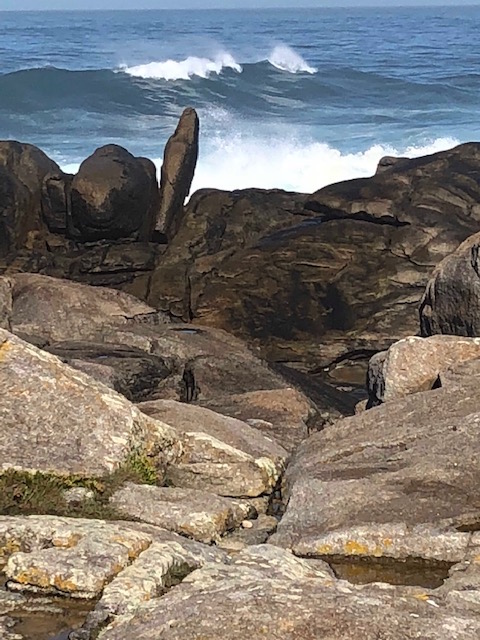
This is the official end of the Camino, so we head out to find the Camino marker noting 00.00 kilometers and are struck by the view before us; the waves crashing against the rocks, its sound both thunderous and serene. There is an ominous feel to this beauty; this area is part of the treacherous Costa de Morte (Coast of Death), known for its many shipwrecks.

We peek into a window of Our Lady of the Boat Church. Struck by lightning on Christmas Day 2013, only the outside has been fully restored and it lacks an interior roof. According to legend, it was on this site that the Virgin Mary met St. James and encouraged him to preach throughout Galicia. It is believed that by a miracle of God, the body of St. James was carried by boat to Muxia, then taken to Santiago.

I am drawn to the area’s spiritual and mystical side and am anxious to find the rocking stone (Pedra de Abalar). Balanced just right, it sits straight up and rocks with the wind. It is said that it has magical powers; touching it can provide spiritual and physical healing.

We find a rock to sit on and soon I am deep in thought, mesmerized by the sound of the ocean. Time seems to stand still. I think about the many pilgrims before me that have sat in this same spot and reflected on their physical, mental and mystical journey with only the screeching of the seagulls to distract them back to reality.

Oct. 17: Muxia

There’s not much to do in a beach town on a rainy day, so it’s a good time to do some writing, reading and plan our upcoming itinerary. We’ll have some time left before we are to meet Big A* in Madrid, so we grab a window seat at our hotel’s café, order some tea and get to work.

By evening, our work is completed and we toast with a glass of wine in the same window seat and decide to venture over to the harbor for dinner. Known for its fishing industry, it is said that the boats you view while you are dining have just unloaded the fish you are dining on for dinner. Once again, we choose a window seat and after much discussion with the waiter (whose dream is travel to the U.S. and drive Route 66) select just the right seafood dishes and white wine to complement them.

Photo Finisterre

Oct. 18: Finesterre

Finesterre is Latin for “end of the earth.” Back when the world was still thought of as flat, this was considered its end. Like Muxia, this town also has a population of 5000 and is also a fishing port, but there is something so much more charming and robust about this city. It has a thriving city center and streets that meander up and down, along the ocean. The Hotel Langosteira has a great vibe. Its whimsical décor features colors of the sea; mosaic tiles in the shape of fish design the walls and even the key chains are wooden fish. Our porch has a view of the ocean and we already plan to make sure we’re up early to see the sun rise.

We get our bearings by walking from one side of the town to the other, scoping out places for dinner by the water.

Oct. 19

We head to the lighthouse, the area’s beacon since 1853, and pause at the bronze boot statue. Perched on a rock, it’s a symbol to all pilgrims of the end of the journey. Signs request that pilgrims no longer practice the ancient ritual of burning an article of clothing here as a symbol of new beginnings, but up ahead we notice a tight group of people standing in circle holding hands and smoke billowing out from the center.

I wish we would have known about the O Semaforo Hotel balanced on the cliffs, but we settle for a beer on their patio overlooking the ocean. While we are initially surprised at the number of tour buses and pilgrims here, as we climb up to the boulders that surround the ocean, there is unexpected silence. Unlike the rough seas of Muxia, here the ocean is tranquil, lapping at the sun dappled rocks, lulling you into awe and leaving you speechless.

I situate myself on a flat rock and sit cross legged with my eyes closed and my hands in prayer at my heart. Out of nowhere, I hear the sound of a flute; a young man has chosen this spot to play for tips. His melody is harmonizing with the sound of the waves and I experience such peace. For a moment, I feel as if I am outside my body and wonder if this is what practicing meditation correctly feels like. The word “peace” keeps coming to mind and I tell myself that I don’t want to forget this feeling when I go back to my busy life. Eyes now open, I feel energized, yet so serene.

We walk back through town and head to the beach. We’ve read of a famous restaurant right on the beach and decide to splurge on a late lunch at Tira do Cordel, enjoying the razor clams and grilled fish. Afterward, we walk the length of the beach, searching for shells and dipping our feet in the water.

It’s been a long day. As we head back to our hotel, I notice two older pilgrims walking toward us. The one that looks like Santa Claus (except that he’s wearing sandals and shorts) stops in front of me and hands me something. I hesitate and shake my head no, but he insists and says “…Yes, for you…” He walks on and I look down to see what he has given me. It is a card with a hand drawn picture of a dove in royal blue paint. Across the bottom are the words “…Peace, Paz…”


*Who’s who? See “Cast of Characters” on the “About” page.

Oct. 13 – 15: O Pedrouzo to Santiago de Compostela

Photo Santiago

We made it to Santiago!

Oct. 13: O Pedrouzo to Santiago- 13 miles, 5 1/2 hours

As we make our way to Santiago, the wonderful scent of the eucalyptus forest and the old, gnarled trees, that resemble the talking trees in the “Wizard of Oz,” distract us from the fact that the inclines and descents today are quite steep.

A city sign announces that we’ve made it to Santiago and we’re getting excited, even though we still have a 45 minute walk on asphalt to the historic city center. One minute we are walking through a dark tunnel serenaded by a bagpiper and the next minute, we exit into the light of day with the Cathedral welcoming us in all its glory. We hug hard and long in the Praza do Obradoiro (the golden square), amongst the other pilgrims who are laughing, crying and/or laying on the ground and looking up at the cathedral. It’s a very emotional moment; we are glad to have arrived, but sorry to see it end.

Santiago is the capital of Galicia and a UNESCO World Heritage Site. And if welcoming pilgrims and tourists isn’t enough excitement for one city, there is also a festival being celebrated. Tents selling grilled meats, artisan bread and foods share space with clothing and jewelry. The streets are filled with jubilant crowds and bagpipe music fills the air. Baby grand pianos have been placed all over town with an invitation to sit down and play.

The Hostal Aires Nunes is just two blocks from the Cathedral on a quiet back street. Our room is decorated in the Spanish version of country French: stone archways, wooden beams on the ceiling, iron chandeliers and a lovely glassed-in sun porch outfitted with two chairs and a table.

What a nice surprise to run into the pilgrim couple from Tacoma, Washington that we met last night when eating pizza. We enjoy another dinner together and plan to meet again tomorrow too.

Oct. 14

We arrive at the Cathedral early to get a seat for the noon pilgrim mass. According to legend, St. James, one of Christ’s Twelve Apostles, was buried in a nearby forest by his disciples. In 1075, a sanctuary began to be erected around his relics resulting in today’s monumental Cathedral. The highlight of the mass is the swinging of the Botafumiero, the largest incense burner in the world. Originally, its purpose was to fumigate the sweaty and disease-ridden pilgrims. Six attendants continue the ritual of the swinging which reaches a speed of over 40 miles per hour.

Unfortunately, we are not able to touch the central column of the Door of Glory; too many hands before us have eroded the marble, so it is now covered with plexiglass. We do, however, maneuver through the crowds to the crypt under the altar to view the relics of St. James and offer up a prayer.

Next, we head to the Pilgrim Office to obtain our Compostela (certificate of completion). The line snakes around and we’re told it’s an hour wait, but running into our pilgrim friend from Lake George, New York makes the time fly by.

She tells us of the older man that she had first met on her flight to Spain. His wife had recently died and he felt so lost and alone. She then confided that she had also lost her spouse, so understood his pain. What a surprise it was to see him exit the same hotel elevator that she was entering in Santiago, now over a month later. They dined together that night and he seemed like a different person, recounting how he had learned so much from the pilgrims he had encountered along the way. The emotionally charged conversation also taught her a thing or two and she felt as if she had come full circle along with him.

We hugged and a minute later, she was lost in the crowd. I stood there with tears in my eyes, wanting to hold on to this newfound relationship, then realizing that I had none of her contact information. This is the essence of the Camino; the deep connections that you make with pilgrims from all walks of life and from all over the world that are even more precious because they are in the moment.

Oct. 15

The weekend crowds are gone, so we head back into the Cathedral to do a little more exploring. Today, we are able to view the church in all its glory and the Baroque altar glittering with gold stands in full view. All through Spain, whether the smallest of villages or the larger towns, the amount of money that the Catholic church has spent on its churches through the years is astounding. It’s hard for me to fathom that I am one of the many pilgrims that have arrived here since the Middle Ages, taking time to reflect at the end of the journey just as they did all those years ago.

After a walk through the public market and a lunch of grilled pulpo (octopus), we spend the afternoon exploring the narrow, winding, cobblestone streets. Then, it’s time to meet the pilgrim couple from Tacoma and toast both husbands, who will soon be celebrating a special birthday, just one day apart.

No one seems to want to go home after the Camino. Our friends are off to Porto, Portugal and we are headed to the “end of the earth.”


Oct. 10 -12: Palas de Rei to O Pedrouzo

437A6CB9-4AF2-49AA-9C9A-995586119D03

You never know what you’ll find around the next corner.

Oct. 10: Palas de Rei- 16 miles, seven hours

It always surprises me when a pilgrim walks by me smoking, but in Europe cigarettes are part of the culture. It’s very common to see generations of the same family all smoking together at the local cafe.

As we travel through woods and farmlands, I sense that the inclines and descents are steeper than yesterday. We’re traveling through dairy country and corn cribs are everywhere. They look like little houses on stilts and are used to dry and store the corn used to feed the animals. To make the time go by, we play a game, calling out the oldest (one said 1856 on it), newest, most decorated and most likely to fall apart if blown on. I tell Mr. Wiz* that I’d like one for my birthday. I hope he knows I’m kidding.

Pensíon Palas is a bit outside of the city and we’re glad to finally arrive. It’s nothing special; plain, but clean. We head into town and see our Canadian friend, who asks us to join her for a glass of wine. We enjoy hearing about her adventurous life, starting with boarding school in Belgium, then living abroad in different cities. She excuses herself in order to enjoy her bathtub (most rooms only come with a shower) and we head to dinner.

Oct. 11: Arzúa- 16 miles, seven hours

The forecast says rain and we trudge up and down through farmland all day long. Just as we’re heading for the steepest part of our trek, we meet a pilgrim from Lake George, New York. We pass the time with my stories of the many happy childhood vacations there. The Caldo Gallego we find for lunch is good and hot and it hits the spot. It’s my favorite soup, made with onions, white beans, potatoes, kale and/or cabbage.

Just as we see the sign for the turn-off to Casa Garea, the rain turns to drizzle. As we head into the eucalyptus forest, the wonderful scent and the singing birds help us to forget for the moment that we feel like two wet rags.

The buildings are old, but the beamed ceilings, stone and starched white linen curtains give it a homey feel. After settling in, we enjoy a glass of wine in the common area. Our Lake George friend greets us with a big smile and announces that this is the first time on the Camino that she will have a private room. We tease her that she will not be able to return to the albergue bunk beds. When we notice a single place setting at one of the dining room tables, we invite her to join us for dinner and a good time is had by all.

Oct. 12: O Pedrouzo- 15 miles, seven hours

It’s drizzling, but we head back through the eucalyptus forest to return to the Camino route with a spring in our step, thinking of the bacon and egg breakfast we plan to treat ourselves to.

The rain is playing a game with us all day; every time we decide we’re too hot and take off our raincoats, it starts to drizzle again. In the end, we decide that the cool mist feels better.

We’re walking right through farms all afternoon, so much so that at one point a farmer asks us all to stop, so his cows can cross the road to his other pasture. The drizzle turns to a pouring rain and the cows are the only ones that seem content.

Pension LO is only a couple of years old. It’s all white decor and contemporary feel are a welcome change. I like the quote that decorates the wall above our bed in script: “The best things in life are the people we love, the places we’ve been and the memories we’ve made along… the Way.”

Only breakfast is served in their dining room and we are not looking forward to having to head to town for dinner in the driving rain. The woman at reception asks us if we’d like to order pizza from a local takeout place, the two couples eating in the dining room give us a thumbs-up on the food they are enjoying and we are so happy that we don’t need to venture out. We enjoy a cozy evening, dining and chatting with the couples from California and Washington state.

*Who’s who? See “Cast of Characters” on the “About” page.
Oct. 7 – 9: Sarria to Portomarín

571B5230-58AE-4216-BDE8-AC7BCD81F49C

Oct. 7: Sarria

Our next stop should be O’Cebreiro, but there are no rooms available anywhere (we even try three towns before and after), so we opt to bus to Sarria. As the Camino gains in popularity, it’s becomes harder to be spontaneous. Then again, we could have followed the three pilgrims who left at 5 a.m., walked in the dark for three and a half hours, then waited in front of the municipal albergue for two hours until they opened (they don’t accept reservations) and did make it to O’Cebreiro.

We are on the bus to Lugo, but the bus arrives late and we miss our connection. Rather than wait four hours, we find that there is a train leaving sooner and decide to walk over to the train station. Two women pilgrims from South Africa ask if they can tag along. Chatting with them in the bus station makes the time go by and we are soon on our way.

Hotel Alfonso IX can’t seem to decide if it’s a modern or an Old World hotel, so it’s somewhere in the middle. It’s a perfect day to sit on their outside patio right on the river and enjoy a glass of wine. We soon strike up a conversation with a pilgrim from Canada. This woman has grit; not only is she a single mom, she’s traveling alone and got bedbugs her very first night on the Camino!

A word here about bedbugs; we’ve heard a lot of horror stories along the way, but have never personally experienced any. When we travel, we are in the habit of checking every hotel bed, regardless of the hotel’s level. As soon as we enter the room, we strip the bed and check it from top to bottom, looking for any black dots. If none, we are good to go.

Oct. 8: Sarria

First priority on our rest day is to get our laundry done. The laundromats are a pleasure to visit; clean, with bowls of hard candies, tissues and copies of the latest tabloid magazines for their guests. The magazines help us practice our Spanish, even though we don’t know any of the people that are featured.

One of the other pilgrims doing laundry introduces himself. He is a professor at the University of Alabama with a Ph.D. in divinity studies and is taking a survey about spirituality while on the Camino. Would we mind completing a survey? We are happy to do it and it helps the time to pass quickly. He jots down his email and says he’d be willing to share his findings once the data has been analyzed.

Oct. 9: Portomarín – 14 miles, 6 1/2 hours

Nothing like starting the day with a steep vertical incline, but we know we are headed to a breakfast of eggs, bacon and thick hunks of bread, so we power up and keep moving.

The path will be more crowded now, all the way to Santiago. Pilgrims that walk these last 100 km will also be entitled to a Compostela, the document of completion. We chat with pilgrims from Canada, Seattle and California and all agree that we can tell the newbies by their clean boots. Somehow, between the barking dogs, mooing cows and throngs of new pilgrims, we seem to lose the crowd, find ourselves all alone and appreciate the silence. The faint sound of bagpipes coming from the woods sounds magical. We come around a turn and in the middle of nowhere stands a young man dressed in traditional garb, playing proudly, for tips.

We are not enjoying crossing over this long bridge. The guard rails are very low on each side and we try to stay right in the middle, not looking down at the river below on the one side or the oncoming traffic on the other.

We are so happy that our hotel is the first one in town. Vistalegre is a brand-new contemporary hotel, only four months old. Though it’s all white, the mix of textures (stone and tile) give it a sophisticated look and the sound of the water sculpture from the glass enclosed garden is a lovely touch. The rooms are not very big, but we vote the shower the best on the Camino.

Later, we run into an older pilgrim from Michigan that we first met at the beginning of the walk. He was initially so shy and withdrawn that we always made it a point to say hello and walk with him a bit. Now, here he was, greeting us heartily, laughing and chatting away. He introduces us to his new friend, another pilgrim who is about his age. It is wonderful to see them interact, despite the fact that neither one speaks the others language. It is said that the Camino provides and once again, it’s beautiful to see it unfold.


Oct. 1- 3: Astorga

DE25A203-E1EA-4A9B-BE9A-8B772D94C0D0

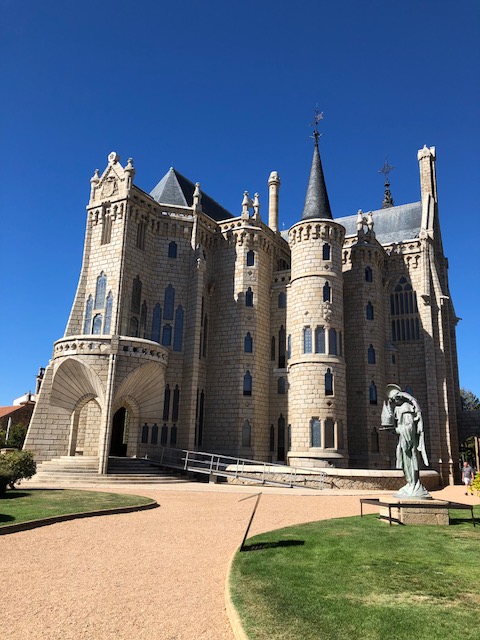
Bishop’s Palace, Astorga

Oct. 1

We’re on the bus headed to Astorga. My face is pressed against the glass, as I watch the pilgrims walking by on a narrow strip of dirt so close to the road. I wish I were there, walking with them.

We arrive at Hotel Ciudad de Astorga. If we were walking, we probably would not be staying at such a modern hotel, but since I’m spending more time than usual in the room, it seems a good choice.

On the Camino, you have your choice of accommodations: donativos (a straw mat on the floor for a donation), albergues ( pilgrim hostels: bunk beds, dormitory style or private rooms), casa rurales (similiar to a bed-and-breakfast) and hotels (two stars and up). Some pilgrims like to reserve ahead and some like to walk into a town and be spontaneous.

Astorga is a lively town (population 12,000) full of historic buildings. In medieval times, because of its convergence to so many of the pilgrim routes, it boasted 20 pilgrim hospitals.

Oct. 2

Last time we were here, we missed seeing the Bishop’s Palace (Palacio Episcopal), so we head there first. After a fire in the early 1900s, the bishop asked his friend, Spanish architect Antoni Gaudi, to redesign what would be his home. Unfortunately, the neo-gothic palace, complete with turrets caused such an uproar that the bishop never had the opportunity to live there.

I never get tired of the watching the two figures strike the bell every hour on baroque facade of the government building in the Plaza Mayor. It’s a great place to people watch, so we head there to have a leisurely late lunch. We enjoy a three-course menu del dia, complete with water, bread and a bottle of wine for 12 euros each ($14.40). The pilgrims all start arriving and sharing stories of their day. We are so glad to run into our friend from Arizona. He seems like a different person; he met an older woman from France who he is walking with and seems so happy to have the company. I feel like the little girl in the class that is the only one not invited to the birthday party; hoping I can walk again soon.

Oct. 3

Do we get back on the Camino tomorrow or do we bus somewhere else? I’m eager to walk, but all morning my knee has been throbbing. Just as we sit down to talk, I could swear that I hear a voice whisper in my ear to go ahead and walk and that I will be just fine. We make our plans to start walking again and I sleep so well, with no apprehension as to what tomorrow will bring.

Sept. 28 – 30: Leòn

B09A1720-0F84-4A10-9300-284EF1B37F4D

Sept. 28

We walk into town together and our Arizona pilgrim friend bids us farewell as he heads to his albergue.

We stayed at Hostal Aldo Cosco Antiqua in 2016 and I remember the wooden beams on the room’s ceiling, the windows that open to overlook a cobblestone street and the lower level’s glass topped flooring with a view to the old city’s stone beginnings.

Before we can decide where to dine, we receive a text from a pilgrim couple from Delaware that we had met early on. They’ve also just arrived and we plan to meet for dinner.

Tonight, the city’s cobblestone streets are packed with young and old revelers. A line snakes down the block to get into the cathedral for a free organ concert, a band plays electric violin and bagpipe music from a stage and there is a feeling of such gaiety in the air.

Sept. 29

My sister, a nurse and JC* (who we all thought should have gone to medical school) agree with the manager of our Burgos hotel who took one look at me and had diagnosed me as having tendinitis. A few minutes later, Google has provided me with a definition and YouTube has taught me some Pilates movements especially for knee issues; fingers crossed that this is the key.

Today, the city is celebrating La Leyenda de los Cien Doncellas (The Legend of the 100 Maidens), which explains the procession of women dressed in beautiful medieval garb. The Arab dancing, sword battle re-enactment and medieval music complete with bagpipes helps to recount the story of the time when Spain was under Muslim rule. A despot seized control of Spain and in exchange for less tyranny, demanded that 100 women be added to his harem. The women revolted and with the help of the army led by the apostle Santiago, Spain was freed.

In the midst of the vibrant music and the throngs of jubilant merrymakers, the Arizona pilgrim we met on arrival comes to mind. I sensed a sadness about him. Is he all alone this evening? Could he use a friend? I call out his name under my breath and scour the streets, hoping that if he is out there, we will somehow run into him.

Sept. 30

The celebration continues with the Fiesta de San Froilàn  (St. Froilàn). Colorful banners line the plaza, as donkeys lead colorfully decorated carts down the square. Every street is crowded, either with shoppers eyeing the merchandise for sale under the many tents or with the customers overflowing out of every bar and cafe into the street.

It appears that no one has stayed home. The sight of generations of family members enjoying each others company is heartwarming.


*Who’s who? See “Cast of Characters” on the “About” page


Sept. 25 – 28: Burgos

77CA2426-771A-494E-A7FC-1ED5BEA8FA14

Cathedral de Santa Maria XIII

Sept. 25

We bus here in two hours and settle into Hotel Monjes Magnos. It’s clean, simple, all white and we have a private room. I send Mr. Wiz* out to explore and see where we’ll dine tonight and I take a rest.

Speaking of food, this seems to be the major past time of Spaniards. Breakfast is light; a cafe con leche (espresso with hot milk) and bread or a sweet roll. During late morning, there may be time for another cafe and a sweet roll. Many towns and businesses still close in the afternoon for a siesta and a big meal is enjoyed. Then, everyone is back on the streets again and you may need either another cafe and a sweet or a wine and tapas to hold you until dinner, which begins after eight in the evening.

Burgos is a big city, sometimes referred to as the “Gothic Capital of Spain”. Thank goodness I’ve been here before and have already seen all the sights, especially the Catedral de Santa Maria XIII, one of the most beautiful and largest of Spain’s many cathedrals. Mr. Wiz revisits all his favorite architectural spots, sends me photos all afternoon and I feel as if I am there with him.

Sept. 26

It’s really something when you notice the abuelas (grandmothers) are all out-walking you, but I find my way to a bench and enjoy the beautiful weather, while Mr. Wiz is out and about.

I’m in ear shot of three pilgrims; the woman is from England and the men are from Sweden and Korea, but they are speaking English. They seem to be delighting in each other’s company, as they share some wine, tapas and their life stories. As they walk away, I can still hear them talking and laughing. They stop to take a photo together and then, spontaneously, continue their walk with their arms around each other. I fumble for my phone, but the photo op has passed. No matter; I don’t think I will ever forget that image. It personifies what the Camino is all about.

Sept. 27

The first thing I see this morning when I wake up is Mr. Wiz’s backpack on the chair, packed up and all ready to go. Our plan was to walk to Estella, but my knee is still acting up, so it looks as if we’ll be here another night. He can sense that I am upset and reminds me that what matters is that we are together and we are on our own Camino.

It’s been five days and I’ve taken all the medication from the clinic. We stop at a pharmacy and I’m told that, not only can I continue taking the meds, I can also increase the dosage and take it in the afternoon. This is quite encouraging.

We’ve been staying close to the hotel each evening, but tonight I’m feeling a bit better, so we decide to venture slowly into old town. We are so surprised to come across our pilgrim friends from Switzerland, Russia and Taiwan. They were our laundry buddies and we joke that dirty laundry will always remind us of each other.

We stop for some wine, then continue on to dinner, this time making sure to swap contact information before we say goodbye again. It’s our last evening with our Russian friend. We hug as if we’d known each other for years, as she whispers in my ear “…If we lived closer, I think we would be good friends…”

Sept. 28

We can’t stop apologizing to each other today. Mr. Wiz is sorry that he did not think to buy the bus tickets to Leòn ahead of time and I’m sorry that I forgot to remind him. The 10:30 a.m. bus is sold out (completo) so we have no choice but to wait until 5:20 p.m. to leave.

With Mr. Wiz carrying both backpacks and me hobbling beside him, there’s not much for us to do. Fortunately, it’s another beautiful day, so we find a bench in the park near the cathedral and headquarter there. I have time to reflect and remember an article I once read that said when you experience conflict, you need to face it, head straight toward it and flow with it, rather than against it. I decide to try that tactic. The time seems to go by quickly, as we plan out our day: share an apple at 1 p.m. and have a beer at 4 p.m.

At the bus station, we meet a pilgrim from Arizona, who also missed out on a ticket for the earlier bus. He had been experiencing ankle issues and said that when he had taken a few days off, he felt lonely and a bit depressed. I feel grateful that I have a partner to share my ups and downs with.


* Who’s who? See “Cast of Characters” on the “About” page.


Sept. 22 – 24: Logroño

2FFEFDAB-A579-4261-97F5-801BF7650B2DS

Sept. 22: Logroño – 17 miles, seven hours

We try to outsmart the sun and leave early and by 7:15 a.m. we are on our way. We’re on a wide path which starts out sloping gently. The sound of my boots crunching on the pebbles underfoot and my hiking poles hitting the ground, as I take each step, lulls me into a meditative state. I hear a pilgrim singing in Spanish as he passes and I am surprised that an hour has already gone by.

The path continues into the Rioja wine region, becomes steeper and continues on and on. I think of the sandwich that we made to eat and look forward to enjoying it with a Coke. Funny to think that at home, I am neither a sandwich eater nor a soda drinker.

Logroño is celebrating their wine festival this weekend. It was hard to find a place to stay and we are “forced” to stay in a lovely hotel. The Marqués de Vallejo has an edgy vibe and a great location.

The city is in party mode. People of all ages are gathered at every taverna; in, out and overflowing onto the streets.  Children play with their toys against the buildings. Parents rock baby carriages with 1 foot, as they handle a glass of wine in one hand, tapas in the other and don’t miss a beat of the conversation. Young and old fill the small streets that look like alleyways. There is such a feeling of joy and happiness in the air. Bands appear from nowhere and impromptu play, as we all clap and dance, following them down the street like the pied piper.

Sept. 23: Logroño- Rest Day

I can hardly walk. My right knee is in pain. Truth is, yesterday I felt a twinge, then an ache as I walked. There was nothing to do, but keep going or be air lifted out. I felt sad, angry and frustrated as I forced myself to continue on. I am the one that worked out hard, six days a week in preparation, including adding 50 deep knee bends to my regimen. I always warm up each morning and am so cautious of the terrain. why me?

The hotel recommends a clinic and we taxi there after breakfast. It’s quiet, with only a few well-dressed people there, none that look ill. The doctor’s diagnosis translates as having knee pain due to over effort. I am told to rest, take an anti-inflammatory drug for five days and should be fine by then. Surprisingly, they are willing to bill my insurance company directly. In less than an hour we are back at our hotel, scratching our heads and wondering what to do now.

I force Mr. Wiz* to go explore and leave me to write, read and sleep. He surprises me with a compression sleeve for my knee and by seeking out our favorite restaurant when we visited here in 2016. I hobble to Pasion Por Ti, hanging on to him, and we enjoy a wonderful three course meal with a bottle of wine, water and bread for 18 euro each ($21.50), forgetting for a while that many decisions still need to be made.

Sept. 24: Logroño- Still here!

We decide to stay one more night to give us time to plan. How lucky that we are in a hotel, rather than an albergue, which does not allow multiple night stays, And, we are also glad to find out that since the wine festival is over, the nightly rate has gone down by 40 percent.

I’m feeling a bit better, but not great. We breakfast close by, then sit in a beautiful park and watch the world go by. We head back to the hotel and go into hyper-mode, trying to figure out our next move.

We both have a strong feeling that we should stay on the Camino route. I suggest that Mr. Wiz walk each day and I meet him by bus. He is adamant that he will not leave my side, so we agree that we’ll head to Burgos tomorrow for a couple of days and take it from there, This is not the Camino we had planned, but we have no choice now but to watch it unfold.


* Who’s who? See “Cast of Characters” on the “About” page.


Sept. 18 – 21: Pamplona to Los Arcos

25B11C32-D00B-4B7B-AF0A-F22CC144AF35

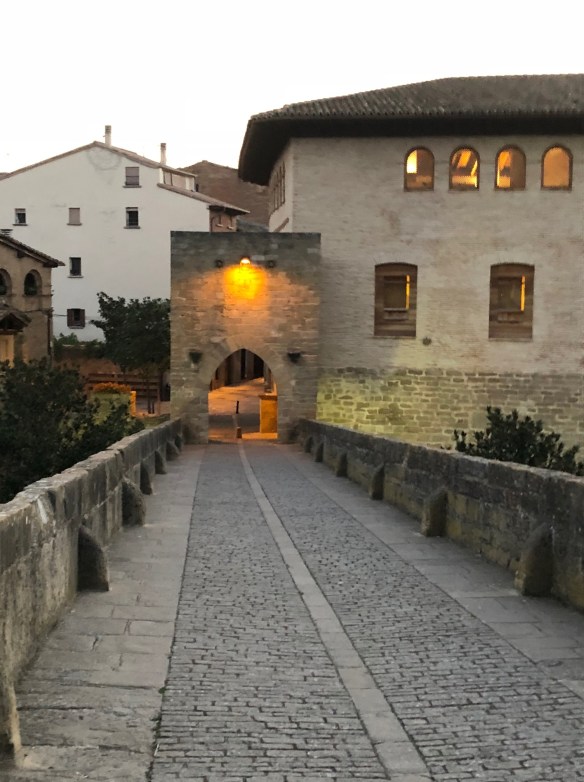
Entering Puente de la Reina

Sept. 18: Pamplona- 13 miles, six hours

It’s so hot! The path is narrow and we walk single file through all sorts of rocky terrain. Bamboo trees that seem 10 feet tall line the route for a while, then a forest. I feel as if I am melting and getting grumpy, but soon I find myself listening to the interesting stories that some pilgrims share with me; how a cowgirl from Nebraska met and married a Latin man from Texas while vacationing in Mexico, the woman from the California who spoke fluent French and lived in France for two years, working as a nanny and interpreter for a wealthy Lebanese family and  the woman who just retired from the army, after living all over the world.

We enter the old city over the historic drawbridge and head to our albergue, Plaza Catedral. Our cubicle has two bunk beds and a view of the garden. We meet our bunk mates from Denmark and Rumania and settle in. After we check out the Cathedral of Santa Maria la Real, some pilgrims wave us over to join them at an outdoor cafe across the street. We continue on to dinner with the merry group from Switzerland, Sweden, Taiwan, Denmark and make room for our Danish bunk mate that was dining alone.

Sept. 19: Puenta de la Reina- 14 miles, 7-1/2 hours

Another hot day! We start out through the city, but soon the path turns to loose rock and boulders. It takes all my concentration to navigate my steps and I feel as if I’m also cleaning out all the cobwebs in my brain. We climb to the top of Alta de Perdón in the midst of all the wind turbines.

We all take turns taking photos of each other at the famous iron sculpture of medieval pilgrims and stand on line to get a handmade wax passport stamp. A young, enterprising couple provide the stamp for free in exchange for our email, in order to send us information about their upcoming Camino documentary.

Sept. 20: Estella- 14 miles, six hours

The bad news: Spain shouldn’t be this hot in September, but the good news is that there is less loose rock. We walk through gently rolling farmlands and pass three hilltop villages. The fields carry with them an artistic quality; the perfect rows of plantings high up in the hills, the squared off sections of beiges and browns that look like suede in the sunlight and even the tractor’s treads leave behind their own ornamental quality.

We are very excited to have a private room at Hosteria de Curtidores. We are warmly greeted with a sample of local beer and our backpacks are carried up to our room. We learn that this area by the river was once the tannery center. The original stone walls of the city can still be viewed behind glass in the basement. First things first; we grab a washing machine and alert our friends to hurry and bring their laundry down and laugh that washing our underwear together is bringing us closer.

Rather than join a big group tonight, we opt for an inside taverna where it’s cool and quiet. We are dining alone when a young woman pilgrim asks for help with the menu. She is delighted when we ask her to join us. Since her husband is now stationed in Afghanistan, it seemed like a good time for her to walk the Camino. She did not want to walk by herself, so asked a friend to join her, never expecting that the friend would get hurt on Day One, stay behind and she would be on this journey alone. By the end of dinner, she realizes that she is only alone if she wants to be.

Sept. 21: Los Arcos- 14 miles, six hours

There is a big group already gathered at Fuente del Vino, drinking the free wine offered to pilgrims at the famous wine fountain spigot. It’s only 8:30 a.m., so we decide on a water toast instead, a photo and we’re on our way. Though the climbs are gentler today, there is no shade and the Powerade is refreshing in the relentless heat.

It’s hard to find a place to stay because of the car races this weekend. Even though it’s not our first (or second) choice, we are grateful to find a private room on the outskirts of town. Hostel Ezequiel does not have much personality and the Wi-Fi is not working, but the room is clean. Apologetic about the Wi-Fi, the receptionist says she will do our laundry and we hang it on the line outside to dry, laughing that we might just be one of the few pilgrims that have monogrammed clothespins, having put our initials on each one with marker.

Los Arcos is a bit of a lackluster town (the population is 1200 and decreasing), but the astonishing beauty of its church, the Inglesia de Santa Maria, makes up for it. The sumptuous interior from the 16th century, the bell tower and the cloisters were enough to actually make me gasp.

We find our friends from the U.S., Switzerland, Russia and Taiwan sitting outside the cathedral. The wonderful conversation continues through wine and then dinner, as we swap stories about our lives and our families. I fall asleep tonight wondering how I could feel so close to people that I’ve just only met.


Sept. 14 – 17: St. Jean Pied de Port, France to Zubieri, Spain

2214A6BD-5E3B-40D2-9DCA-ACA4F1B8F86F

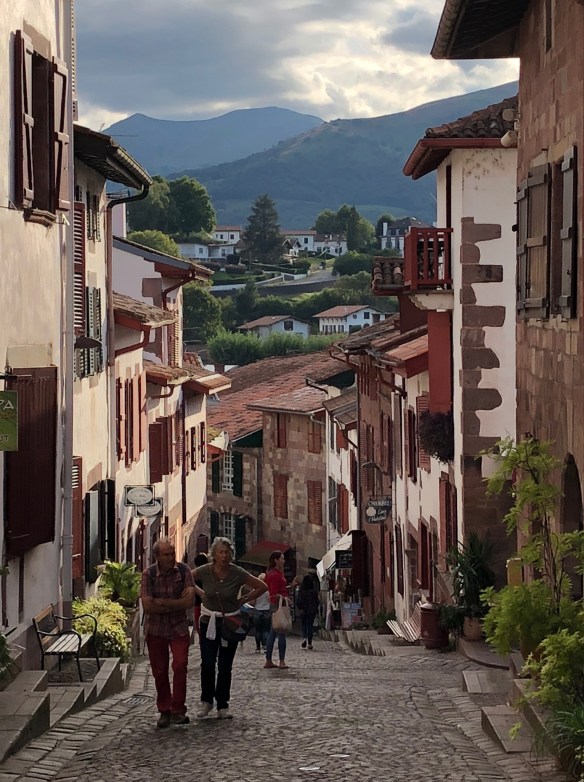
Main street – St. Jean Pied de Port, France

Sept. 14: St. Jean Pied de Port, France

This ancient capital of the Basque region nestled in the Pyrenees is a welcoming place to start, The storybook village is crowded with pilgrims from all over the world, excited to begin their adventure.

We stay at Beilari, one of the many albergues in town, except that this one comes with a recommendation. Albergues are hostels run exclusively for pilgrims, who show their pilgrim passport and receive a stamp (a lovely souvenir by the end of the trip).

All 22 guests are greeted warmly, settle in and later we all congregate around the long, wooden dining tables. Our host serves us a glass of port and asks us to introduce ourselves, say where we’re from and why we are doing the Camino. The group is from the U.S., France, Malta, Brazil and Australia and we immediately feel a deep connection to each other.

We set the table together as our host tells us that for this night only, we are a family and will share a home cooked meal together. Impressively, he repeats this all in English, French and Spanish and tells us that he plans to learn German during the offseason.

We are told not to set alarms and the next morning awaken to the sounds of a Gregorian chant. After sharing breakfast, we head out together on our first day.

Sept. 15: Orisson, France- 7 miles, three hours

It’s a strenous, uphill walk, so we plan to stop in the albergue in Orisson before continuing through the Pyrenees tomorrow.

We sit outside all afternoon, delighting in the travel stories from our newfound friends from the U.S., Switzerland and Australia, even though traveling through India on a motorcycle and hiking in Nepal are not on our bucket list.

Before dinner we are asked to, once again, introduce ourselves, which seems to give you as much insight into others as it does into yourself. I fall asleep wishing I could have given all 38 new members of my new one-night family a group hug.

Sept. 16:  Roncesvalles, Spain- 9 miles, five hours

This is so much better than our 2016 experience; it’s not raining, the trail is better and the rooms at the monastery have been renovated.

It’s a long, uphill climb, but the scenery is breathtaking and the only sound you can hear is the occasional cow bell. I have a sudden urge to run through the hills, twirling around and singing the words to “The Sound of Music,” but suddenly remember the Camino golden rule: never take an extra step that is not necessary.

There are two bunk beds to a cubicle and we are sharing it with a French couple that speak no English. My French friend and I soon find something we have in common; we both keep hitting our heads on the top bunk, laugh and high-five each other.

We enjoy another home cooked dinner, then a big group of us gather to toast a U.S. couple celebrating their 36th wedding anniversary.

Sept. 17: Zubieri- 14 miles, six hours

Of course, things could always be worse. Last time it rained, but now it’s hot and the shale, tree roots and loose rock make the path unrelentingly difficult as we trudge uphill and then descent, over and over again.

At our albergue Palo de Avellano, we meet an older couple who left from their front door in Germany and are now heading home.

Two Tylenol and one power nap later, I am ready for a glass of wine. At the bar, we are invited to join a woman from Holland sitting alone and then run into a couple from Texas.

At dinner, we’re seated next to five men from Denmark who met when they were 6 years old and travel together once a year. We laugh and talk, almost forgetting that it’s lights out at 10 p.m.