Oct. 30: Ribadiso – 18 miles
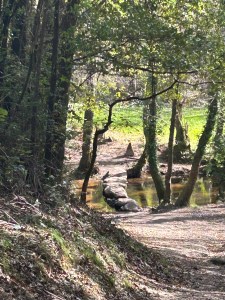
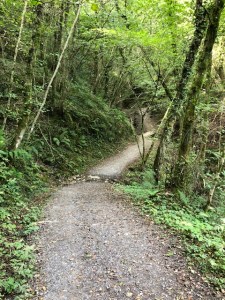
The wooded areas help mask the noisy highway we periodically cross. We are walking the usual mileage today, but for some reason, it seems much longer, and I am exhausted.
The only thing that keeps me going is running into the sweet New Zealand family, joining them for a Coke, and finishing the last few miles together. The mom has such a lovely, serene way about her. She is originally from Ireland and said that even though the people are friendly in the small town her husband grew up in, it’s so remote and she feels so distant from her family. Her frown turns into a smile as she shares that they plan to meet her sister in Rome after the Camino.
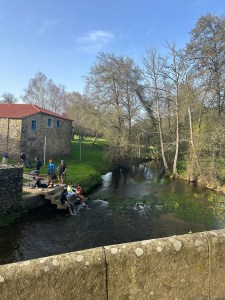
We arrive in Ribadiso and walk over the medieval bridge to the sound of pilgrims laughing and splashing in the river. We ask them if the water’s cold, and they all answer in unison with a resounding “Yes!”
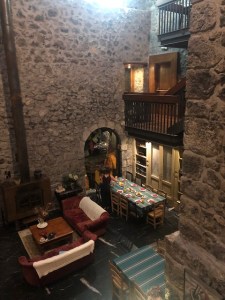
With its lovely pool, Pensión Ribadiso would be even nicer on a warmer day. The room is welcoming with its wood-beamed ceiling, and it’s wonderful to have a washer and dryer on the premises.
Luckily for us, there is a restaurant right across the street, so we don’t have to walk back up the hill. We meet a pilgrim from South America who confides in us that he’s not used to the early 8 p.m. dinners here in Spain. At home, he dines at 10 p.m.!
Oct 31: O Pedrouzo- 16 miles
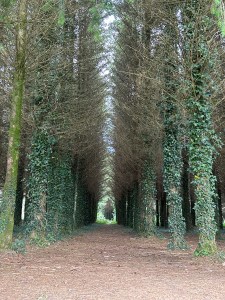
It’s better to get the steep climb out of the way early! From then on, we’re in and out of eucalyptus forests, and we take in the scent of eucalyptus with every breath. We’re getting to the end of our walk, and I’m hoping I have successfully cleaned out all the cobwebs in the corners of my brain. Chatting with strangers, you may or may not ever see again, has a magical quality. Walking and talking side by side, rather than facing each other, may explain why the words seem easier. Spending time walking alone is a wonderful gift to give yourself.
The town has a worn look to it. The sidewalks are full of shops and restaurants, trying hard to look their best. The streets are one loud cacophony of cars, trucks, and pilgrims. Pensión Residential Platas is not impressive, but it’s clean, and the young woman at the front desk has a warm smile.
We remembered our first time here in 2016. After walking in a torrential downpour, we were not looking forward to heading out again to dinner. When we returned downstairs, we noticed pilgrims eating in the breakfast room. They told us we could place an order at the local pizza place that would deliver. This time, we decide to seek out that same restaurant and celebrate that, for one evening, we are in a No (French) Fry Zone and order the same meal.
Nov. 1 – 3: Santiago – 15 miles
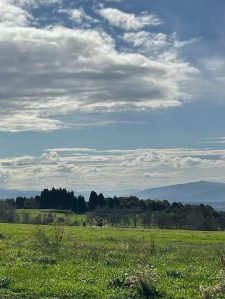
Walking through the forest is a lovely way to start the day. Its denseness makes us feel at peace,
As John Brierley eloquently states in his Camino guidebook “It’s a long slog up to Mount Goza.” An elevated area overlooking the city, it doesn’t have much to offer except for a few pilgrim sculptures and a view of the sprawling complex offering 400 beds in dormitory-style blockhouses.
We head downhill and down the stairs and are welcomed by asphalt. The city noise, the wide streets, and the traffic startle us. Some passersby on the street smile and give us a thumbs-up, as if to say, “Almost there, keep going!”
We are happy to find a restaurant serving Caldo Gallego. The restaurant is empty, but a few minutes later, large groups are seated around us, ready to enjoy a long, late afternoon lunch. The sounds of conversation and laughter make for good company.
In the distance, we can see the spires of the Cathedral, but we are not fooled into thinking we are close by. Block after block, we trudge on, gazing into non-descript store windows and focusing all our concentration on crossing the busy streets.
Finally, we come to “Porta do Camiño, the famous gate and entrance to the wonderful, old city. Almost immediately, the streets narrow and turn to cobblestone. Every shop and restaurant window intrigues us and we are brimming with anticipation.

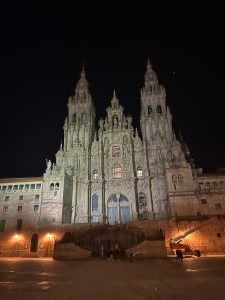
As we enter the dark tunnel, the familiar sound of the bagpiper welcomes us. Once again, we wonder -are musicians stationed there 24/7 to greet every pilgrim? Just a few more steps and we are in the Cathedral Plaza. While the majestic Cathedral sparkles overhead in the sunlight, pilgrims, mingled with tourists and townspeople, are crying, hugging, laughing, or too overwhelmed to do anything more than lay on the ground with their eyes closed.
This is our fourth time experiencing Santiago, but it never gets old. We hug and shed some tears; tears of joy for a successful arrival and tears of sadness for the trip coming to an end. We look up to see our friend, the solitary pilgrim from Colorado, running towards us.
With a tear-stained face, he tells us that, since he arrived in Santiago, he had seen everyone he had encountered along the way,, except us and now, here we were! He speaks happily and rapidly, nothing like the man we first met, and I am so happy for him and his newfound metamorphosis.
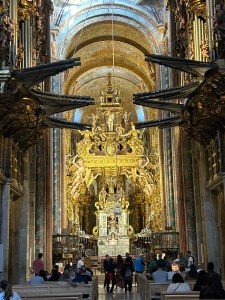
The Cathedral, a World UNESCO Heritage Site, was completed in 1211. Housing the remains of Saint James, it inspired pilgrimages, which ended at this iconic location. The highlight of the pilgrim mass is the Botafumiero. Six attendants dramatically swing it up and over the heads of the parishioners.
We take the time to view our favorite areas
- Stepping down into the crypt of Saint James and taking a minute to kneel and say a prayer.
- Visiting the Praza de Quintana, near the Cathedral, at night to view the shadow of a pilgrim projected on the wall, a trick of the lights reflecting off the square.
Unfortunately, you can now only view these areas from afar:
- The weathered spot in the solid marble – a finger hole – created by the millions of grateful pilgrims that touched the spot after a safe arrival.
- Touching our foreheads to the sculpture of Maestro Mateo, one of the Cathedral’s master builders, to receive some of his artistic genius.

The Hotel Rua Villar is an elegant townhouse, just steps from the Cathedral. Our room looks out to the main street, but there is nothing except a large terrace across from us, making it very private. I look forward to taking time each day to sit and write in their lovely library.
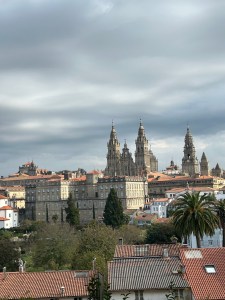
We head to the pilgrim office to obtain our Compostela, the Camino certificate of completion, and enjoy walking all over Santiago. As we stroll Old Town, Alameda Park, and the Mercado de Abastos food market, I wonder if we will see our pilgrim friends again.
Before we leave Santiago, we run into the Norwegian couple and the New Zealand family, tearfully hugging and reminiscing. I watch for the Australian couple, thinking I will see them any minute, but I never do. I wish I could’ve told them how wonderful it was to have met them. After stewing about it, I realize that time well spent was in that moment, and rather than worry about what was not, I should be grateful for what was.
As we prepare to depart Santiago, we have a big decision to make. Do we continue our Camino by walking to A Coruña, and Ferrol or travel by train and become tourists?


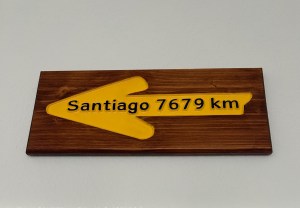 This sign shows the distance from Georgetown, Texas to Santiago de Compostela, Spain
 A Moxie Girl