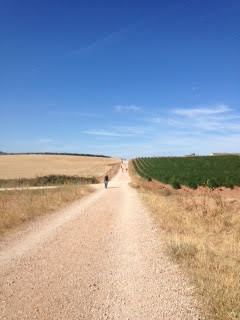
Sept. 24 – 27: Muros de Nalón to Luarca

Sept. 24: Muros de Nalón – 16 miles
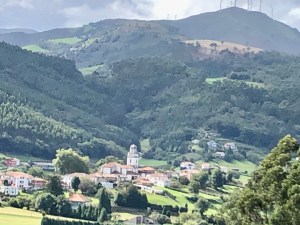
We breakfast with a couple from England and a man from Poland who left his front door in May and has been walking ever since! It’s a pleasant walk through villages and dirt trails in the forest…until the rain starts.

We find ourselves sloshing through mud and over rocks and gnarled tree roots.  Navigating puddles and trenches takes total concentration and we are laser focused for what seems like hours. I’m not sure what’s more slippery; the ascents or the descents. The rain seems to be enjoying the game it’s playing with us. Every time we get too warm and take off our rain jackets, it starts up again.

We welcome the drizzle and the change from muddy forest to road. We chat with a woman from the Netherlands who regales us with stories about each of her Camino adventures over the last ten years. It’s a League of Nations, as we stand at a crossroads with pilgrims from all different countries trying to ascertain the correct route. The yellow arrows and the shells posted along the way are our guides. At the start, the base of the shell pointed the correct way, but now they are displayed both ways!

Casa Carmina has not opened for the day yet, so we wait on a bench across the street with some other pilgrims. The mother/daughter owners are a well-oiled machine, welcoming us early out of the drizzle and getting us settled. Rather than a room of bunk beds, we opt for a private room at this albergue. The weather clears and we enjoy some wine, sitting outside on their lovely grounds. We chat with a young woman from the Netherlands, who started cycling from the northern most part of her country and plans to end up at the southern most point of Portugal. And to make it even more of an experience, she’s camping along the way!

Sept. 25: Soto de Lunas – 14 miles
Another difficult day awaits us! It’s a repeat of yesterday and we’re fixated on every muddy step, with steep ups and downs. In between, we are treated to peeks of the ocean and walks through small towns.

There’s a convivial gathering in the crowded bar and dining room as we enter Hotel Valle de Luiñas. We are welcomed warmly at this lovely rural inn and told our bags have not arrived yet. We had planned to enjoy Sunday dinner here, so we wash our faces and hands and quickly sit down. With our muddy pants and boots hidden under the white tablecloth, we decide we don’t look too bad from the waist up.

The first one in the shower each day is responsible for giving the shower report. Is it slippery? Which are the hot/cold faucets? Sometimes they are opposite.  Does it leak? I purposely let Michael go first today.

Sept. 26: Cadavedo – 16 miles
The good news: the hotel is right on the Camino path. The bad news: our guidebook rated yesterday a two in difficulty and rates today a three! Right away, we come to a long tunnel which is so dark, we can’t see a thing. By the light of our phones we walk cautiously, trying to ascertain the terrain.

By days end, we will have tackled five water crossings, each with its own unique characteristics. Whether we’re balancing from rock to slick rock, deciding the sturdiest place to step on a tree root or wondering if it’s best to go straight through or around the perimeter, we can count on our our hiking poles to get us to the other side. The narrow path that follows takes us up a steep incline, but the view of the ocean at the top makes it all worthwhile.

We’re so happy to have arrived that we don’t mind climbing the grand staircase at Hotel Rural Casa Roja, a charming renovated country home. We never tire of the stone walls and beamed ceilings that these places all have in common. It’s not much of a town, but with lovely sitting areas, inside and out, we make sure to take advantage of both. But, not before buying a bottle of wine at the market conveniently located across the street.

Sept. 27: Luarca – 11 miles
We begin with jackets on, only to take them off a few minutes later. There’s no rain in the forecast, the temperature quickly rises from the 60’s to the 70’s and it’s cloudy; perfect for walking.

The forest path is steep, but surprisingly dry. The makeshift steps, made up of twisted tree roots and rocks, force us to contemplate every step, but rather than tiring me out, it leaves me with a peaceful feeling. Walking through the small farm towns is a welcome pleasure. The old stone dwellings that look as if they’ve seen better days seem to be magically transformed into homes with just the addition of their blooming flower boxes.

Luarca is an older seaside town. What makes it unique are the white homes balancing on the cliffs that encircle the Bay of Biscay. I am fascinated to see how they are connected and still standing! The streets are so incredibly steep, I wonder how they get around on icy/snowy days. Meanwhile, two “señoras” (older women) are arm in arm, talking and laughing, as they bypass us and make their way quickly down the street!

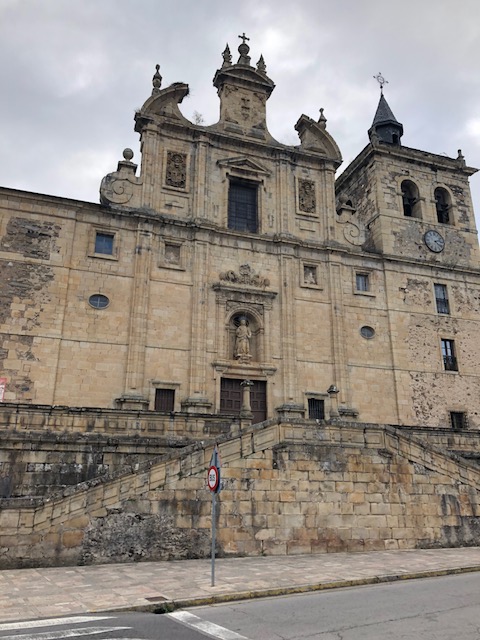
Built in 1906, the Hotel Villa de Luarca was a residence and our room looks out to a lovely little courtyard filled with flowers. Most towns close up in the late afternoon and as soon as they reopen again for the evening, the bars, restaurants and plazas quickly all come alive. After a quick walking tour of the historic quarter after dinner, it’s time for these two peregrinos to call  it a night.

Sept. 17 – 23: Gijón to Aviles

Sept. 17 – 22: Gijón
When we detect some swelling in his foot, we realize Michael’s blisters are still an issue. We decide to take a longer break and bus to Gijón. One of Spain’s largest cities, it’s double the size of Santander and another urban beach/lively promenade town. If you have to rest, this seems like just the place. The Hotel Hernan Cortés is a bit older, but has the lovely patina of a time gone by and is in a great location. 

Not wanting to walk too far, we notice people sitting on a stone wall with drinks, waiting for a band to begin to play. It’s a lovely spot with a view of the harbor, but we opt for a table instead. Just when I’m wondering what I can do to cheer Michael up, the band’s van pulls up right in front of us:             

We have a good laugh at the band’s name and from then on, it seems as if, once again, The Camino Provides, bringing the amusement right to us, so we don’t have to walk far. First, there’s the Asturias Cheese Festival (the province we’re in) with plenty of tastes. Then, a street demonstration of gladiator techniques performed by men in costume. Impromptu street parades and the sound of bagpipes are everywhere. Sitting on a bench and people watching on the promenade is a favorite Spanish pastime.

On Sundays, the stores are closed, but the plaza is lively, full of friends and families gathering together. It’s baptism day at the church we’re sitting outside of and we watch as families, dressed in their finest, visit and take photos of their beautiful babies. 

We walk on the beach, hoping the salt water will help heal Michael’s foot. I bury his feet in the cool sand, telling him it’s an old Spanish tradition. I can’t determine if the water’s too cold, but the waves always decide for me, knocking me over and tossing me around until I’m all salty, sandy and happy. With eyes closed, we lay on the beach breathing in the salty air. In the distance, we hear a flamenco guitarist playing alongside the sound of the crashing waves. I come up with a new mantra: “Monta las olas” (Ride the waves).

We are able to take advantage of the Menu Del Dia served from 1 – 4 p.m., rather than waiting for dinner, which doesn’t start until 8 p.m. For anywhere from €12€ – €19. it includes three courses, bread, water and a half bottle of wine, per person (usually you are charged for bread and water). My favorite is Fabada, a stew made of beans, Spanish sausage, potatoes and kale. Michael loves the Bacalao Viscaina, salted codfish stew cooked in tomatoes. While we pass so many homes with gardens each day, vegetables are rarely seen on menus, so we usually order a Salada Mixta, a big salad served with tuna. 

One of the more unique restaurants we dine in is called Toro. It’s an upscale Japanese all-you-can-eat restaurant. For €14 you can choose from 100 small plates. You  check off your choices on a form and hand it to the waiter, with one caveat: you will be charged €3f for every plate that you don’t finish! 

Michael has been wearing his boots a portion of each day and the insoles he bought have really helped. He says he’s ready to go again! On our last night, I make a toast: “Para sus ampollas!” (to your blisters!). If it wasn’t for them, we wouldn’t have gotten to know beautiful Gijón. 

Sept. 23: Aviles – 18 miles
The long walk out of Gijón reminds me what a large city it really is. The route through an industrial area is is anything but scenic. The sounds of the pebbles crunching under our shoes and the cars on the nearby expressway have a certain rhythm that becomes the background to my thoughts.

The dilapidated stone buildings on the farm road we’re walking on don’t look inhabited, until I notice their TV antennas and electricity connections. In the middle of nowhere, we come upon a basket of broken tiles and markers The mountain of tiles has been created by Pilgrims, who have left a tribute to someone they are thinking of/praying for; very touching. 

Luckily, there’s a wide shoulder on the road we’re walking on and it finally leads us into town. It’s is so old and unattractive, until we turn the corner. The plaza is a registered historic district and the best preserved in the region. It looks like a movie set! 

The Hotel 40 Nudos is older and quite plain, with very clean rooms. It becomes one of our favorites when they serve us complimentary tapas with our wine- a treat for hungry pilgrims counting the minutes until 8 p.m. 

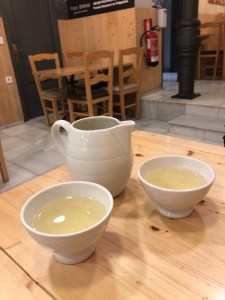
We dine at a pulperia and choose to have our octopus grilled, rather than boiled- it’s delicious! In the province of Galicia, the octopus is revered. Everything stops in order to celebrate everything octopus at their annual Pulperia Festival. We order a “jarra” (pitcher) of Galician wine served from a tap and realize we better forgo our usual toast and use two hands to pick up our bowls/glasses.

Sept. 8 – 12: Guernica to Castro Urdiales

Sept. 8: Guernica- 17 miles
Today we walk in rural countryside through forests and alongside flowing streams. It’s very hilly, but the sound of the rushing water is soothing and a stop at the the Zenarruza monastery provides a cool, peaceful place to rest.

We are heading towards what we think is the hotel, but once again, there is no signage. It’s been a long walk through the town and we’re hot, tired and very grateful to have arrived at Hotel Gernika. The classic hotel has an air of old world elegance and air conditioning! After showering, we enjoy a glass of wine in their beautiful solarium and wonder how we will be able to handle U.S. prices for a glass of wine, when we return, after paying anywhere from €1.60 to €3 here (exchange rate to U.S. dollar is almost equal).

Guernica is considered the spiritual center of the Basque Country and was the site of the aerial bombings of its civilians in 1937 during the Spanish Civil War. In downtown Guernica, large black and white blowups of photos of the damaged city are front and center, serving as a reminder of the atrocities on that memorable day.

Sept. 9 – 10: Bilbao- 19 miles
From the city streets, we quickly find ourselves on an intense, narrow path through the woods. The ascents and descents are much more treacherous due to the slippery wet rocks and the mud. For miles, the smell of the eucalyptus trees is our only comfort and the only sound we can hear is our heavy breathing.

It wasn’t easy to find a mid price hotel in such a big city, so we splurge and stay at the Hotel Abando. Unlike all the other hotels to date, the staff hardly looks up when we arrive, is not very welcoming and is no help at all in finding us a laundromat. We are so happy to hear from our Danish friend, with an invitation to try a restaurant that has been recommended to him, we forget about our hotel experience. Our new mantra is “Es lo que es,”- it is what it is.

We spend most of our rest day at the Guggenheim Museum. Designed by Frank Gehry, its cutting edge design also reflects in its modern art exhibits. The main exhibit entitled “Motion- Autos, Art, Architecture” celebrates forty of the most distinctive cars in relation to beauty, rarity and technical progress. My favorite part of the exhibit is a vision of the future of cities presented by a number of universities from across the world.


Sept. 11: Santurzi – 12-1/2 miles
The bad news: today’s walk is along a river, industrial areas and rundown towns. The good news: it’s all flat! Not having to worry about every step you take gives us more time to a relax and think.

As we enter Santurzi, the juxtaposition of the two sides of the city is startling. The old neighborhoods we’re walking through transcend into a couple of blocks of modern condos and lovely mansions before our eyes.

The UHR Palacio de Orio is magnificent, but we’re disappointed the rooms are rather plain. We take some time to explore its nooks and crannies and imagine it in its heyday.

Sept. 12: Castro Urdiales- 18-1/2 miles
The city streets soon lead to a walking/bike path. There’s not much to see, but we’re grateful it’s flat…for now. We follow the yellow arrows (the official Camino way markings) past a very unusual site; cows grazing on a vertical pasture so steep that it appears they are hanging on with their hooves. This keeps us entertained until we arrive on a boardwalk that follows along the Atlantic Ocean, the crashing waves lulling us into a walking rhythm. Then, it’s up 120 stone steps and then we’re looking down at the ocean.

We follow a shortcut to the road. Luckily, there’s little traffic and a small shoulder we can walk on, single file. The gas station we stop at does not sell water, but a kind gentleman hears our plight and insists we take his cold bottle of water. They say the Camino provides and today we are blessed with more than one example.

We’re all set to walk the short distance to our hotel. Our app says only one and a half miles, but it also says it will take 43 minutes. What?! We’re done! We stop at a bar, order two beers and ask the bartender to please call a taxi, while we sit outside and wait. A few minutes later, she runs out to tell us a bus will be arriving in three minutes right down then block that can take us. With stealth like precision, we dump the water out of our water bottles, fill them with beer and run for the bus.

It takes me a minute or two to realize that all the passengers at the front of the bus are discussing where our hotel is and where we should get off. We are told to exit, thank everyone and are escorted by a woman passenger, who insists on walking us to our destination, after her long shift at as a waitress. We part company, but not after hugs all around.

Castro Urdiales is a popular seaside resort on the Bay of Biscay. The Las Rocas Playa Hotel’s large windows frame the lovely white stucco, red tiled roofed homes that line the street to the beach, mostly second homes. The hotel’s tranquil ivory and beige color scheme reminds us that our walking for the day is almost done. Just a quick visit to the beach (with just enough time to get our legs wet), then we’re enjoying dinner in their dining room, looking out those big windows and wishing we could stay just a bit longer.


Oct. 4 – 6: Rabanal del Camino to Villafranca del Bierzo

78487E87-9F8B-469F-9252-C5F2B88529CE

San Nicholas Real Monastery

Oct. 4: Rabanal del Camino- 13 miles, five hours

I prayed, practiced positive thinking and E.F.T. (the psychological form of acupuncture) and even had a long talk with my right knee, but she was stubborn. She had no intention of healing until she was ready. And, in 10 days as quickly as it happened, my knee miraculously healed.

I am so happy that I think even the scruffy brush we are walking through is beautiful. In the quiet of the morning, I find myself hypnotized by the mosaic patterns on the hard ground made by the grids of the many boot soles that have passed here before me (over 300,000 completed the Camino in 2017). I look up to notice that the earth is such a beautiful copper color it looks as if it’s been painted. It’s a fairly flat path, so I amuse myself by wondering what is behind the ancient stone buildings (some thousands of years old), with majestic wooden doors. Are the homes beautiful and modern inside? Or, does the outside reflect the inside?

The front door of the Hotel Rural Casa Indie opens to a courtyard and all the rooms encircle it. The room’s French doors and beamed ceilings give the rustic feel we expected, but the old wooden floor planks are so uneven that a trip to the bathroom in the dark will be an adventure.

Before dinner, we head to the church for Latin Vespers led by the Benedictine monks. It is beautiful in its simplicity. The original stone on the barrel-vaulted ceilings and the walls peeks out from ancient paint. When the lights are turned off, the crucifix on the wall behind the altar, lit from above, has an even more dramatic presence. One of the monks walks around the pews and blesses us all with holy water. Afterward, we greet one of the monks who speaks English and he is so pleased to hear that we enjoyed the experience.

Oct. 5: Molinaseca: 16 miles, eight hours

What a lovely way to start the day; first watching the sun rise as we are walking, then being serenaded by a young pilgrim, who has carried his guitar with him every step of the way.

We’re on dirt roads most of the day, which narrow and widen as we walk. My favorite are the narrowest parts, when only one person can barely fit and the trees envelop you.

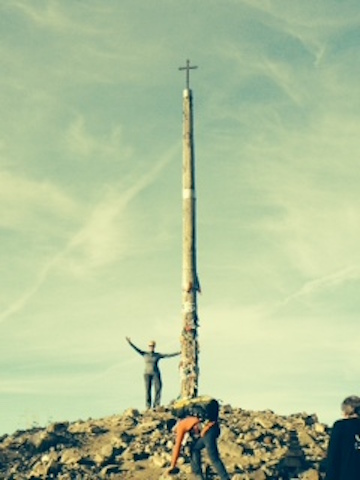
The closer we get to Alto Altar, the highest point of our entire journey (4550 feet) and Cruz de Farro, the more emotional I become. The plain metal cross stands on a mountain of stones like a beacon to pilgrims. Two days ago, I could barely walk from my bed to the bathroom and now I am almost there, ready to fulfill one of the highlights of our journey. We’ve brought two rocks from home and wrote the names of two special people who are very dear to us. We find just the right spot, wipe our tears off them, say a prayer, then nestle them in among the many other rocks. The ancient legend is that by leaving the stones behind, you are turning over your burdens to God.

The steep inclines and descents seem as if they will never end. Between the loose rock and shale, horse and cow manure and chestnuts in shells that resemble Nerf balls (except that these are covered in needles), you have no choice but to stay focused. I while away the time by thinking of the salad I am hoping to find for lunch. We turn the corner and come upon the cafe where we had the best salad of our 2016 trip. The husband and wife owners are so pleased we have returned and tell us we have made their day.

We quickly settle in at Hostal el Palacio so we can sit outside and have a glass of wine with a view of the river, the bridge and the mountains. The lovely old stone building houses rooms that are a combination of Old World and modern.

We take a walk around town and agree that the town looks like a movie set; the old stone buildings and street lights are all from a time gone by. Four teenage girls sitting on a bench with their iPhones and the Mercedes that cruises by look totally out of place.

Oct. 6: Villafranca del Bierzo: 19 miles, eight hours

It’s better that I didn’t realize beforehand that this would be our longest walk of the Camino. Luckily, it’s in the 70s (great walking weather) and the path starts out fairly flat. A walk through a neighborhood of mansions is particularly entertaining.

It seems as if we are walking up and down through vineyards for miles and miles. All of a sudden, dark clouds sweep over us, the wind picks up and it starts to rain. We already have our rain gear on, so there’s nothing else to do but take turns singing Broadway show tunes to pass the time on this unending path.

Villafranca del Bierzo (population 3500) traces its origins back to the year 791. The village flourished during the Middle Ages as an important resting spot before the mountains of Galicia for pilgrims on the Camino and still provides that same service all these years later.

Of all the days, we need to walk through the entire town to get to where we are staying: the San Nicholas Real Monastery. The sheer magnitude of the building is overwhelming. Built in the 17th century in the Baroque style, the courtyard and cloisters would be lovely to visit on a nicer day. Our room is small and all white with some basic wooden furniture, but it’s clean and the window shutters open to reveal a view of the town.

As we head up to our room, we are surprised to see our friend from Arizona. We catch up and promise to keep in touch, hoping we can plan to meet up again.

After such a long day, we agree that we will not venture out this evening. We are the only ones in the dining room and admire the frescoes on the wall and the vaulted ceilings. Enjoying dinner in our private dining room to the sound of a Gregorian chant playing softly in the background, this may not be the best menu del dia we’ve ever had, but tonight it sure seems like it is.


Sept. 28 – 30: Leòn

B09A1720-0F84-4A10-9300-284EF1B37F4D

Sept. 28

We walk into town together and our Arizona pilgrim friend bids us farewell as he heads to his albergue.

We stayed at Hostal Aldo Cosco Antiqua in 2016 and I remember the wooden beams on the room’s ceiling, the windows that open to overlook a cobblestone street and the lower level’s glass topped flooring with a view to the old city’s stone beginnings.

Before we can decide where to dine, we receive a text from a pilgrim couple from Delaware that we had met early on. They’ve also just arrived and we plan to meet for dinner.

Tonight, the city’s cobblestone streets are packed with young and old revelers. A line snakes down the block to get into the cathedral for a free organ concert, a band plays electric violin and bagpipe music from a stage and there is a feeling of such gaiety in the air.

Sept. 29

My sister, a nurse and JC* (who we all thought should have gone to medical school) agree with the manager of our Burgos hotel who took one look at me and had diagnosed me as having tendinitis. A few minutes later, Google has provided me with a definition and YouTube has taught me some Pilates movements especially for knee issues; fingers crossed that this is the key.

Today, the city is celebrating La Leyenda de los Cien Doncellas (The Legend of the 100 Maidens), which explains the procession of women dressed in beautiful medieval garb. The Arab dancing, sword battle re-enactment and medieval music complete with bagpipes helps to recount the story of the time when Spain was under Muslim rule. A despot seized control of Spain and in exchange for less tyranny, demanded that 100 women be added to his harem. The women revolted and with the help of the army led by the apostle Santiago, Spain was freed.

In the midst of the vibrant music and the throngs of jubilant merrymakers, the Arizona pilgrim we met on arrival comes to mind. I sensed a sadness about him. Is he all alone this evening? Could he use a friend? I call out his name under my breath and scour the streets, hoping that if he is out there, we will somehow run into him.

Sept. 30

The celebration continues with the Fiesta de San Froilàn  (St. Froilàn). Colorful banners line the plaza, as donkeys lead colorfully decorated carts down the square. Every street is crowded, either with shoppers eyeing the merchandise for sale under the many tents or with the customers overflowing out of every bar and cafe into the street.

It appears that no one has stayed home. The sight of generations of family members enjoying each others company is heartwarming.


*Who’s who? See “Cast of Characters” on the “About” page


Sept. 18 – 21: Pamplona to Los Arcos

25B11C32-D00B-4B7B-AF0A-F22CC144AF35

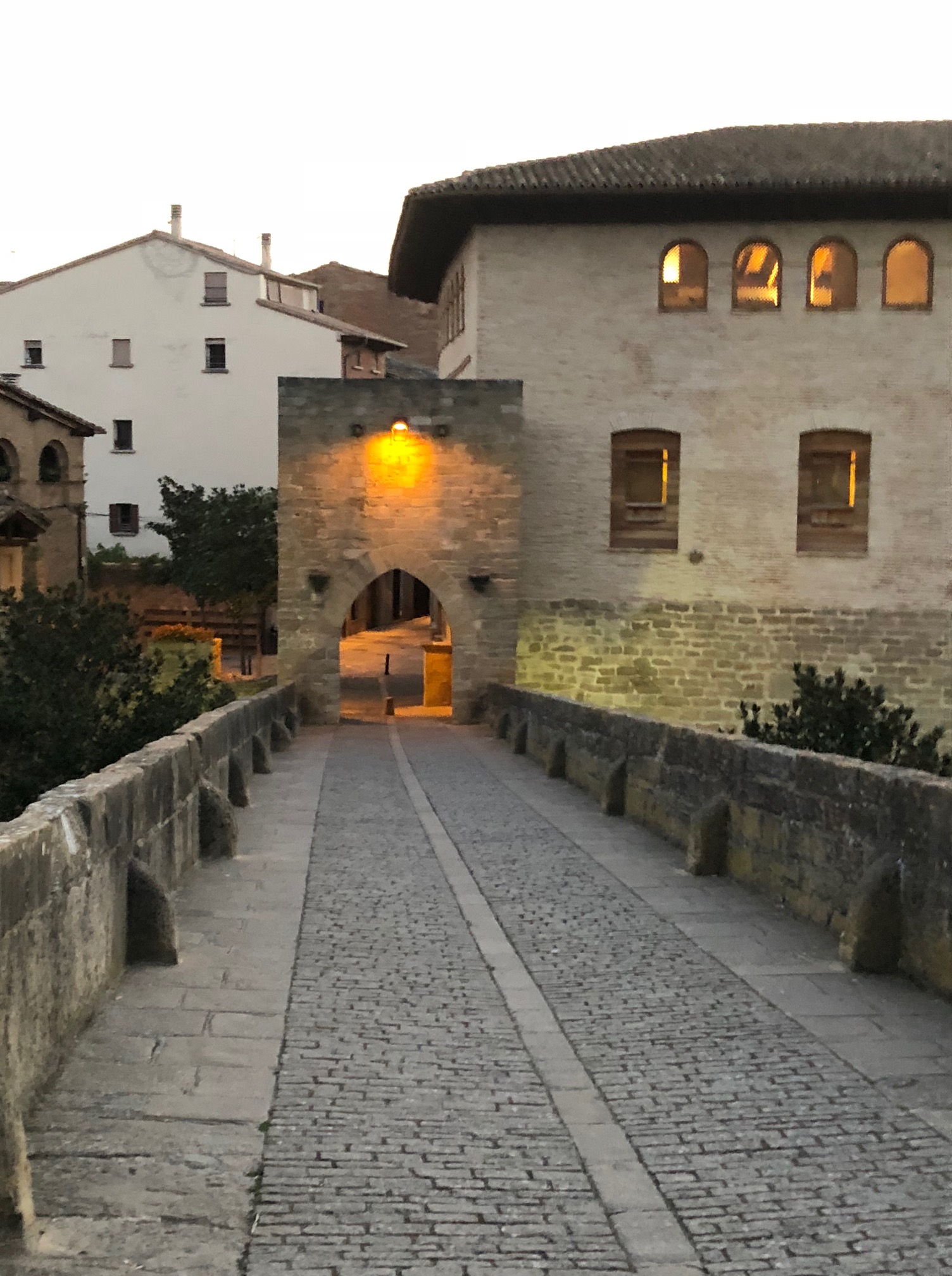
Entering Puente de la Reina

Sept. 18: Pamplona- 13 miles, six hours

It’s so hot! The path is narrow and we walk single file through all sorts of rocky terrain. Bamboo trees that seem 10 feet tall line the route for a while, then a forest. I feel as if I am melting and getting grumpy, but soon I find myself listening to the interesting stories that some pilgrims share with me; how a cowgirl from Nebraska met and married a Latin man from Texas while vacationing in Mexico, the woman from the California who spoke fluent French and lived in France for two years, working as a nanny and interpreter for a wealthy Lebanese family and  the woman who just retired from the army, after living all over the world.

We enter the old city over the historic drawbridge and head to our albergue, Plaza Catedral. Our cubicle has two bunk beds and a view of the garden. We meet our bunk mates from Denmark and Rumania and settle in. After we check out the Cathedral of Santa Maria la Real, some pilgrims wave us over to join them at an outdoor cafe across the street. We continue on to dinner with the merry group from Switzerland, Sweden, Taiwan, Denmark and make room for our Danish bunk mate that was dining alone.

Sept. 19: Puenta de la Reina- 14 miles, 7-1/2 hours

Another hot day! We start out through the city, but soon the path turns to loose rock and boulders. It takes all my concentration to navigate my steps and I feel as if I’m also cleaning out all the cobwebs in my brain. We climb to the top of Alta de Perdón in the midst of all the wind turbines.

We all take turns taking photos of each other at the famous iron sculpture of medieval pilgrims and stand on line to get a handmade wax passport stamp. A young, enterprising couple provide the stamp for free in exchange for our email, in order to send us information about their upcoming Camino documentary.

Sept. 20: Estella- 14 miles, six hours

The bad news: Spain shouldn’t be this hot in September, but the good news is that there is less loose rock. We walk through gently rolling farmlands and pass three hilltop villages. The fields carry with them an artistic quality; the perfect rows of plantings high up in the hills, the squared off sections of beiges and browns that look like suede in the sunlight and even the tractor’s treads leave behind their own ornamental quality.

We are very excited to have a private room at Hosteria de Curtidores. We are warmly greeted with a sample of local beer and our backpacks are carried up to our room. We learn that this area by the river was once the tannery center. The original stone walls of the city can still be viewed behind glass in the basement. First things first; we grab a washing machine and alert our friends to hurry and bring their laundry down and laugh that washing our underwear together is bringing us closer.

Rather than join a big group tonight, we opt for an inside taverna where it’s cool and quiet. We are dining alone when a young woman pilgrim asks for help with the menu. She is delighted when we ask her to join us. Since her husband is now stationed in Afghanistan, it seemed like a good time for her to walk the Camino. She did not want to walk by herself, so asked a friend to join her, never expecting that the friend would get hurt on Day One, stay behind and she would be on this journey alone. By the end of dinner, she realizes that she is only alone if she wants to be.

Sept. 21: Los Arcos- 14 miles, six hours

There is a big group already gathered at Fuente del Vino, drinking the free wine offered to pilgrims at the famous wine fountain spigot. It’s only 8:30 a.m., so we decide on a water toast instead, a photo and we’re on our way. Though the climbs are gentler today, there is no shade and the Powerade is refreshing in the relentless heat.

It’s hard to find a place to stay because of the car races this weekend. Even though it’s not our first (or second) choice, we are grateful to find a private room on the outskirts of town. Hostel Ezequiel does not have much personality and the Wi-Fi is not working, but the room is clean. Apologetic about the Wi-Fi, the receptionist says she will do our laundry and we hang it on the line outside to dry, laughing that we might just be one of the few pilgrims that have monogrammed clothespins, having put our initials on each one with marker.

Los Arcos is a bit of a lackluster town (the population is 1200 and decreasing), but the astonishing beauty of its church, the Inglesia de Santa Maria, makes up for it. The sumptuous interior from the 16th century, the bell tower and the cloisters were enough to actually make me gasp.

We find our friends from the U.S., Switzerland, Russia and Taiwan sitting outside the cathedral. The wonderful conversation continues through wine and then dinner, as we swap stories about our lives and our families. I fall asleep tonight wondering how I could feel so close to people that I’ve just only met.


The Camino, the Dog and the Girl

Photo Camino Dog

I wondered why she needed a service dog, but it’s not something you ask someone. On the Camino, dogs were a novelty. He was the star of the show, receiving so much attention. Head down and the ever-present cigarette between her fingers, she remained out of the spotlight, answering every question about him with as few words as possible. She was petite and cute, but there was a toughness about her that told you that this was someone you did not want to mess with. When she did look up, I noticed that she seldom smiled and her eyes were devoid of any sparkle. They were hauntingly dark and piercing, as if they held secrets that were not discussed in polite company.

We seemed to be on a similar pace and ran into each other almost daily. I made sure that I greeted her every day with a smile and a quick “Hola” or “Buenos Dias” so as not to interfere with her solitude. While others around her were sometimes talking and laughing together, she and her dog always walked alone. He was her best friend and the way they interacted brought a tear to my eye.

One morning, I noticed that the dog was walking right next to an older woman, rather than his master. Out of character for the girl, she asked the older woman if she was feeling all right. Without too much explanation, she briefly mentioned that her dog was able to sense low blood sugar in humans through his sense of smell. The woman brushed it off, thanked her and continued on.

When I saw her the next morning, I asked about the older woman after my usual morning greeting. I was surprised that she actually seemed to want to respond and spoke with more emotion in her voice than I had ever heard before. Luckily, the woman was staying at the same albergue (hostel) as she and her dog. As soon as the older woman sat down on her bed, she passed out. Realizing that the dog’s diagnosis was correct, the girl was able to get help for her immediately and, by dinner time, the woman was feeling better. Another example of how the Camino provides.

Our relationship reverted back to my daily one word acknowledgments until one evening the following week. I was sitting outside at a café, enjoying a glass of red wine and she asked if she could join me. Startled, I agreed and hoped that we would not suffer those long pauses of discomfort when conversation does not come naturally.

I can’t recall what actually happened next. I may have commented about the day’s terrain, but all I remember is that she started to speak. And when she did, the words came like an avalanche; spilling out of her so rapidly. It was as if they had filled her up, swelled to capacity and finally exploded. She hardly seemed to breathe as she told a captivating story of her life: the military, a college education, promotions, Iran, Iraq, Afghanistan, Post-Traumatic Stress Disorder (PTSD), an honorable discharge, her service dog, the Camino.

I was lost in her words, my mind racing to keep up with her story. It took all I had in me to not interrupt. I had so many questions, but this was her moment. What if digging deeper put her over the edge?

When she abruptly stopped speaking and took a deep breath, we just looked at each other for a moment. She looked different; her posture seemed less rigid, her expression was softer. I was unsure of what to say, but when the jovial group of pilgrims that I was to meet there joined us, she hurriedly said her goodbyes and she and her dog left.

A few days went by and I wondered why I had not run into her. I was glad to see her the following day, smiled and gave my usual greeting, but she did not smile back. “…I have to leave…” was all she said in a flat tone. She explained that the pads of her dog’s feet were scraped and bleeding and he couldn’t walk anymore. She had tried ointments, but nothing had worked. She knew he would stand by her side regardless and just keep going, but this was the right thing to do. She was confident they would return next year and pick up where they had left off.

She then put one finger on my arm and whispered “…Thank you, my friend…” I returned the one finger touch and replied softly “…Buen Camino…” It was the first thing that came to mind, but I meant it in the bigger sense. I had so much more I wanted to say, but at that particular moment, words did not seem appropriate. For her that small gesture of intimacy was at the same level as the “Heimlich Hugs” that my Spanish grandmother was famous for and I knew I would always cherish the fact that she chose me to share it with.

She and her dog were gone the next day. Unlike others you might meet and connect with along the Camino, we did not exchange contact information. I thought about her a lot. I wondered why I had been chosen to be the one to interact with her. In this brief relationship, who was the student and who was the teacher? Just as in the military, I questioned if the Camino was breaking me down and rebuilding me from the bottom up in order to make me a better person.

For days, I would hear pilgrims say out loud “…Hey, where’s the dog?..” and I would answer that they went home, each time hoping to myself that they would find a place in the world to call home and that that there would be another arm for her to put her one finger on.


The Lure of the Camino

Photo Lure Camino

Dale! (Spanish for “let’s do it!”). It was one year ago that Mr. Wiz* and I said those words to each other and left Saint Jean Pied de Port, France to hike over the Pyrenees and the 500-mile route to Santiago, Spain.

Since the 11th century, pilgrims have followed the Way of St. James to the Cathedral of Santiago, where his remains are said to be buried. For a time, its popularity waned until the movie The Way was released in 2011. Starring Martin Sheen and written and directed by Emilio Estevez, the father/son team reintroduced the Camino and are greatly responsible for its revival and the over 250,000 people from all over the world that traveled its routes in 2016 by hiking, biking or horseback.

The French route that we traveled is the most popular, but there are many others throughout Europe that all end in Santiago. Tradition dictates that it is “your Camino”; you travel each day as long as you would like, stopping at an albergue (a pilgrim hostel), five-star hotel or anything in between. You need not make the journey all at once, but in order to obtain a Compostela (certificate of completion), you need to have walked at least 100km (200km by bike) to Santiago and have had your Credencial (pilgrim passport) stamped along the way.

Your travels take you through small and large towns, fields, orchards, mountains and the flat plains of the meseta. There is a physical, mental and spiritual component to the journey that seems to be dictated by your location and the terrain. Many have also experienced a mystical aspect, seeing firsthand how “the Camino provides.”

Now, imagine all of this while sharing it with people from all over the world. As you walk each day, wishing each passerby “Buen Camino” (a good walk), can result in everything from a smile to hours of heartfelt conversation. Every 24 hours, relationships are made and lost, as people walk ahead and then catch up to each other (which usually results in lots of hugs and a celebratory glass of wine).

As each day ended, I found myself overcome with emotion, reliving all the details that made that day like no other. A simple gesture, a chance encounter, a small town on such a large world stage; there was such beauty in the incongruity of it all.

One year later, I still feel its effects on me almost daily. I now try to focus on the present, listen more and go with the flow. I have a newfound respect for the uncomplicated aspects of a simpler life. I seem to be more curious, inquisitive and adventurous. Solitude has become as important to me as socializing. Meeting other pilgrims and sharing our common bond has been invigorating.

Who would think that just putting one foot in front of the other would set me off in a new direction and lead me to a new way of life.


*Who’s who? See “Cast of Characters” on the “About” page

Five Life Lessons in 500 Miles: What the Camino Taught Me

Image


Photo Cruz 2

This year, I walked 500 miles through Spain and became a Peregrino, (a pilgrim). I, like the more than 250,000 people from all over the world that are drawn there each year, walked (or biked) to the Shrine of the Apostle Saint James in northern Spain’s medieval city of Santiago de Compostela. The routes, known as “caminos” or ways, originate all over Europe. We traveled the same paths as those did thousands of years before us for the same reasons (spiritual, mental, physical) and with little change.

It is said that “the Camino provides.” One of its gifts was the simplicity of each day. As you trekked through each small town, you were reminded of the beauty of an uncomplicated life. After 33 days of being “unplugged” from the usual stimuli of our daily lives, my minds was clear and open, a freedom seldom experienced.

Whether I was enjoying the camaraderie of other pilgrims or the solitude of walking alone, my days were filled with time for sharing thoughts with others or with myself. I returned home with the unexpected souvenirs of some lessons learned and a new way to live life: 

  1. Focus on one step at a time: Rather than waking up each day and thinking of the 12 – 20 miles of inclines and descents ahead, it was important to concentrate on your footing. Likewise, giving my attention to smaller goals rather than the big picture, will keep me on track and not leave me feeling overwhelmed.
  2. Listen more: I was so captivated by the life stories of the other pilgrims that I found myself listening, really listening to what they had to say. In the quiet moments, I paid more attention to the sounds of nature. I was even more attuned to what I was thinking and feeling. Now, when I have the inclination to interrupt in order to get a word in, rush through a day or disregard myself, I will instead try to remember to savor the moment.
  3. Go with the flow: A day of torrential downpours, a missed turn, dirty clothes and a broken washer and dryer; the day’s trials were nothing that a laugh over a glass of wine with some other pilgrims couldn’t fix. I have trouble “winging it” and always prefer the flow to be pre-planned. I now realize that I need to loosen up and enjoy the ride.
  4. Be open: This was an amazing opportunity to meet people from all over the world and realize that even though they may look, speak or act differently, we basically are all the same. Rather than shying away from those that are different from I am, I will make an effort to be more receptive and try to let my curiosity lead the way to new experiences.
  5. Be grateful: Living so simply for a month, slowing down and watching the small details of life go by opened my eyes to what really matters: health, happiness, family and friends. I will remember to start each day being thankful for what I have, work at giving back in some way and try to cling to as much simplicity as I can.


Pictured: The Cruz de Farro (Iron Cross) near Rabanal
Pilgrims bring a stone from home and carry it on their journey to symbolize the spiritual, mental and physical aspects of their lives that are weighing them down. When you leave the stone behind, it is said you are ridding yourself of these burdens.


The Camino: Oct. 17 – 21, 2016

                                                 photo-parador

Oct. 17- Palas de Rey: 16 miles, six hours

The path is nothing but mud and it’s drizzling. I’m sweating in my rain jacket and trudging along. A fellow pilgrim, a lovely older woman traveling alone catches up to me and with a sparkle in her eyes, says “What a beautiful morning! I love the mist. It changes the entire perspective of the landscape.” As I’m listening to her, I unzip my jacket, pull down my hood and the light drizzle instantly cools me off. By the time she goes on her way, I’m feeling great and the rain has already stopped.

We’re up and down again, walking right through farms and past lovely old stone farm houses, catching a glimpse of daily life: an old woman humming to herself as she hangs laundry; a farmer out in the pasture tending his sheep; a woman picking raspberries who stops to offer us some; the cows lazily grazing in the fields; the dogs sleeping in the sun. I find I have acquired a new skill and though it may not be resumé material, it’s interesting to note: I am now able to differentiate an animal’s manure by its smell.

I laugh to myself as I coin a new phrase: “In Spain, what goes up, must come UP”! Walking in the forest always seems a bit mystical, especially the way the light plays on and around the trees, lined up in exact rows. The scent of the eucalyptus trees is even stronger when we crush some leaves in our hands.

The outside tables are still wet in the little taverna when we stop for a cold drink. A fellow pilgrim is wiping off his table with a rag from the owner and when he sees us, he wipes off ours too. I pass on the kindness by wiping the table for some other pilgrims that sit at the next table. It’s a small gesture, but speaks to the feeling of community.

The Pensión Palas is simple, modern and clean, but the town seems old and rundown. The big excitement of the evening is that I am served rice with my dinner, rather than the ever-present french fries.

Oct. 18- Castañeda: 13 and one-half miles, six and one-half hours

The temperature is in the high 60s and cloudy; perfect walking weather. We’re up and down, through forests, farmlands and towns. It seems it will be a fairly uneventful day until we come to a river. The bridge is made up of boulders covered in mud. I take a minute to access the route and see I have no choice. I feel more confident with my poles, until I realize that the last two boulders narrow and the poles won’t fit. I panic for a second, but tell myself I have to keep moving forward; other pilgrims are behind me and there’s nowhere else to go. It takes all I’ve got in me to slowly make my way to the end. I’m amazed at my newfound grit and it gives me a spring in my step.

Casa Garea, our Casa Rural for the evening, is located at the beginning of town on the main road. The shoulder is narrow on the road and the cars are zooming by at breakneck speeds. Our only option is to walk through a big field. Our boots are sinking into the fresh dirt, making the walking more difficult. On arrival, the owner greets us and asks if we enjoyed the walk through the forest. We realize that we were too quick to get off the pilgrim path; a few kilometers ahead there was a sign that would have led us right to our destination. Lesson learned: always refer to our map.me app. (which requires no internet connection), especially when tired.

The room is cozy with wooden beams on the ceiling and white, starched linen curtains on the windows. After we freshen up, the owner brings in some wood for the fireplace and we sit in the downstairs sitting room with a glass of wine and relax. It’s not that cold out, but the warmth of the fire feels good. We make sure not to fall asleep and miss dinner.

Oct. 19- Pedrouzo: 16 miles, 6 and one-half hours

I spend my morning saying a prayer for each of the pilgrims that we pass that are not well but keep plodding along: five limping; three with food poisoning; and one with an intestinal virus. I am humbled by their strength and determination and feel a bit guilty that I have made it to this point unscathed; me, with the weak stomach, who always thought of myself as clumsy. I want to hug them and tell them how much I admire them, but each of them seems to be in a type of meditative state, some even wincing with every step. “Buen Camino,” the usual greeting, does not seem appropriate. All I can think of is to give them a thumbs-up as I pass them by.

Pensión LO is brand-new, all white and very modern, but the room has one design flaw: there are no shelves or closets! We balance what we’ll need for the evening on our backpacks and hope for the best. There’s lots of traffic in this town, but it looks a bit old and bleak, so we head back to the Camino path to find a restaurant for dinner. After some hugs and catching up, a friend we run into suggests the place she’d just dined at. It’s very contemporary, with a wooden communal table in the middle and shelves lined with gourmet foods; it looks so out of place. The food is good and the service is slow, but the wine is served right away and we are entertained by a mother and her 15-year old precocious son from Finland traveling the Camino together.

Oct. 20- Santiago: 13 miles, five hours

It feels like Christmas morning! We’re up early and excited to get going, but the sun has yet to rise. It’s still dark when we head out, but we only need the flashlight for a few minutes. The path takes us through some suburban towns, past the airport and alongside some roads, with just enough inclines and descents to make us realize that just because it’s our last day of walking does not mean it will be an easy one.

All that’s separating us from entering Santiago is a bridge. As we draw closer, we notice that it’s an old, depilated, wooden bridge with missing, uneven slats. The guard rails are unusually low, so as the traffic speeds by both beside us and below us, it gives us the sensation of Vertigo. We try to focus on walking exactly down the middle, keep our heads down and watch every step we take as quickly as we can.

We’re standing in front of the Santiago city sign, but after what it took to get here, it seems like a bit of a lackluster greeting. Besides the sign to welcome us, there is a gas station and a row of restaurants. It takes another hour to get to the old section of the city. Just when we feel our energy waning, some local residents assure us we are almost there and give us a thumbs-up.

As we approach, we hear the faint sound of bagpipes. There’s a musician dressed in a cloak and a feathered hat playing in the tunnel. As we exit the tunnel, the Cathedral comes into full view, sparkling in the sunlight. Now that’s the dramatic welcome we were hoping for!

We hug longer than usual and both get teary eyed. Amongst the tourists who quite don’t know what to make of this, the Plaza de Obradoiro (known as the “golden square”) is full of pilgrims hugging, chatting, taking group photos, sitting cross legged in groups or just laying down on the ground in the sun around the Cathedral.

It’s time for lunch and we agree that some wine might be necessary to celebrate and to help us to sort out our emotions. We’re so grateful for a safe journey and not sure how we feel. Are we elated to have arrived or melancholy that it’s over?

We’re splurging and staying at the Hostal de los Reyes Católicos, the famous five star parador (see photo at top of page). Paradores are a hotel network of government owned, restored historical buildings throughout Spain. This massive structure was originally a hospital built in 1499 by Queen Isabella and King Ferdinand (hence, the hotel’s name) and is said to be the oldest hotel in Europe. We explore every corner of the four courtyards, the church and the sitting areas. We read every historical sign that tells the story of each area and makes it come to life.  Our room is a lovely retreat with a feeling of Old World Spain that looks out onto one of the courtyards.

Santiago is a vibrant city with a bit of a carnival atmosphere, due in part to the large number of pilgrims descending on it each day. Streets filled with shops, restaurants and outdoor cafes twist and turn into narrow passageways that open to small plazas.

We had befriended a pilgrim couple early on in the walk and talked of sharing a celebratory dinner in Santiago in the hotel dining room. With the reservation now made, we now realize that our pilgrim clothes might not be suitable and some shopping might be in order. We laugh and wonder if we will recognize each other, all cleaned up. As we head back to the hotel, we join a group of fellow pilgrims for a celebratory drink. It’s a lovely evening enhanced by the gourmet dinner and the wonderful company. We end the evening with a toast to the continuance of our newfound friendship.

Oct. 21: Santiago

All Camino routes end at Santiago’s Cathedral where Saint James, the patron Saint of Spain, is buried. We head to the Cathedral early in order to get a seat for the noon Pilgrims’ Mass, a pilgrim tradition. We are disappointed that we are no longer able to place our hand on the column in the inner portico as a mark of gratitude for a safe arrival. After millions of pilgrims wore finger holes in the solid marble over time, the area is now covered by a protective barrier. The highlight of the Mass is the swinging of the Botafumeiro, a giant incense burner (featured in the movie “The Way”). It was originally used to fumigate the dirty and disease-ridden pilgrims. The eight attendants start pulling up and down until it swings as high as the ceiling. We lift our heads to follow it and realize it is right over our heads; a strange feeling.

Next, we head to the Pilgrims Office to obtain our Compostelo Certificate of Completion. All along the route, we have obtained stamps from hotels, restaurants, churches, etc. on our Pilgrim Passports, denoting what towns we visited. From Sarria on, we were required to obtain two stamps a day. The 45 minutes fly by as we compare notes with fellow pilgrims. We run into some pilgrims and agree that a last glass of wine together is in order. It’s hard to say goodbye…

Since I’ve arrived in Santiago I have not slept well. All the sights and sounds of the last 35 days are swirling around in my head and I am trying to sort them out. It is said that the Camino is divided into three parts. The first is physical, as your body gets used to the grueling daily regimen. The second is mental, as you walk the flat, somewhat boring paths of the meseta. The last is spiritual, as you near Santiago and the end of your long journey.

The Camino books and YouTube videos tell stories of pilgrims experiencing some sort of spiritual epiphany and I am hoping that I am one of them, but as I analyze each day and experience nothing comes to mind. I open our Camino book and start to flip through it, not sure why. We have owned this book for over a year and have referred to it many times throughout each day, but for some reason I have never turned to the last page until now. The words of a poem by Marianne Williamson (made famous by Nelson Mandela in his freedom speech) make the hair on my arms stand up on end and bring tears to my eyes. My spiritual gift was waiting for me in those last pages:

Our deepest fear is not that we are inadequate.
Our deepest fear is that we are powerful beyond measure.
It is our Light, not our darkness, that most frightens us.

We ask ourselves, who am I to be brilliant, gorgeous, talented and fabulous?
Actually, who are you not to be? You are a child of God.
Your playing small doesn’t serve the world.
There’s nothing enlightened about shrinking.
So that other people won’t feel insecure around you.

We were born to make manifest the Glory of God that is within us.
It’s not just in some of us; it’s in everyone.
And as we let our Light shine,
We consciously give other people permission to do the same.
As we are liberated from our own fear,
Our presence automatically liberates others.

photo-lm