Oct. 30 – Nov. 3: Ribadiso to Santiago

Oct. 30: Ribadiso – 18 miles
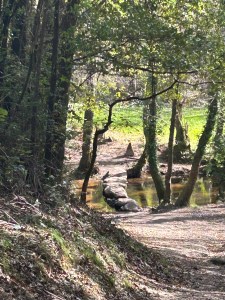
The wooded areas help mask the noisy highway we periodically cross. We are walking the usual mileage today, but for some reason, it seems much longer, and I am exhausted. 

The only thing that keeps me going is running into the sweet New Zealand family, joining them for a Coke, and finishing the last few miles together. The mom has such a lovely, serene way about her. She is originally from Ireland and said that even though the people are friendly in the small town her husband grew up in, it’s so remote and she feels so distant from her family. Her frown turns into a smile as she shares that they plan to meet her sister in Rome after the Camino.
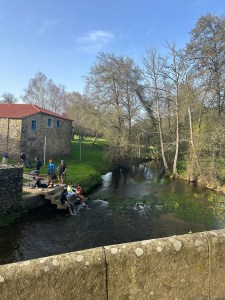
We arrive in Ribadiso and walk over the medieval bridge to the sound of pilgrims laughing and splashing in the river. We ask them if the water’s cold, and they all answer in unison with a resounding “Yes!”  

With its lovely pool, Pensión Ribadiso would be even nicer on a warmer day. The room is welcoming with its wood-beamed ceiling, and it’s wonderful to have a washer and dryer on the premises. 

Luckily for us, there is a restaurant right across the street, so we don’t have to walk back up the hill. We meet a pilgrim from South America who confides in us that he’s not used to the early 8 p.m. dinners here in Spain. At home, he dines at 10 p.m.!

Oct 31: O Pedrouzo- 16 miles
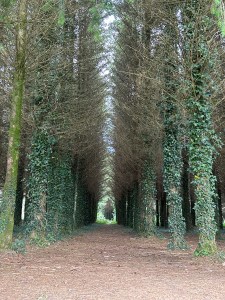
It’s better to get the steep climb out of the way early! From then on, we’re in and out of eucalyptus forests, and we take in the scent of eucalyptus with every breath. We’re getting to the end of our walk, and I’m hoping I have successfully cleaned out all the cobwebs in the corners of my brain. Chatting with strangers, you may or may not ever see again, has a magical quality. Walking and talking side by side, rather than facing each other, may explain why the words seem easier. Spending time walking alone is a wonderful gift to give yourself.

The town has a worn look to it. The sidewalks are full of shops and restaurants, trying hard to look their best. The streets are one loud cacophony of cars, trucks, and pilgrims. Pensión Residential Platas is not impressive, but it’s clean, and the young woman at the front desk has a warm smile.

We remembered our first time here in 2016. After walking in a torrential downpour, we were not looking forward to heading out again to dinner. When we returned downstairs, we noticed pilgrims eating in the breakfast room. They told us we could place an order at the local pizza place that would deliver. This time, we decide to seek out that same restaurant and celebrate that, for one evening, we are in a No (French) Fry Zone and order the same meal. 

Nov. 1 – 3: Santiago – 15 miles
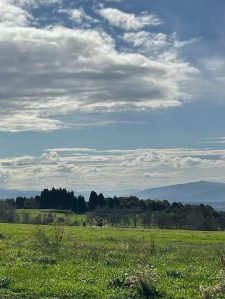
Walking through the forest is a lovely way to start the day. Its denseness makes us feel at peace,

As John Brierley eloquently states in his Camino guidebook “It’s a long slog up to Mount Goza.” An elevated area overlooking the city, it doesn’t have much to offer except for a few pilgrim sculptures and a view of the sprawling complex offering 400 beds in dormitory-style blockhouses.

We head downhill and down the stairs and are welcomed by asphalt. The city noise, the wide streets, and the traffic startle us. Some passersby on the street smile and give us a thumbs-up, as if to say, “Almost there, keep going!” 

We are happy to find a restaurant serving Caldo Gallego. The restaurant is empty, but a few minutes later, large groups are seated around us, ready to enjoy a long, late afternoon lunch. The sounds of conversation and laughter make for good company. 

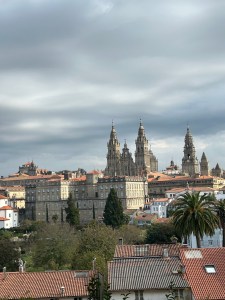
In the distance, we can see the spires of the Cathedral, but we are not fooled into thinking we are close by. Block after block, we trudge on, gazing into non-descript store windows and focusing all our concentration on crossing the busy streets. 

Finally, we come to “Porta do Camiño, the famous gate and entrance to the wonderful, old city. Almost immediately, the streets narrow and turn to cobblestone. Every shop and restaurant window intrigues us and we are brimming with anticipation.

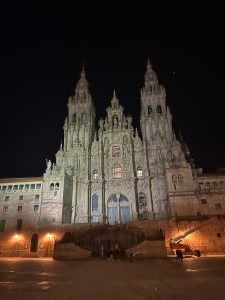
As we enter the dark tunnel, the familiar sound of the bagpiper welcomes us. Once again, we wonder -are musicians stationed there 24/7 to greet every pilgrim? Just a few more steps and we are in the Cathedral Plaza. While the majestic Cathedral sparkles overhead in the sunlight, pilgrims, mingled with tourists and townspeople, are crying, hugging, laughing, or too overwhelmed to do anything more than lay on the ground with their eyes closed.  

This is our fourth time experiencing Santiago, but it never gets old. We hug and shed some tears; tears of joy for a successful arrival and tears of sadness for the trip coming to an end. We look up to see our friend, the solitary pilgrim from Colorado, running towards us. 

With a tear-stained face, he tells us that, since he arrived in Santiago, he had seen everyone he had encountered along the way,, except us and now, here we were! He speaks happily and rapidly, nothing like the man we first met, and I am so happy for him and his newfound metamorphosis.
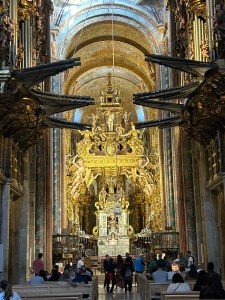
The Cathedral, a World UNESCO Heritage Site, was completed in 1211. Housing the remains of Saint James, it inspired pilgrimages, which ended at this iconic location. The highlight of the pilgrim mass is the Botafumiero. Six attendants dramatically swing it up and over the heads of the parishioners. 

We take the time to view our favorite areas

  • Stepping down into the crypt of Saint James and taking a minute to kneel and say a prayer.
  • Visiting the Praza de Quintana, near the Cathedral, at night to view the shadow of a pilgrim projected on the wall, a trick of the lights reflecting off the square. 

Unfortunately, you can now only view these areas from afar:

  • The weathered spot in the solid marble – a finger hole – created by the millions of grateful pilgrims that touched the spot after a safe arrival.  
  • Touching our foreheads to the sculpture of Maestro Mateo, one of the Cathedral’s master builders, to receive some of his artistic genius. 

The Hotel Rua Villar is an elegant townhouse, just steps from the Cathedral. Our room looks out to the main street, but there is nothing except a large terrace across from us, making it very private. I look forward to taking time each day to sit and write in their lovely library. 
We head to the pilgrim office to obtain our Compostela, the Camino certificate of completion, and enjoy walking all over Santiago. As we stroll Old Town, Alameda Park, and the Mercado de Abastos food market, I wonder if we will see our pilgrim friends again. 

Before we leave Santiago, we run into the Norwegian couple and the New Zealand family, tearfully hugging and reminiscing. I watch for the Australian couple, thinking I will see them any minute, but I never do. I wish I could’ve told them how wonderful it was to have met them. After stewing about it, I realize that time well spent was in that moment, and rather than worry about what was not, I should be grateful for what was.

As we prepare to depart Santiago, we have a big decision to make. Do we continue our Camino by walking to A Coruña, and Ferrol or travel by train and become tourists? 
Oct. 14 – 18 : Moratinos to León

Seems like we’ll  never arrive in Moratinos!

Oct. 14: Moratinos- 20 miles
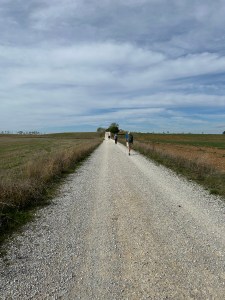
It’s a quiet morning. As pilgrims head out, many are starting their day in thought. It’s another cool day and besides focusing on the rocky, dirt path, there’s not much scenery to embrace; just miles of farmland. I become fascinated with the ant hills along the way. Some almost look like castles and each one has a hole in the center. I wonder what a mini camera would show?
This helps me pass the time and also clean out the cobwebs in the corners of my brain at the same time!

We’re startled to see a food truck ahead of us- in the middle of nowhere! Our breakfast was light, so we stop and have a “tostado con tomato,” a hunk of crunchy bread, but this time instead of chopped tomato, the bread is sprinkled with olive oil and loaded with slices of fresh tomato- delicious! We compliment the young entrepreneurial couple and they tell us they do quite well, stationing themselves along the Camino, and that they also live in the back of their camper.

With a devotion to pilgrim hospitality, Italians Bruno and Ana built Albergue San Bruno. It’s a large house, unconventional in design, with a couple of levels that house both dorms with beds and private rooms. With various doors and halls, I can only figure out how to get to our room and back downstairs. We hurry and shower, so we can relax out in their garden.

All the hungry pilgrims are hovering around the door, waiting for the communal dinner to start at 7 p.m. We share a table with two sisters from the Netherlands, a man from France and a couple from Kansas. Bruno and Ana don chef’s hats and formally welcome us all. They tell us they will close for the season November 1 and return to Italy, but not to rest, to work! Over wine, salad, pasta carbonara and cake, we are entertained by the Frenchman, who tells us after his first Camino, he quit his corporate job two weeks after he arrived home and changed his career path.

Oct. 15: El Burgo Ranero – 18 miles
It’s not raining yet, but we can feel it coming. The fact that we’re heading to a new Albergue for lunch takes our minds off walking the “Soulless Senda” for awhile. 

The sun disappears quickly, the wind picks up, the sky darkens and and we stop and jump into our raincoats, but the rain only lasts for a few minutes. We’ve been through this before with the weather teasing us, so we decide to just leave our raincoats on.

Tonight we’re staying in a gas station! I know what you’re thinking, but the Hotel Castillo de Burgo is actually behind the gas station. We are warmly greeted and the room is quite nice, modern and clean. The restaurant is open all evening, the dining room has white tablecloths, and the staff seems happy to be working there. What more could you ask for?!

Downtown Mansilla


A surprise around every corner in Mansillas

Oct. 16 – Mansilla de los Mulas – 13 miles
There’s not much in the way of scenery today, so it’s a jgood time to reflect. In his Camino guidebook, Brierley notes “Classified as the longest extant stretch of Roman road left in Spain today, we follow in the footsteps of Emperor Augustus himself.” Out of the silence, the sound of our shoes crushing the gravel and the click of our hiking poles, as they tap the ground, creates an almost Zen-like rhythm that carrys us the rest of the way.

Our room at Pensión de Blanca (plain and clean) has three beds, so we have plenty of room to spread out. The owner pulls out a map and with a magic marker, gives us directions to everything in town, but tonight we already know where we’re dining. 

It’s not very often that Brierley gives a restaurant review, so when he recommends La Curiosa, we head there early and have a glass of wine to secure a spot. The first floor is almost museum-like, with collections of everything from old typewriters, books, tin cans and advertisements arranged just so on shelves. Upstairs, we are pleasantly surprised by the large windows and white tablecloths. We chat with women from Madrid, Chicago, and Arizona, all walking alone, and when the hosts asks if we would like to sit together, we all say “ Why not?”

While enjoying the delicious smoked trout salad, veal with blue cheese and local goat cheese drizzled with local honey, we are on edge, listening to the Chicago woman’s story of how she was scammed by a white collar squatter. Since the squatter was already living in the same New York City building, our friend assumed the usual background checks, etc. were unnecessary. Two years later, with legal assistance, she was finally able to get her tenant evicted, but had only collected $2500 from her- one months rent!

So happy to be in León!


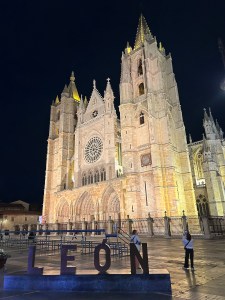
The cathedral sparkles at night


Our favorite white wine is the Galician Albariño

Oct. 17 & 18: León – 13 miles
We’re happy it’s cool and not raining. We’re so anxious to get to León, one of our favorite cities, we don’t even mind that we’re walking parallel to the busy highway most of the day.

León has been a pilgrim stop since the 10th century. Today, with a population of almost 450,000, the bustling city has a vibrant, joyful feel. I’m not sure when people go to work or children go to school, because it seems that the revelry continues all day and all night in the Plaza Mayor and down every narrow side street in the walled city. It’s the perfect place for a rest day.

Though we don’t seem to have the constitution of the locals, who don’t mind sitting outside in cold weather, we very quickly realize the custom of ordering one drink, which is served with a complimentary tapas, and then moving on another bar until you’ve had your dinner.

We are served a small plate full of warm, just fried calamari – delicious! Across the bar, I notice a couple chatting. As the man, picks up the calamari, it seems to be a long, never ending piece. I make eye contact with the woman and we laugh, she making the gesture of wrapping it around her neck and me, holding my hands up, like a lasso. It’s one of those quick lovely moments. All this for 6e for two glasses of wine and tapas!

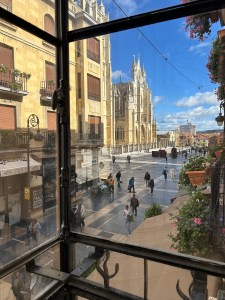
View from our room’s patio

Called “ the house of light” because of its famed stained glass windows, the Santa María de León Cathedral is now a UNESCO World Heritage sight. Our hotel, Hostal Albany Ancha, is in a great location, not too far from the church. The room has a brick wall, interesting metal light fixtures, a glass enclosed patio, but no closet! In Spain, you learn quickly- “Es lo que es” (it is what it is)!

Oct. 8 – 13: Burgos to Carrión de los Condes

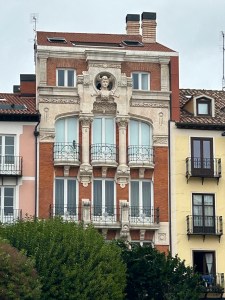
Our favorite building in Burgos

Please note:
– e = euro. The dollar and the euro are currently almost equal in value.
– Mr. Wiz = my husband, Michael, who is well versed on almost every subject and seems to know the answer to almost every question.

The French Route
Oct. 8: Madrid to Burgos
The Renfe high speed train station and plaza are jam packed. In typical Spanish fashion, people are talking, laughing, drinking, and eating. After our long travels, we opt for a quiet dinner at the nearby Charmartín Hotel dining room, We enjoy two glasses of wine each, along with a delicious three course dinner for 24 euros each. In Texas, $24 would barely cover two glasses of wine.

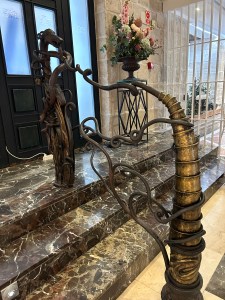
The entry to Hotel Rice Palacio Balsones

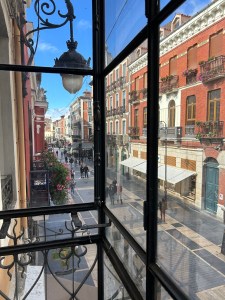
Hotel Rice Palacio de los Blasones, located in Old Town Burgos, a perfect location, is charming. Our room’s beamed ceilings, stone wall, and small balcony balance well with the contemporary furnishings.

Oct. 9: Burgos
Burgos still exhibits signs of its medieval splendor. The esplanade with its topiaries and sculptures, is the place where families and friends still dress up, meet (originally in horse and carriages, now strolling), and stop for a drink or a cafe con leche (espresso and steamed milk).

The capital of Leon and Castile for five centuries, its 12 entry gates and winding cobblestone streets give the city old world charm, but it’s the cathedral that is its highlight.

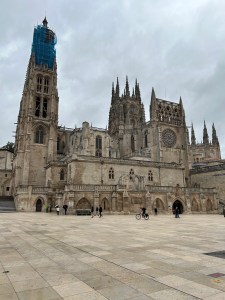
Cathedral de Santa Maria de Burgos

Construction on the Catedral de Santa Maria de Burgos began in 1221 and ended in 1567, bringing together famous architects and artists of the day to perfect the Gothic style of this UNESCO World Heritage Site.

What is a UNESCO World Heritage site?
In 1972, the United Nations Educational, Scientific, and Cultural Organization (UNESCO) adopted a treaty for “the identification, protection, and preservation of natural heritage around the world.” This agreement is unique in that 195 countries have pledged to secure the world’s most significant natural and cultural heritage from threats such as natural disasters, mass tourism, wars, and construction.

Rodrigo Diaz de Vivar, known as El Cid, is buried in the cathedral. The 11th century nobleman and military leader was born near Burgos and is Spain’s most celebrated national folk hero.

We arrive on the tail end of a hurricane. We haven’t started walking yet, so the heavy winds and occasional drizzle doesn’t affect us, but we later hear stories of some near accidents from walking and cycling pilgrims who were unaware of the storm’s magnitude.

Sunflowers and “suede” landscape

Oct. 10: Hornillos del Camino- 12 miles
“Dale!” (Let’s do it!) It’s cloudy and cool; perfect for walking. The sunflower fields go on forever, with the sunflowers proudly standing straight up, not realizing that their golden flowers have given way to dead, black ones. The fields are a patchwork of fall colors, all mowed down for the season into what looks like suede. 

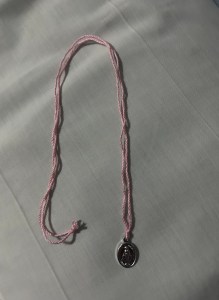
My necklace for the rest of the trip

We stop at a church to get a “sello,” a stamp on our pilgrim passport, which will be a lovely souvenir of places visited. The long line of pilgrims doesn’t deter the enthusiasm of the two nuns greeting each of us. When it’s my turn, the nun not only presents me with a medal to wear, she also blesses me and clasps my hand. I feel overwhelmed with emotion and vow to wear the necklace every day.

Flowers cheer up the building

Hornillos del Camino is a dilapidated town. With a population of 70, the decrepit buildings are a hodgepodge of different building materials. As with all of these old towns, they were once bustling commerce centers along the Camino and seem to come alive again with the arrival of pilgrims. They proudly continue their tradition of serving pilgrims and are grateful for the economy they bring.

La Casa del Abuelo is plain and old, but it’s clean and welcoming. Their sheets billow in the wind on the clothesline, interspersed with pilgrims’ clothes. The courtyard, with its unmatched tables and chairs, takes on an upbeat vibe, as pilgrims talk and laugh. A pilgrim from Idaho, with seven children and 14 grandchildren, regales us with his adventures of shooting feral hogs in Texas for $50 each and being welcomed into a motorcycle gang he had no interest in joining.

The sign on the bar says it’s closed for an hour and I assume the señora/owner is taking a rest. I happen to glance through the window and watch her lovingly feeding her mother and imagine how very full her days must be. When we leave, I tell her how special she is to care for family and for us and we hug.

A yellow arrow points the way to Castrojerez

Oct. 11: Castrojerez- 13 miles
We’ve just enjoyed our first, second breakfast; a Camino tradition. It’s a cool, quiet morning and the rocky trail keeps us focused on our footsteps. We stop at the Ruinas del Convento de San Antón, a monastery from the 14th century, which devoted itself to caring for pilgrims.

Castrojerez’s Main Street

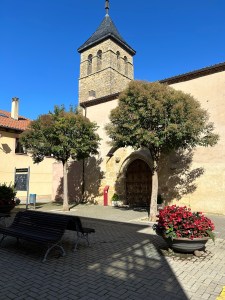
With a population of 500, this sleepy town mirrors Hornillos. There’s not much to discover on our walk around town and we joke with a couple from Northern Ireland, asking each other if there’s something we’ve missed. The senior couple both live on the Irish Sea ( she swims in the see each morning!) and they met by chance on the beach only a year ago. We all agree, if we lived closer, we would be fast friends.

El Manzano, our alburgue, is plain and clean. We are glad for the savvy companies that deliver ready made pizzas, pastas, and paellas to these establishments, leaving their customers with just the task of heating them up and serving them hot and fresh to us. Our dinner entertainment is hearing the story of a family cycling the Camino with a 10 year old ( who is also biking) and his mother pulling an infant carrier. When they finish the Camino, they plan to camp in Morocco for six months.

The church in Castrojerez sparkled as we left in the early morning

All the way up, then all the way down!

Oct. 12: Fromista- 16 miles
We immediately start the day with a strenuous long, steep climb and an even steeper descent. Both seem never ending, but we are entertained by stories from couples that moved from St. Louis to the Virgin Islands and from Washington D.C to Sitka, Alaska. We make it a point to stop every two hours, take off our packs and hydrate, to help us keep going.

With a declining population of 840, Fromista also mirrors Hornillos, except for its Inglesia de San Martín, which is said to be the finest example of Romanesque architecture in Spain!

Spanish “bubblegum” body wash and shampoo!


Ready for a shower, we can’t seem to find any soap in our room at the Hotel Rural San Pedro, another plain and clean establishment. It seems the soap dispenser is in the shower and it makes us laugh. At home, we are so fussy about what shampoo and soap we use, but here the neon hot pink soap is just fine with us.

It’s a holiday, there are limited restaurant choices and pilgrims are hungry. Many of us line up outside a place that opens at 6 p.m. (and not the usual 8 p.m.), and are disappointed to find out a group of Korean travelers have reserved the entire restaurant. Thank goodness for the small bar that serves that same prepared food we enjoyed the day before.

San Zoilo: view from our room


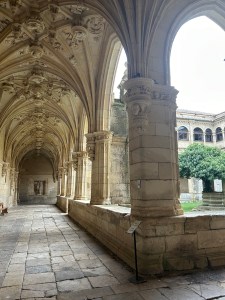
San Zoila cloisters

Oct. 13: Carrión de los Condes- 12 miles
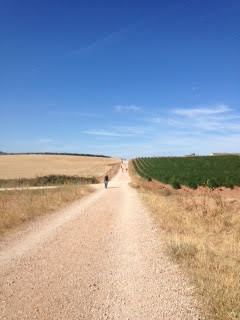
Famous Camino guidebook author, John Brierley, calls this part of the walk the “soulless senda” or path. Whether it’s the two, narrow, side by side paths that run alongside nondescript fields or the highway, this becomes the perfect time for reflection and introspection.

This time, we found the staff aloof and preoccupied and later were disappointed to find out other pilgrims staying there were never invited to visit their lovely church, museum, and cloisters, nor were they told about the discounted dinner menu for guests of the hotel, which we asked about and did receive.

Mr. Wiz has taken it upon himself to be in charge of doing our laundry. The laundromat is busy and chaotic, with pilgrims from all parts of the world waiting their turn. We laugh with a woman from Canada who’s next and says she’s not sure if she should place her laundry bag in front of the machine or just sit in front of it. Mr. Wiz explains the process to anyone that looks confused and I ask him if he’s running for mayor or just wants a job running the place.


.


.


,


Sept. 28 – 30: Leòn

B09A1720-0F84-4A10-9300-284EF1B37F4D

Sept. 28

We walk into town together and our Arizona pilgrim friend bids us farewell as he heads to his albergue.

We stayed at Hostal Aldo Cosco Antiqua in 2016 and I remember the wooden beams on the room’s ceiling, the windows that open to overlook a cobblestone street and the lower level’s glass topped flooring with a view to the old city’s stone beginnings.

Before we can decide where to dine, we receive a text from a pilgrim couple from Delaware that we had met early on. They’ve also just arrived and we plan to meet for dinner.

Tonight, the city’s cobblestone streets are packed with young and old revelers. A line snakes down the block to get into the cathedral for a free organ concert, a band plays electric violin and bagpipe music from a stage and there is a feeling of such gaiety in the air.

Sept. 29

My sister, a nurse and JC* (who we all thought should have gone to medical school) agree with the manager of our Burgos hotel who took one look at me and had diagnosed me as having tendinitis. A few minutes later, Google has provided me with a definition and YouTube has taught me some Pilates movements especially for knee issues; fingers crossed that this is the key.

Today, the city is celebrating La Leyenda de los Cien Doncellas (The Legend of the 100 Maidens), which explains the procession of women dressed in beautiful medieval garb. The Arab dancing, sword battle re-enactment and medieval music complete with bagpipes helps to recount the story of the time when Spain was under Muslim rule. A despot seized control of Spain and in exchange for less tyranny, demanded that 100 women be added to his harem. The women revolted and with the help of the army led by the apostle Santiago, Spain was freed.

In the midst of the vibrant music and the throngs of jubilant merrymakers, the Arizona pilgrim we met on arrival comes to mind. I sensed a sadness about him. Is he all alone this evening? Could he use a friend? I call out his name under my breath and scour the streets, hoping that if he is out there, we will somehow run into him.

Sept. 30

The celebration continues with the Fiesta de San Froilàn  (St. Froilàn). Colorful banners line the plaza, as donkeys lead colorfully decorated carts down the square. Every street is crowded, either with shoppers eyeing the merchandise for sale under the many tents or with the customers overflowing out of every bar and cafe into the street.

It appears that no one has stayed home. The sight of generations of family members enjoying each others company is heartwarming.


*Who’s who? See “Cast of Characters” on the “About” page


The Camino, the Dog and the Girl

Photo Camino Dog

I wondered why she needed a service dog, but it’s not something you ask someone. On the Camino, dogs were a novelty. He was the star of the show, receiving so much attention. Head down and the ever-present cigarette between her fingers, she remained out of the spotlight, answering every question about him with as few words as possible. She was petite and cute, but there was a toughness about her that told you that this was someone you did not want to mess with. When she did look up, I noticed that she seldom smiled and her eyes were devoid of any sparkle. They were hauntingly dark and piercing, as if they held secrets that were not discussed in polite company.

We seemed to be on a similar pace and ran into each other almost daily. I made sure that I greeted her every day with a smile and a quick “Hola” or “Buenos Dias” so as not to interfere with her solitude. While others around her were sometimes talking and laughing together, she and her dog always walked alone. He was her best friend and the way they interacted brought a tear to my eye.

One morning, I noticed that the dog was walking right next to an older woman, rather than his master. Out of character for the girl, she asked the older woman if she was feeling all right. Without too much explanation, she briefly mentioned that her dog was able to sense low blood sugar in humans through his sense of smell. The woman brushed it off, thanked her and continued on.

When I saw her the next morning, I asked about the older woman after my usual morning greeting. I was surprised that she actually seemed to want to respond and spoke with more emotion in her voice than I had ever heard before. Luckily, the woman was staying at the same albergue (hostel) as she and her dog. As soon as the older woman sat down on her bed, she passed out. Realizing that the dog’s diagnosis was correct, the girl was able to get help for her immediately and, by dinner time, the woman was feeling better. Another example of how the Camino provides.

Our relationship reverted back to my daily one word acknowledgments until one evening the following week. I was sitting outside at a café, enjoying a glass of red wine and she asked if she could join me. Startled, I agreed and hoped that we would not suffer those long pauses of discomfort when conversation does not come naturally.

I can’t recall what actually happened next. I may have commented about the day’s terrain, but all I remember is that she started to speak. And when she did, the words came like an avalanche; spilling out of her so rapidly. It was as if they had filled her up, swelled to capacity and finally exploded. She hardly seemed to breathe as she told a captivating story of her life: the military, a college education, promotions, Iran, Iraq, Afghanistan, Post-Traumatic Stress Disorder (PTSD), an honorable discharge, her service dog, the Camino.

I was lost in her words, my mind racing to keep up with her story. It took all I had in me to not interrupt. I had so many questions, but this was her moment. What if digging deeper put her over the edge?

When she abruptly stopped speaking and took a deep breath, we just looked at each other for a moment. She looked different; her posture seemed less rigid, her expression was softer. I was unsure of what to say, but when the jovial group of pilgrims that I was to meet there joined us, she hurriedly said her goodbyes and she and her dog left.

A few days went by and I wondered why I had not run into her. I was glad to see her the following day, smiled and gave my usual greeting, but she did not smile back. “…I have to leave…” was all she said in a flat tone. She explained that the pads of her dog’s feet were scraped and bleeding and he couldn’t walk anymore. She had tried ointments, but nothing had worked. She knew he would stand by her side regardless and just keep going, but this was the right thing to do. She was confident they would return next year and pick up where they had left off.

She then put one finger on my arm and whispered “…Thank you, my friend…” I returned the one finger touch and replied softly “…Buen Camino…” It was the first thing that came to mind, but I meant it in the bigger sense. I had so much more I wanted to say, but at that particular moment, words did not seem appropriate. For her that small gesture of intimacy was at the same level as the “Heimlich Hugs” that my Spanish grandmother was famous for and I knew I would always cherish the fact that she chose me to share it with.

She and her dog were gone the next day. Unlike others you might meet and connect with along the Camino, we did not exchange contact information. I thought about her a lot. I wondered why I had been chosen to be the one to interact with her. In this brief relationship, who was the student and who was the teacher? Just as in the military, I questioned if the Camino was breaking me down and rebuilding me from the bottom up in order to make me a better person.

For days, I would hear pilgrims say out loud “…Hey, where’s the dog?..” and I would answer that they went home, each time hoping to myself that they would find a place in the world to call home and that that there would be another arm for her to put her one finger on.


The Lure of the Camino

Photo Lure Camino

Dale! (Spanish for “let’s do it!”). It was one year ago that Mr. Wiz* and I said those words to each other and left Saint Jean Pied de Port, France to hike over the Pyrenees and the 500-mile route to Santiago, Spain.

Since the 11th century, pilgrims have followed the Way of St. James to the Cathedral of Santiago, where his remains are said to be buried. For a time, its popularity waned until the movie The Way was released in 2011. Starring Martin Sheen and written and directed by Emilio Estevez, the father/son team reintroduced the Camino and are greatly responsible for its revival and the over 250,000 people from all over the world that traveled its routes in 2016 by hiking, biking or horseback.

The French route that we traveled is the most popular, but there are many others throughout Europe that all end in Santiago. Tradition dictates that it is “your Camino”; you travel each day as long as you would like, stopping at an albergue (a pilgrim hostel), five-star hotel or anything in between. You need not make the journey all at once, but in order to obtain a Compostela (certificate of completion), you need to have walked at least 100km (200km by bike) to Santiago and have had your Credencial (pilgrim passport) stamped along the way.

Your travels take you through small and large towns, fields, orchards, mountains and the flat plains of the meseta. There is a physical, mental and spiritual component to the journey that seems to be dictated by your location and the terrain. Many have also experienced a mystical aspect, seeing firsthand how “the Camino provides.”

Now, imagine all of this while sharing it with people from all over the world. As you walk each day, wishing each passerby “Buen Camino” (a good walk), can result in everything from a smile to hours of heartfelt conversation. Every 24 hours, relationships are made and lost, as people walk ahead and then catch up to each other (which usually results in lots of hugs and a celebratory glass of wine).

As each day ended, I found myself overcome with emotion, reliving all the details that made that day like no other. A simple gesture, a chance encounter, a small town on such a large world stage; there was such beauty in the incongruity of it all.

One year later, I still feel its effects on me almost daily. I now try to focus on the present, listen more and go with the flow. I have a newfound respect for the uncomplicated aspects of a simpler life. I seem to be more curious, inquisitive and adventurous. Solitude has become as important to me as socializing. Meeting other pilgrims and sharing our common bond has been invigorating.

Who would think that just putting one foot in front of the other would set me off in a new direction and lead me to a new way of life.


*Who’s who? See “Cast of Characters” on the “About” page

Five Life Lessons in 500 Miles: What the Camino Taught Me

Image


Photo Cruz 2

This year, I walked 500 miles through Spain and became a Peregrino, (a pilgrim). I, like the more than 250,000 people from all over the world that are drawn there each year, walked (or biked) to the Shrine of the Apostle Saint James in northern Spain’s medieval city of Santiago de Compostela. The routes, known as “caminos” or ways, originate all over Europe. We traveled the same paths as those did thousands of years before us for the same reasons (spiritual, mental, physical) and with little change.

It is said that “the Camino provides.” One of its gifts was the simplicity of each day. As you trekked through each small town, you were reminded of the beauty of an uncomplicated life. After 33 days of being “unplugged” from the usual stimuli of our daily lives, my minds was clear and open, a freedom seldom experienced.

Whether I was enjoying the camaraderie of other pilgrims or the solitude of walking alone, my days were filled with time for sharing thoughts with others or with myself. I returned home with the unexpected souvenirs of some lessons learned and a new way to live life: 

  1. Focus on one step at a time: Rather than waking up each day and thinking of the 12 – 20 miles of inclines and descents ahead, it was important to concentrate on your footing. Likewise, giving my attention to smaller goals rather than the big picture, will keep me on track and not leave me feeling overwhelmed.
  2. Listen more: I was so captivated by the life stories of the other pilgrims that I found myself listening, really listening to what they had to say. In the quiet moments, I paid more attention to the sounds of nature. I was even more attuned to what I was thinking and feeling. Now, when I have the inclination to interrupt in order to get a word in, rush through a day or disregard myself, I will instead try to remember to savor the moment.
  3. Go with the flow: A day of torrential downpours, a missed turn, dirty clothes and a broken washer and dryer; the day’s trials were nothing that a laugh over a glass of wine with some other pilgrims couldn’t fix. I have trouble “winging it” and always prefer the flow to be pre-planned. I now realize that I need to loosen up and enjoy the ride.
  4. Be open: This was an amazing opportunity to meet people from all over the world and realize that even though they may look, speak or act differently, we basically are all the same. Rather than shying away from those that are different from I am, I will make an effort to be more receptive and try to let my curiosity lead the way to new experiences.
  5. Be grateful: Living so simply for a month, slowing down and watching the small details of life go by opened my eyes to what really matters: health, happiness, family and friends. I will remember to start each day being thankful for what I have, work at giving back in some way and try to cling to as much simplicity as I can.


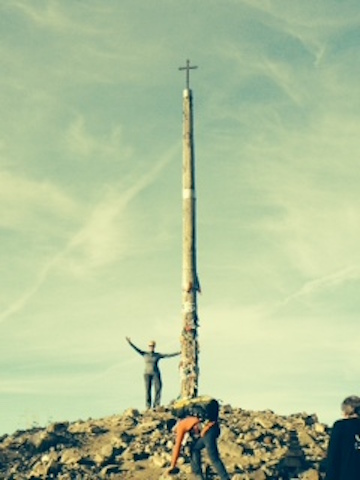
Pictured: The Cruz de Farro (Iron Cross) near Rabanal
Pilgrims bring a stone from home and carry it on their journey to symbolize the spiritual, mental and physical aspects of their lives that are weighing them down. When you leave the stone behind, it is said you are ridding yourself of these burdens.


The Camino: Oct. 17 – 21, 2016

                                                 photo-parador

Oct. 17- Palas de Rey: 16 miles, six hours

The path is nothing but mud and it’s drizzling. I’m sweating in my rain jacket and trudging along. A fellow pilgrim, a lovely older woman traveling alone catches up to me and with a sparkle in her eyes, says “What a beautiful morning! I love the mist. It changes the entire perspective of the landscape.” As I’m listening to her, I unzip my jacket, pull down my hood and the light drizzle instantly cools me off. By the time she goes on her way, I’m feeling great and the rain has already stopped.

We’re up and down again, walking right through farms and past lovely old stone farm houses, catching a glimpse of daily life: an old woman humming to herself as she hangs laundry; a farmer out in the pasture tending his sheep; a woman picking raspberries who stops to offer us some; the cows lazily grazing in the fields; the dogs sleeping in the sun. I find I have acquired a new skill and though it may not be resumé material, it’s interesting to note: I am now able to differentiate an animal’s manure by its smell.

I laugh to myself as I coin a new phrase: “In Spain, what goes up, must come UP”! Walking in the forest always seems a bit mystical, especially the way the light plays on and around the trees, lined up in exact rows. The scent of the eucalyptus trees is even stronger when we crush some leaves in our hands.

The outside tables are still wet in the little taverna when we stop for a cold drink. A fellow pilgrim is wiping off his table with a rag from the owner and when he sees us, he wipes off ours too. I pass on the kindness by wiping the table for some other pilgrims that sit at the next table. It’s a small gesture, but speaks to the feeling of community.

The Pensión Palas is simple, modern and clean, but the town seems old and rundown. The big excitement of the evening is that I am served rice with my dinner, rather than the ever-present french fries.

Oct. 18- Castañeda: 13 and one-half miles, six and one-half hours

The temperature is in the high 60s and cloudy; perfect walking weather. We’re up and down, through forests, farmlands and towns. It seems it will be a fairly uneventful day until we come to a river. The bridge is made up of boulders covered in mud. I take a minute to access the route and see I have no choice. I feel more confident with my poles, until I realize that the last two boulders narrow and the poles won’t fit. I panic for a second, but tell myself I have to keep moving forward; other pilgrims are behind me and there’s nowhere else to go. It takes all I’ve got in me to slowly make my way to the end. I’m amazed at my newfound grit and it gives me a spring in my step.

Casa Garea, our Casa Rural for the evening, is located at the beginning of town on the main road. The shoulder is narrow on the road and the cars are zooming by at breakneck speeds. Our only option is to walk through a big field. Our boots are sinking into the fresh dirt, making the walking more difficult. On arrival, the owner greets us and asks if we enjoyed the walk through the forest. We realize that we were too quick to get off the pilgrim path; a few kilometers ahead there was a sign that would have led us right to our destination. Lesson learned: always refer to our map.me app. (which requires no internet connection), especially when tired.

The room is cozy with wooden beams on the ceiling and white, starched linen curtains on the windows. After we freshen up, the owner brings in some wood for the fireplace and we sit in the downstairs sitting room with a glass of wine and relax. It’s not that cold out, but the warmth of the fire feels good. We make sure not to fall asleep and miss dinner.

Oct. 19- Pedrouzo: 16 miles, 6 and one-half hours

I spend my morning saying a prayer for each of the pilgrims that we pass that are not well but keep plodding along: five limping; three with food poisoning; and one with an intestinal virus. I am humbled by their strength and determination and feel a bit guilty that I have made it to this point unscathed; me, with the weak stomach, who always thought of myself as clumsy. I want to hug them and tell them how much I admire them, but each of them seems to be in a type of meditative state, some even wincing with every step. “Buen Camino,” the usual greeting, does not seem appropriate. All I can think of is to give them a thumbs-up as I pass them by.

Pensión LO is brand-new, all white and very modern, but the room has one design flaw: there are no shelves or closets! We balance what we’ll need for the evening on our backpacks and hope for the best. There’s lots of traffic in this town, but it looks a bit old and bleak, so we head back to the Camino path to find a restaurant for dinner. After some hugs and catching up, a friend we run into suggests the place she’d just dined at. It’s very contemporary, with a wooden communal table in the middle and shelves lined with gourmet foods; it looks so out of place. The food is good and the service is slow, but the wine is served right away and we are entertained by a mother and her 15-year old precocious son from Finland traveling the Camino together.

Oct. 20- Santiago: 13 miles, five hours

It feels like Christmas morning! We’re up early and excited to get going, but the sun has yet to rise. It’s still dark when we head out, but we only need the flashlight for a few minutes. The path takes us through some suburban towns, past the airport and alongside some roads, with just enough inclines and descents to make us realize that just because it’s our last day of walking does not mean it will be an easy one.

All that’s separating us from entering Santiago is a bridge. As we draw closer, we notice that it’s an old, depilated, wooden bridge with missing, uneven slats. The guard rails are unusually low, so as the traffic speeds by both beside us and below us, it gives us the sensation of Vertigo. We try to focus on walking exactly down the middle, keep our heads down and watch every step we take as quickly as we can.

We’re standing in front of the Santiago city sign, but after what it took to get here, it seems like a bit of a lackluster greeting. Besides the sign to welcome us, there is a gas station and a row of restaurants. It takes another hour to get to the old section of the city. Just when we feel our energy waning, some local residents assure us we are almost there and give us a thumbs-up.

As we approach, we hear the faint sound of bagpipes. There’s a musician dressed in a cloak and a feathered hat playing in the tunnel. As we exit the tunnel, the Cathedral comes into full view, sparkling in the sunlight. Now that’s the dramatic welcome we were hoping for!

We hug longer than usual and both get teary eyed. Amongst the tourists who quite don’t know what to make of this, the Plaza de Obradoiro (known as the “golden square”) is full of pilgrims hugging, chatting, taking group photos, sitting cross legged in groups or just laying down on the ground in the sun around the Cathedral.

It’s time for lunch and we agree that some wine might be necessary to celebrate and to help us to sort out our emotions. We’re so grateful for a safe journey and not sure how we feel. Are we elated to have arrived or melancholy that it’s over?

We’re splurging and staying at the Hostal de los Reyes Católicos, the famous five star parador (see photo at top of page). Paradores are a hotel network of government owned, restored historical buildings throughout Spain. This massive structure was originally a hospital built in 1499 by Queen Isabella and King Ferdinand (hence, the hotel’s name) and is said to be the oldest hotel in Europe. We explore every corner of the four courtyards, the church and the sitting areas. We read every historical sign that tells the story of each area and makes it come to life.  Our room is a lovely retreat with a feeling of Old World Spain that looks out onto one of the courtyards.

Santiago is a vibrant city with a bit of a carnival atmosphere, due in part to the large number of pilgrims descending on it each day. Streets filled with shops, restaurants and outdoor cafes twist and turn into narrow passageways that open to small plazas.

We had befriended a pilgrim couple early on in the walk and talked of sharing a celebratory dinner in Santiago in the hotel dining room. With the reservation now made, we now realize that our pilgrim clothes might not be suitable and some shopping might be in order. We laugh and wonder if we will recognize each other, all cleaned up. As we head back to the hotel, we join a group of fellow pilgrims for a celebratory drink. It’s a lovely evening enhanced by the gourmet dinner and the wonderful company. We end the evening with a toast to the continuance of our newfound friendship.

Oct. 21: Santiago

All Camino routes end at Santiago’s Cathedral where Saint James, the patron Saint of Spain, is buried. We head to the Cathedral early in order to get a seat for the noon Pilgrims’ Mass, a pilgrim tradition. We are disappointed that we are no longer able to place our hand on the column in the inner portico as a mark of gratitude for a safe arrival. After millions of pilgrims wore finger holes in the solid marble over time, the area is now covered by a protective barrier. The highlight of the Mass is the swinging of the Botafumeiro, a giant incense burner (featured in the movie “The Way”). It was originally used to fumigate the dirty and disease-ridden pilgrims. The eight attendants start pulling up and down until it swings as high as the ceiling. We lift our heads to follow it and realize it is right over our heads; a strange feeling.

Next, we head to the Pilgrims Office to obtain our Compostelo Certificate of Completion. All along the route, we have obtained stamps from hotels, restaurants, churches, etc. on our Pilgrim Passports, denoting what towns we visited. From Sarria on, we were required to obtain two stamps a day. The 45 minutes fly by as we compare notes with fellow pilgrims. We run into some pilgrims and agree that a last glass of wine together is in order. It’s hard to say goodbye…

Since I’ve arrived in Santiago I have not slept well. All the sights and sounds of the last 35 days are swirling around in my head and I am trying to sort them out. It is said that the Camino is divided into three parts. The first is physical, as your body gets used to the grueling daily regimen. The second is mental, as you walk the flat, somewhat boring paths of the meseta. The last is spiritual, as you near Santiago and the end of your long journey.

The Camino books and YouTube videos tell stories of pilgrims experiencing some sort of spiritual epiphany and I am hoping that I am one of them, but as I analyze each day and experience nothing comes to mind. I open our Camino book and start to flip through it, not sure why. We have owned this book for over a year and have referred to it many times throughout each day, but for some reason I have never turned to the last page until now. The words of a poem by Marianne Williamson (made famous by Nelson Mandela in his freedom speech) make the hair on my arms stand up on end and bring tears to my eyes. My spiritual gift was waiting for me in those last pages:

Our deepest fear is not that we are inadequate.
Our deepest fear is that we are powerful beyond measure.
It is our Light, not our darkness, that most frightens us.

We ask ourselves, who am I to be brilliant, gorgeous, talented and fabulous?
Actually, who are you not to be? You are a child of God.
Your playing small doesn’t serve the world.
There’s nothing enlightened about shrinking.
So that other people won’t feel insecure around you.

We were born to make manifest the Glory of God that is within us.
It’s not just in some of us; it’s in everyone.
And as we let our Light shine,
We consciously give other people permission to do the same.
As we are liberated from our own fear,
Our presence automatically liberates others.

photo-lm


The Camino: Sept. 23 – 26, 2016

img_0013

Sept. 23- Nájera: 18 miles, seven hours

The Harvest Festival revelers kept us up with their shouting and singing, but we still are up and ready to go.

Today’s path starts out flat through towns and then vineyards. We welcome the cooler temperature in the 60s, no sun and no steep inclines or descents.

Throughout the day the path changes from dirt to rocks to concrete. Trails flow through forests, fields, vineyards, towns and along busy and quiet roadways. The terrain dictates how long the days walk will be.

Nájera was the capital of the Navarre kingdom in the 11th century and its old stone buildings still stand proudly. We arrive at the Hostal Ciudad de Nájera and are greeted so warmly by the father and son owners as if we were family. They carry our backpacks up the stairs to our rooms and present us with a cold bottle of red wine, which we gratefully accept. All this and a bathtub too!

Sept. 24- Santo Domingo de la Calzada: 14 miles, five hours

It’s such a peaceful start to the day when you walk just before sunrise.

The flat path soon gives way to long inclines, then long descents, with lots of loose gravel, but the welcoming smiles and wishes of “Buen Camino!” from the townspeople in each little town we pass through gives us the energy we need to continue.

We thought we had another hour to go and are so surprised and happy to see the town sign that we celebrate with a Coke with lemon. The Hospederia Cisterciense is run by the nuns of the same name and we are impressed by its Old World charm and the simple, clean, crisp feeling of the rooms.

Sept. 25- Belorado: 14 miles, five hours

The nuns are fussing over us at breakfast, making sure we have enough to eat and wishing us “Buen Camino!.”

Most of today’s walk travels right next to the busy N-120 Highway. Cars and trucks are roaring by and the sound is anything but relaxing.

I am feeling less intimidated of the terrain and allow myself to let my mind wander just a bit, without ever losing respect for the Camino. One loose pebble underfoot is a reminder to keep focused.

Belorado is another lovely old town, centered on a plaza and a church. We are so happy when we finally find Pensione Toni. It’s a big room with 4 beds just for us, so we spread out and make ourselves comfortable.

Our feet are throbbing, as if they have a heartbeat and we are concerned. Later, when we join a New Zealander and a New Yorker for cocktails, we are relieved to know that they also have the same problem; blame it on the hard pavement.

Sept. 26- San Juan de Ortega: 15 miles, 5 and one-half hours

Today marks day No. 11; we have already completed one-third of the Camino!

The sunrise makes the fields glow and I have all I can do to stop myself from running through them singing the theme from “The Sound of Music.” Luckily, I resist, since it would have defied the No. 1 Camino rule: don’t take any extra steps that you don’t have to!

The route is flat, until we come upon some very steep inclines and descents, which luckily were very short. We pass Atapuerca, which displays the earliest human remains ever discovered in Europe. Then, we see a sign which says “Oasis Ahead.” Is that salsa music we hear in the distance?

We come across a young woman selling food and cold drinks for a donation and giving out slices of cold melon; so refreshing! Two pilgrims who do not know each other start dancing and everyone is laughing and clapping.

With a population of 18, the small town is centered around a lovely stone church. Our Hotel Rural La Hanera is very comfortable. We sit outside with a view of the church and enjoy some wine, while conversing with a couple from Iceland and a young man from New York. When the owner notices all the hungry pilgrims patiently waiting for the restaurant to open at 7 p.m., he decides to open 15 minutes earlier for us and we are all grateful.


The Camino: Sept. 19 -22, 2016

image

Sept. 19- To Puenta de la Reina: 15 miles, seven hours

On our way out of Pamplona, we walk through the beautiful park and gardens and then to the University, where they stamp our pilgrim passport.

Today, the walking is very difficult; steep inclines and descents with lots of loose, rocky terrain. We’re walking with a group from Germany and I make them laugh when I say that I will be declining a drink “on the rocks” at cocktail time.

We are so happy to have a private room at the Albergue Puenta de la Reina. We sit outside and enjoy a cold beer on their private terrace, run into our Australian friend and plan to have dinner together.

Sept. 20- To Estella: 14 miles, six hours

It’s always nice when the terrain starts out flat. As we walk, we watch a farmer plowing his fields, then stop to breathe in the wonderful smell of the rich, red earth; such a wonderful, clean smell!

We always take a rest in each small town we pass, sometimes to have a snack or just to use the facilities. In this particular place, the woman behind the counter was complaining, in Spanish, that everyone on the bathroom line should be paying something. I suggested to her, in Spanish that she put up a sign in different languages and charge a fee (marketing 101).

We are lucky to find a private room in the Capuchino Monastery tonight. No laundry service is available, so we start our laundry and then sit in the garden, enjoying a cold beer. We laugh with a German couple and agree that this isn’t a bad way to do laundry.

Sept. 21- To Los Arcos: 13 miles, six hours

I love walking through the towns early in the morning. They look like a movie set. With the old stone buildings and the town center with the church and plaza, it’s always a surprise when someone passes you in contemporary clothing or a car drives by.

First thing in the morning, we come upon the famous Fuente del Vino: a free wine spigot for pilgrims from one of the local wineries. We decline, but the Europeans make up for us!

We are in the Rioja wine country and pass through miles of vineyards. As we’re walking, we think we hear music. Around the bend, in the middle of nowhere, there is a husband and wife playing the violin and accordion for donations.

Tonight, we are staying at Pensione Los Arcos. Jose, the manager, not only welcomes us, but gives us his cell phone number in case we need anything. We enjoy discussing the day’s adventures with people from Sweden, Australia and Utah.

Sept. 22- To Logroño: 17 miles, 7 and one-half hours

The flat city pavement and the flat dirt road give us a false sense of security. While we knew to expect inclines and descents today, we are surprised to find that there were so many and that they were so steep.

I try to enjoy the beautiful vistas and keep my mind off the inevitable. The large blocks of farmland in beiges, browns and greens look like suede in the sunlight. A farmer and his dogs guide a flock of sheep on a steep parcel of land. A trail through the forest was a welcome respite from the sun.

We happen to land here on one of the biggest festival days of the year- the Harvest Festival. The plaza is teaming with people and filled with musicians and dancers. It’s so exciting to be a part of it!

Tonight, we’re staying at the Alburgue La Bilbaina. While it’s a great location and very clean, we could have done without the many old, uneven, ceramic tile steps that lead up to our room.


,