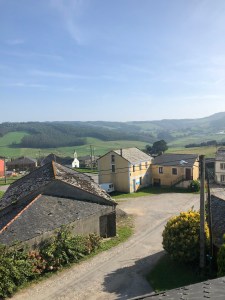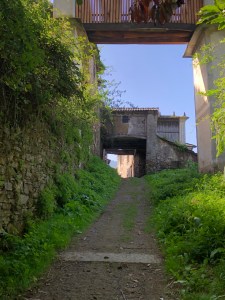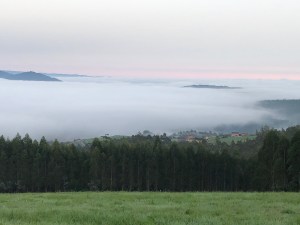

Sept. 24 – 27: Muros de Nalón to Luarca

Sept. 24: Muros de Nalón – 16 miles
We breakfast with a couple from England and a man from Poland who left his front door in May and has been walking ever since! It’s a pleasant walk through villages and dirt trails in the forest…until the rain starts.

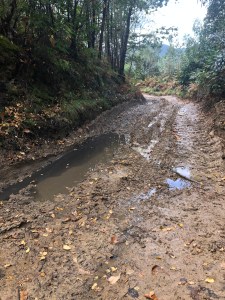
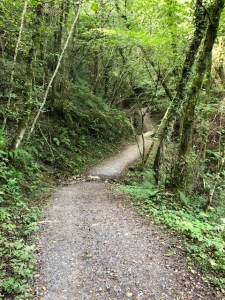
We find ourselves sloshing through mud and over rocks and gnarled tree roots.  Navigating puddles and trenches takes total concentration and we are laser focused for what seems like hours. I’m not sure what’s more slippery; the ascents or the descents. The rain seems to be enjoying the game it’s playing with us. Every time we get too warm and take off our rain jackets, it starts up again.

We welcome the drizzle and the change from muddy forest to road. We chat with a woman from the Netherlands who regales us with stories about each of her Camino adventures over the last ten years. It’s a League of Nations, as we stand at a crossroads with pilgrims from all different countries trying to ascertain the correct route. The yellow arrows and the shells posted along the way are our guides. At the start, the base of the shell pointed the correct way, but now they are displayed both ways!

Casa Carmina has not opened for the day yet, so we wait on a bench across the street with some other pilgrims. The mother/daughter owners are a well-oiled machine, welcoming us early out of the drizzle and getting us settled. Rather than a room of bunk beds, we opt for a private room at this albergue. The weather clears and we enjoy some wine, sitting outside on their lovely grounds. We chat with a young woman from the Netherlands, who started cycling from the northern most part of her country and plans to end up at the southern most point of Portugal. And to make it even more of an experience, she’s camping along the way!

Sept. 25: Soto de Lunas – 14 miles
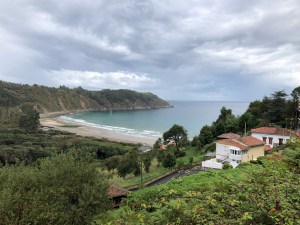
Another difficult day awaits us! It’s a repeat of yesterday and we’re fixated on every muddy step, with steep ups and downs. In between, we are treated to peeks of the ocean and walks through small towns.

There’s a convivial gathering in the crowded bar and dining room as we enter Hotel Valle de Luiñas. We are welcomed warmly at this lovely rural inn and told our bags have not arrived yet. We had planned to enjoy Sunday dinner here, so we wash our faces and hands and quickly sit down. With our muddy pants and boots hidden under the white tablecloth, we decide we don’t look too bad from the waist up.

The first one in the shower each day is responsible for giving the shower report. Is it slippery? Which are the hot/cold faucets? Sometimes they are opposite.  Does it leak? I purposely let Michael go first today.

Sept. 26: Cadavedo – 16 miles
The good news: the hotel is right on the Camino path. The bad news: our guidebook rated yesterday a two in difficulty and rates today a three! Right away, we come to a long tunnel which is so dark, we can’t see a thing. By the light of our phones we walk cautiously, trying to ascertain the terrain.

By days end, we will have tackled five water crossings, each with its own unique characteristics. Whether we’re balancing from rock to slick rock, deciding the sturdiest place to step on a tree root or wondering if it’s best to go straight through or around the perimeter, we can count on our our hiking poles to get us to the other side. The narrow path that follows takes us up a steep incline, but the view of the ocean at the top makes it all worthwhile.

We’re so happy to have arrived that we don’t mind climbing the grand staircase at Hotel Rural Casa Roja, a charming renovated country home. We never tire of the stone walls and beamed ceilings that these places all have in common. It’s not much of a town, but with lovely sitting areas, inside and out, we make sure to take advantage of both. But, not before buying a bottle of wine at the market conveniently located across the street.

Sept. 27: Luarca – 11 miles
We begin with jackets on, only to take them off a few minutes later. There’s no rain in the forecast, the temperature quickly rises from the 60’s to the 70’s and it’s cloudy; perfect for walking.

The forest path is steep, but surprisingly dry. The makeshift steps, made up of twisted tree roots and rocks, force us to contemplate every step, but rather than tiring me out, it leaves me with a peaceful feeling. Walking through the small farm towns is a welcome pleasure. The old stone dwellings that look as if they’ve seen better days seem to be magically transformed into homes with just the addition of their blooming flower boxes.

Luarca is an older seaside town. What makes it unique are the white homes balancing on the cliffs that encircle the Bay of Biscay. I am fascinated to see how they are connected and still standing! The streets are so incredibly steep, I wonder how they get around on icy/snowy days. Meanwhile, two “señoras” (older women) are arm in arm, talking and laughing, as they bypass us and make their way quickly down the street!

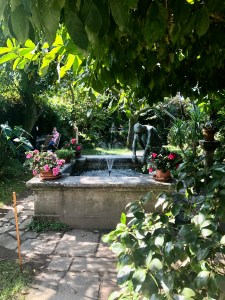
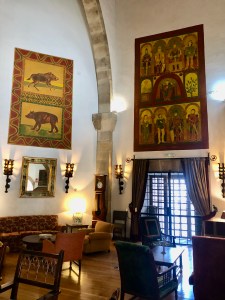
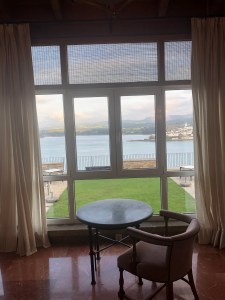
Built in 1906, the Hotel Villa de Luarca was a residence and our room looks out to a lovely little courtyard filled with flowers. Most towns close up in the late afternoon and as soon as they reopen again for the evening, the bars, restaurants and plazas quickly all come alive. After a quick walking tour of the historic quarter after dinner, it’s time for these two peregrinos to call  it a night.

Sept. 17 – 23: Gijón to Aviles

Sept. 17 – 22: Gijón
When we detect some swelling in his foot, we realize Michael’s blisters are still an issue. We decide to take a longer break and bus to Gijón. One of Spain’s largest cities, it’s double the size of Santander and another urban beach/lively promenade town. If you have to rest, this seems like just the place. The Hotel Hernan Cortés is a bit older, but has the lovely patina of a time gone by and is in a great location. 

Not wanting to walk too far, we notice people sitting on a stone wall with drinks, waiting for a band to begin to play. It’s a lovely spot with a view of the harbor, but we opt for a table instead. Just when I’m wondering what I can do to cheer Michael up, the band’s van pulls up right in front of us:             

We have a good laugh at the band’s name and from then on, it seems as if, once again, The Camino Provides, bringing the amusement right to us, so we don’t have to walk far. First, there’s the Asturias Cheese Festival (the province we’re in) with plenty of tastes. Then, a street demonstration of gladiator techniques performed by men in costume. Impromptu street parades and the sound of bagpipes are everywhere. Sitting on a bench and people watching on the promenade is a favorite Spanish pastime.

On Sundays, the stores are closed, but the plaza is lively, full of friends and families gathering together. It’s baptism day at the church we’re sitting outside of and we watch as families, dressed in their finest, visit and take photos of their beautiful babies. 

We walk on the beach, hoping the salt water will help heal Michael’s foot. I bury his feet in the cool sand, telling him it’s an old Spanish tradition. I can’t determine if the water’s too cold, but the waves always decide for me, knocking me over and tossing me around until I’m all salty, sandy and happy. With eyes closed, we lay on the beach breathing in the salty air. In the distance, we hear a flamenco guitarist playing alongside the sound of the crashing waves. I come up with a new mantra: “Monta las olas” (Ride the waves).

We are able to take advantage of the Menu Del Dia served from 1 – 4 p.m., rather than waiting for dinner, which doesn’t start until 8 p.m. For anywhere from €12€ – €19. it includes three courses, bread, water and a half bottle of wine, per person (usually you are charged for bread and water). My favorite is Fabada, a stew made of beans, Spanish sausage, potatoes and kale. Michael loves the Bacalao Viscaina, salted codfish stew cooked in tomatoes. While we pass so many homes with gardens each day, vegetables are rarely seen on menus, so we usually order a Salada Mixta, a big salad served with tuna. 

One of the more unique restaurants we dine in is called Toro. It’s an upscale Japanese all-you-can-eat restaurant. For €14 you can choose from 100 small plates. You  check off your choices on a form and hand it to the waiter, with one caveat: you will be charged €3f for every plate that you don’t finish! 

Michael has been wearing his boots a portion of each day and the insoles he bought have really helped. He says he’s ready to go again! On our last night, I make a toast: “Para sus ampollas!” (to your blisters!). If it wasn’t for them, we wouldn’t have gotten to know beautiful Gijón. 

Sept. 23: Aviles – 18 miles
The long walk out of Gijón reminds me what a large city it really is. The route through an industrial area is is anything but scenic. The sounds of the pebbles crunching under our shoes and the cars on the nearby expressway have a certain rhythm that becomes the background to my thoughts.

The dilapidated stone buildings on the farm road we’re walking on don’t look inhabited, until I notice their TV antennas and electricity connections. In the middle of nowhere, we come upon a basket of broken tiles and markers The mountain of tiles has been created by Pilgrims, who have left a tribute to someone they are thinking of/praying for; very touching. 

Luckily, there’s a wide shoulder on the road we’re walking on and it finally leads us into town. It’s is so old and unattractive, until we turn the corner. The plaza is a registered historic district and the best preserved in the region. It looks like a movie set! 

The Hotel 40 Nudos is older and quite plain, with very clean rooms. It becomes one of our favorites when they serve us complimentary tapas with our wine- a treat for hungry pilgrims counting the minutes until 8 p.m. 

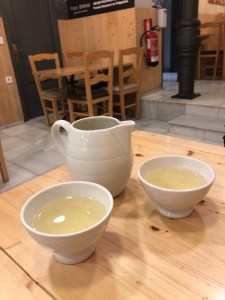
We dine at a pulperia and choose to have our octopus grilled, rather than boiled- it’s delicious! In the province of Galicia, the octopus is revered. Everything stops in order to celebrate everything octopus at their annual Pulperia Festival. We order a “jarra” (pitcher) of Galician wine served from a tap and realize we better forgo our usual toast and use two hands to pick up our bowls/glasses.

Sept. 8 – 12: Guernica to Castro Urdiales

Sept. 8: Guernica- 17 miles
Today we walk in rural countryside through forests and alongside flowing streams. It’s very hilly, but the sound of the rushing water is soothing and a stop at the the Zenarruza monastery provides a cool, peaceful place to rest.

We are heading towards what we think is the hotel, but once again, there is no signage. It’s been a long walk through the town and we’re hot, tired and very grateful to have arrived at Hotel Gernika. The classic hotel has an air of old world elegance and air conditioning! After showering, we enjoy a glass of wine in their beautiful solarium and wonder how we will be able to handle U.S. prices for a glass of wine, when we return, after paying anywhere from €1.60 to €3 here (exchange rate to U.S. dollar is almost equal).

Guernica is considered the spiritual center of the Basque Country and was the site of the aerial bombings of its civilians in 1937 during the Spanish Civil War. In downtown Guernica, large black and white blowups of photos of the damaged city are front and center, serving as a reminder of the atrocities on that memorable day.

Sept. 9 – 10: Bilbao- 19 miles
From the city streets, we quickly find ourselves on an intense, narrow path through the woods. The ascents and descents are much more treacherous due to the slippery wet rocks and the mud. For miles, the smell of the eucalyptus trees is our only comfort and the only sound we can hear is our heavy breathing.

It wasn’t easy to find a mid price hotel in such a big city, so we splurge and stay at the Hotel Abando. Unlike all the other hotels to date, the staff hardly looks up when we arrive, is not very welcoming and is no help at all in finding us a laundromat. We are so happy to hear from our Danish friend, with an invitation to try a restaurant that has been recommended to him, we forget about our hotel experience. Our new mantra is “Es lo que es,”- it is what it is.

We spend most of our rest day at the Guggenheim Museum. Designed by Frank Gehry, its cutting edge design also reflects in its modern art exhibits. The main exhibit entitled “Motion- Autos, Art, Architecture” celebrates forty of the most distinctive cars in relation to beauty, rarity and technical progress. My favorite part of the exhibit is a vision of the future of cities presented by a number of universities from across the world.


Sept. 11: Santurzi – 12-1/2 miles
The bad news: today’s walk is along a river, industrial areas and rundown towns. The good news: it’s all flat! Not having to worry about every step you take gives us more time to a relax and think.

As we enter Santurzi, the juxtaposition of the two sides of the city is startling. The old neighborhoods we’re walking through transcend into a couple of blocks of modern condos and lovely mansions before our eyes.

The UHR Palacio de Orio is magnificent, but we’re disappointed the rooms are rather plain. We take some time to explore its nooks and crannies and imagine it in its heyday.

Sept. 12: Castro Urdiales- 18-1/2 miles
The city streets soon lead to a walking/bike path. There’s not much to see, but we’re grateful it’s flat…for now. We follow the yellow arrows (the official Camino way markings) past a very unusual site; cows grazing on a vertical pasture so steep that it appears they are hanging on with their hooves. This keeps us entertained until we arrive on a boardwalk that follows along the Atlantic Ocean, the crashing waves lulling us into a walking rhythm. Then, it’s up 120 stone steps and then we’re looking down at the ocean.

We follow a shortcut to the road. Luckily, there’s little traffic and a small shoulder we can walk on, single file. The gas station we stop at does not sell water, but a kind gentleman hears our plight and insists we take his cold bottle of water. They say the Camino provides and today we are blessed with more than one example.

We’re all set to walk the short distance to our hotel. Our app says only one and a half miles, but it also says it will take 43 minutes. What?! We’re done! We stop at a bar, order two beers and ask the bartender to please call a taxi, while we sit outside and wait. A few minutes later, she runs out to tell us a bus will be arriving in three minutes right down then block that can take us. With stealth like precision, we dump the water out of our water bottles, fill them with beer and run for the bus.

It takes me a minute or two to realize that all the passengers at the front of the bus are discussing where our hotel is and where we should get off. We are told to exit, thank everyone and are escorted by a woman passenger, who insists on walking us to our destination, after her long shift at as a waitress. We part company, but not after hugs all around.

Castro Urdiales is a popular seaside resort on the Bay of Biscay. The Las Rocas Playa Hotel’s large windows frame the lovely white stucco, red tiled roofed homes that line the street to the beach, mostly second homes. The hotel’s tranquil ivory and beige color scheme reminds us that our walking for the day is almost done. Just a quick visit to the beach (with just enough time to get our legs wet), then we’re enjoying dinner in their dining room, looking out those big windows and wishing we could stay just a bit longer.


Sept. 3 – 7: San Sebastián to Extebarria

Sept. 3-4: San Sebastián
It’s taken the usual 24 hours for me to get over the sudden panic that sets in when you don’t feel your jewelry on your hands or wrists, They’ve all been left home for safe keeping, along with nail polish and most of my makeup, It will take another day for me to settle into the “Camino me.”

San Sebastián is one of those cities blessed with a beach in its center, The Bay of Biscay, the lovely parks and the lively Old Town make it sparkle. The joy and exuberance of the locals overflows from the bars and restaurants into the streets, as families and friends gather, standing or sitting on steps, and children play quietly nearby. Nary a sweatsuit to be seen, there’s an air of sophistication in everyone’s dress, even down to the babies,

We choose to stay at the Hotel Distrito Oeste, since it’s closer to the Camino start and walking distance to the square. Located in a quiet neighborhood, it’s white, stark, minimalist style is relaxing. The staff is very friendly and accommodating, even taking the time to explain why the whole city is dressed in the colors of their favorite boat racing teams this weekend.

Sept. 5: Zarautz- 13.5 miles
One minute we are walking through a lovely neighborhood and all of a sudden we find ourselves on a single path in the woods going straight up! Every once in a while, the Bay of Biscay peeks out, but there’s only time for a quick glance, Our total focus is on navigating the ups and downs and the rocks and boulders. For what seems like hours, we are in a meditative state, only looking up to say “Buen Camino” (good walk) to other pilgrims as they pass by. Lunch is a much welcome respite and we enjoy dining with a pilgrim from Washington D.C.

Zarautz is a beach town and a surfing mecca in the Basque region. The Pension Tixki Polit is rather basic, but the staff overwhelms us when they agree to do our laundry, but will not accept payment. We settle on purchasing them cold Coca Colas and everyone is happy.

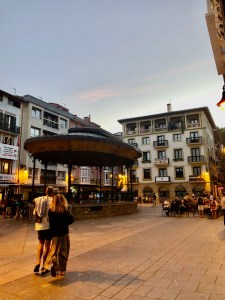
The hotel is located right on the Musika Plaza. Every town, regardless of size, has a plaza, which brings people together with food, drink and music. We are surprised the revelry has continued so late on a Monday night, until we’re told tomorrow is a holiday in celebration of the 500th anniversary of a famous voyage to the new world by an explorer of Basque origin.

Sept 6: Itziar- 12 miles
We breakfast with a young Danish man, who convinces us an app is better than the book we are relying on and kindly sets us up with a Camino travel app. We start the day on a walking path along the Atlantic Ocean, this time able to take in the incredible views and greet passersby with a smile and an “Hola” (hello/hi).

We head up, in and out of the woods, sometimes withj spectacular views of the ocean or verdant farmlands, whose squares of various colors of green beam in the sunlight. This is about the time I remember the saying we came up with on our last Camino- In Spain, what comes up must go up!

We share our joke with a couple from Ireland and find we are staying at the same hotel. With no sign outside, we cross our fingers and hope this first building at the beginning of town is our final destination. Turns out, it is the Hotel Kanala!

Again, though the rooms are rather plain, the lovely welcome we receive and the inviting bar and dining room make up for it. There’s nothing nearby, so we’re in for the night and dine with our new Irish friends.

We are surprised by the elegant meal, from the delicious amuse bouche we begin with to the end of the meal, where what looks like a small mint on a plate becomes a warm towel once the waiter pours a bit of hot water on it.

Sept. 7: Extebarria- 17 miles
The single path of moss covered rocks and the trees canopied above make it look like an enchanted forest. All day, it’s a gradual incline that just keeps inclining! The click of our hiking poles on the ground, an occasional rooster crow or a cow bell is all we hear.

When we ask a woman for directions to our hotel, she insists on walking us there, probably thinking these hot, tired peregrinos (pilgrims) need a break. We warmly thank her and come upon an incredible stone building in the countryside.

The Hotel Antsotegi was a 600 year old foundry, now renovated into a country inn. The massive stone walls, wooden beams and rustic furniture make you want to stay and relax there a while, but we had to be content with the festive dinner we shared with our new friends from Ireland and Denmark, who all happened to be staying there, too. Who knows if we’ll ever see each other again, but tonight, we’re a Camino family.

Walking the Walk, Again…

Photo Walking the WalkA favorite keepsake, a sign that shows the distance from Georgetown, Texas to Santiago, Spain- 4772 miles.

For thousands of years, pilgrims have traveled the ancient paths to the cathedral in Santiago, Spain, where the remains of St. James lay to rest. The Camino de Santiago de Compostela – St. James under a field of stars – evokes physical, spiritual and mystical qualities. 

Inspired by the 2011 movie “The Way,” starring Martin Sheen, we walked the Camino Frances, the most popular route that begins in France, in 2016 and 2018. 

Funny how, back in 2016, we didn’t understand why so many “crazy pilgrims” kept returning year after year. Now, here we are setting out to walk the Camino del Norte, along the northern coast. 

Where else could you find such simplicity, a peaceful rhythm to each day, the camaraderie of strangers and be given the opportunity to pray with your feet? 

A Curly World

Photo Curly World

Whether wild or demure, never underestimate the power of a curl. Little is known about this type of hair, that I, along with approximately only 15% of the Caucasian population seem to have been born with. As I get to know them more personally, those little ringlets are always surprising me when I least expect it, going about their merry way, with no clue they are a constant metaphor for life. 

While straight hair is lighter, due to its individual strands, curly hair moves as one unit and gets less tangled. When this force fiercely bands together, the coils and twists always get their way. I have finally realized when I want to part my hair on the right side and those stubborn spirals decide to undercut me and make it a left part day, it’s a subtle reminder to just go with the flow. 

But, this wasn’t always the case. During my entire teen years, with songs by the Beach Boys playing nonstop in my head and dreams of having long, straight hair like the girls they sang about, I persistently waged war against my hair. Curl Free, to straighten my hair, led to ironing it- luckily, I remembered to use a towel between my hair and the iron. I finally realized it was time to throw in that towel when setting my wet hair in juice cans overnight resulted in the words “Tropicana” to be imprinted across my dry hair. 

Securing those untamed locks in a bun professionally steered me through my business years. It was an outspoken hairdresser that finally convinced me to cut my hair short. With nothing more than a photo from Playboy magazine, he was able to counter my objection of not wanting to look like a boy. 

I naively thought I had won the battle. This outwardly well-groomed appearance helped to create the no nonsense persona I always wanted. But, just because the curls were chopped off, doesn’t mean they, and the personality traits that accompany them, weren’t still there. So, who was I? Was I the straight as an arrow me, that meant business, or the curly fun-loving and outgoing me?

COVID kept us all from haircuts and as my curls began to reappear, I somehow felt comfortable to welcome them back, not that I had much choice. This time though, it seemed these old friends were popping up at a time when I had decided that maybe the methodical Linda could coexist with my alter ego, Lola. 

According to Glamour magazine, curls are one of the biggest beauty trends for 2022. “Expect to see curls everywhere!” they reported. Whether wavy, curly or kinky, the three types of curly hair are known to be easier to care for. Flowing freely, they are smugly aware that, as their numbers increase, curly heads could single handedly transform the hair care industry, with blow dryers, hot rollers and curling irons going the way of the bubble hair dryers and bobby pins. There’s a curly hair movement out there and it won’t stop until it makes waves.

 Author’s Note:

If you enjoyed this post, please scroll down, like it and feel free to share it!

Senior Living: Not For the Faint of Heart

Photo JC Birthday

She’s double booked herself again. Tomorrow’s day trip was her idea, so she shouldn’t miss it, but her hair appointment got rescheduled for the same day. She promised The Knockouts – her boxing partners – she wouldn’t skip a class, but now water aerobics is at the same time.

When you’re 92 years young with a busy schedule, it’s hard to fit everything into a day – especially when Happy Hours start at 4 p.m.! My mom is a wonder and a force to be reckoned with. Moving into a new senior residence has given her even more pep and vitality, something we didn’t even think was possible.

According to the International Council on Active Aging, in 2020 the number of people age 60 years and over passed the 1 billion mark for the first time ever. That relates to one in every seven people with a higher average disposable income and more time to enjoy life than previous generations.

Seniors are trending as the fastest growing demographic and sparking excitement as marketers rush to cater to this lucrative untapped market. There was a time when old age meant declining into inactivity. Now, these new customers don’t let age hold them back. Young at heart and in good physical health, their zest for life leads them to look for challenging experiences and embrace life to the fullest.

Mom recently returned from a trip to New York, St. Pete Beach and Disneyworld with my sister. October is already on the calendar for a family trip to Puerto Rico. Now, she’s focused on 2023 travel plans. She’s been in contact with a younger friend, while also helping a new friend train to be free of her walker. My guess is she’s grooming her to be her next cruise partner.

Every year on her birthday, we convince her to wear her birthday outfit: white dress, silver jewelry and, of course, silver birthday crown. She’s always said “When you’ve got it, flaunt it” and now is definitely no time to stop!

As the population matures around us, seniors bring with them a newfound determination to practice Carpe Diem – Latin for “seize the day.” They’ve demonstrated that older is now synonymous with wiser, optimism can benefit you as a lifestyle choice, and seizing the day can be accomplished with style, grace and swagger.

Author’s Note:
If you enjoyed this post, please scroll down, like it and feel free to share it!
Pencil Me In?

Photo Pencil Me In

I have the uncanny ability to tell you what I was doing on any given day, beginning as far back as 1969. This has less to do with my psychic abilities and more to do with the small month-at-a-glance calendars distributed for free each year by Hallmark. For years, appointments along with noteworthy occasions were documented neatly in those small squares. Once Hallmark no longer cooperated with my calendar dependency, I graduated to a Filofax, the epitome of personal organization.

Recently, one of our neighbors announced, after a vacation to New Mexico, they planned to relocate there. They quickly sold their home, car, RV, truck and most of their furniture to other neighbors and were on their way, mentioning they planned to “pencil things in” as they went along.

That stopped me in my tracks! You see, in all of my calendars nothing seems to appear in pencil. I am strictly a pen/permanent marker girl. If you pencil things in, you are, in fact, winging it and have the ability to change or even erase your plans. I seem to have been born without the “play it by ear” or “off the cuff” gene. Which brought me to thinking about the yellow stick that started it all: the pencil.

When Hyman Lipman invented the pencil with the built-in eraser in 1895, writers everywhere were eternally grateful, no longer having to carry around a stale baguette under their arm. Before Hyman’s invention, the baguette was known to be the most effective way to erase ink off a page.

The best graphite came from China. In order to promote the fact their pencils carried the best quality lead, Chinese pencil manufacturers started painting their pencils yellow, the color associated with royalty.

Pencils have made their mark on history. In 1800s England, stealing a pencil meant banishment to the penal colony for seven years. Once graphite was found to be the perfect coating for cannonballs, it became a precious commodity on the black market. Mining workers were forced to strip before heading home and consumers were hoodwinked into purchases of wooden sticks painted yellow with black tips. During World War II, rotary pencil sharpeners were banned in England and people were encouraged to use a knife, thought to be a less wasteful way to sharpen.

Famous authors have drawn on the simple pencil for inspiration. In a 1935 article in Esquire magazine, Ernest Hemingway acknowledged the pencil as a means of constantly and easily refining his work. Working in his father’s pencil factory as a young man, Henry David Thoreau was responsible for introducing the measurement for the hardness of pencil lead. Having calculated levels from numbers one to four, the number two pencil became the standard in the U.S..

A single pencil has enough graphite to draw a line 35 miles long or write 45,000 words. Even though I have since moved on to a calendar on my iPhone, perhaps I should try to sharpen my skills, introduce the pencil to my writing world and not worry about being so precise. Write or wrong, it may be pointless, but it’s worth a try.

Author’s Note:
If you enjoyed this post, please scroll down, like it and feel free to share it!

Charleston, South Carolina: A City With Good Taste- November 2022

Photo Charleston Plantation                                                    Boone Hall Plantation

You won’t find any skyscrapers in Charleston. The cobblestone streets, horse drawn carriages and pastel colored antebellum homes are a testament to the city’s rigorous preservation and strict architectural guidelines. 

Humbled by its air of aristocracy and elegance, I couldn’t help but think of the element of human suffering that lurks in the city’s shadows. The city was the key port responsible for the sale and transport of enslaved African Americans to all the major cities in the U.S. Rather than shying away from its history, Charleston strives to tell the real stories of its past by honoring it and educating us. 

Stay

Our Airbnb was just a couple of blocks from King Street; the perfect location. It was a lovely, two story home and each bedroom had its own bathroom. I loved the cozy patio on the second floor and all the amenities the owner so thoughtfully left for us.

Savor

This is one of the few cities I’ve visited where making Open Table reservations one – two weeks ahead didn’t ensure our first restaurant choice. I’m not sure if COVID was to blame or if restaurants are always this crowded, but I suggest planning way ahead – especially if you’re a group, like we were. The six of us like to share entrees, so we experience the menu. Since we were in oyster country, our appetizer was a foregone conclusion.

We were introduced to our first taste of South Carolina’s low country cuisine at Delaney’s Oyster House. Seafood based and served mostly with rice, it’s similar to New Orleans’ creole style cooking. Dining in the historic home, we had a view of the palm trees swaying on the outdoor patio as we feasted on crab and rice, swordfish and fried oysters. By the time we dined at Poogan’s Porch, a restored Victorian home, we were well versed in the cuisine and headed right for the shrimp and grits, scallops and fried chicken.

Never ones to pass up French restaurants, we were not disappointed with the mussels and frites at the cozy Bistronomy. At 39 Rye de Jean, housed in a lovely building circa the 1800s, we enjoyed the scallops, pork chops and lamb shank, and chuckled at the sign above the bar that read “Ooh La La.”

We were impressed when one of the members of the Hyman family stopped by our table to greet us. Hyman’s Seafood, the big, rollicking family owned restaurant has been perfecting itself since 1890. We were greeted with tastes of warm hushpuppies while we waited outside for our table (no reservations are accepted). Brian has been cajoling anyone that walks by into tasting their specialty for years. The combination of the warm, cornmeal based golden fritters and his warm smile and big personality, made it hard to say no. While we waited for our (award winning) she crab soup and fried seafood, served with more hushpuppies, we took turns reading aloud the small cards left on the table. Each with its own positive saying, you are invited to choose your favorite and then turn it in at the gift shop for a free magnet with that same saying. You can guess where we headed right after lunch. At first, we were surprised to see six large, old fashioned working sinks in the middle of the shop, but then realized how clever that was. They were placed there to wash your hands with their famous salt scrub and give it a try before you made a purchase. 

The message on the menu read “Lard Have Mercy!” That set the tone for Sunday Brunch at Big Bad Breakfast. After ordering The Jack Benny (a crispy fried hash cake, two poached eggs, sliced ham, wilted spinach, hollandaise and ham powder), it was hard to choose a side, since it seemed as if most of the menu was already on my plate! My choice of the broiled, sugar coated bruleed grapefruit was a good one. Having raised breakfast to an art form, no reservations are accepted, but if there is a wait, it’ll be worth it. 

This is not your ordinary de-sanctified church turned bar/restaurant. Look up to the ceiling at Church and Union and you’ll notice rows of white cursive writing on the black ceiling. Artist, John Morris was commissioned to paint the inspirational messages from “The Wayward Seaman,” the 2500-year old manuscript that discusses the art of war. Penned by Chinese General, Sun Tzu in the fifth century, it provided motivational guidance and strategic thinking that proved applicable in all situations. One of my favorite quotes was “Move swift as the wind and closely formed as the wood.” Working 12 hours each evening, it took Morris six months to complete all 13 chapters. 

Sightsee

Walking to the wharf via historic King Street, it was refreshing to see local and regional shops outnumber national chains. Eclectic, yet exuding sophistication, we were taken with the area’s vibe. Across from waterfront park, you couldn’t help but stop in front of each mansion along the street to relish its splendor and wonder about its past.

When in Charleston, a plantation tour is a must! Named the No. 1 plantation in Charleston by USA Today, we chose Boone Hall Plantation, not the closest, but well worth the Uber ride. Built in 1681 by Englishman Major John Boone, the 738-acre estate is listed on the National Register of Historic Places and is still a working farm.

Our tickets included an entire day of events and tours. Boone Hall is the only Charleston plantation to present a distinctive presentation titled “The Gullah Culture,” in which descendants of the Gullah people present the history of their slave culture through stories, song and dance. A tour of the mansion built in 1936 provided us with some background into the life of a plantation owner. A 40-minute tour of the grounds on a motorized tractor helped us appreciate the vastness of the property and its farm. The self-guided tour of the nine original slave cabins dating back to 1790 – 1810, were an emotional glimpse into the aspects of daily life.  

Still eager to discover more about this amazing city, we booked a walking tour through Walks of Charleston. Not only did our tour guide, Amy Tankersley, have a wonderful sense of humor, she had a way of making every detail interesting. Who else would take it upon themselves to actually construct a diorama in order to explain the original city’s walls?! I particularly loved the alleys we visited; narrow public streets that widened to all of a sudden surprise you with glances of interesting homes and beautiful gardens. We would never have found these hidden gems on our own or gained so much insight into Charleston. 
In only a few short days, Charleston had succeeded in winning us over us with its southern charm, reminding us “Y’all come back now, ya hear?”

Photo Charleston Alley

                                            Another “secret” public street