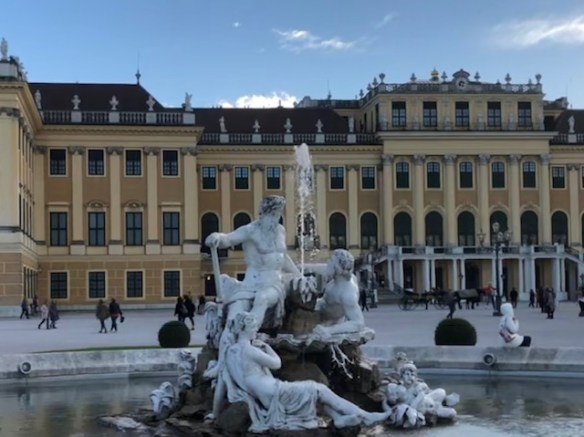
Vienna, Austria: Oct. 29 – Nov. 1, 2018

Photo Vienna

Schönbrunn Palace

It’s a short flight from Prague to Vienna and by the time we get settled in our seats, we are already there. It’s a good feeling when you arrive in a foreign airport and see that little sign with your last name on it, so, once again, we hire a driver sent from our hotel.

The Der Wilhelmshof Hotel is a unique, family run boutique hotel. Designed in collaboration with Viennese artists, their art is not just placed on the walls or on display, but actually becomes part of the décor. Our room has a contemporary mural painted on the wall behind the bed that playfully continues onto the wall sconces.

We enjoy a drink in the hotel bar, as the cheery cocktail waitress (she introduces herself as “Pauline from Poland”) and the concierge assist us in a restaurant selection for the evening. The decision is unanimous; Schweizerhaus is a landmark from the 1920s serving traditional cuisine in a beautiful beer garden. It’s a short walk through a lovely park and a carnival that’s in full swing. We’re seated at a long communal table next to a large Viennese family. We smile, say hello and when they hear that we are from Texas, they are fascinated and have many questions. They guide us through the menu and do not steer us wrong. The gigantic, crispy pork knuckle arrives on a large wooden platter along with a helping of wiener schnitzel (thin pan-fried, breaded pork cutlets) and a warm potato salad made with oil rather than mayonnaise. The ice cold beer tops off a perfect meal. We thank our new friends, who all line up to shake our hands when they leave.

While walking the city streets, we discover that there is a refined and artistic elegance to Vienna. The largest city in Austria, it’s the birthplace of Mozart and Beethoven and known for its many imperial palaces. We feel as if we are taking a step back in time when we visit Schönbrunn Palace, a UNESCO World Heritage Site and the former summer home of the Habsburg family.

St. Stephen’s Cathedral is considered the most important religious building in Vienna with its mix of Gothic and Romanesque architecture and magnificent spires dating back to the 1300s. Considered the “mother church” to Roman Catholics, it was built on an ancient cemetery dating back to Roman times.

There is no time to visit them all, so we let Mr. Wiz* choose which museum we will explore. He makes a good choice; the Albertina Museum. The magnificently furnished state rooms from the Habsburg Palace come alive when they are accompanied by narratives of its occupants. The dramatic black and white photographs chronicling everyday life in poor New York City neighborhoods in the 1930s by Helen Levitt startle us. The comprehensive exhibit of Claude Monet details his life, revealing little known accounts that give us new insight and on display were paintings we’ve never seen at any other museums.

Once again, all the restaurant research Big A* and I have done has paid off. The music is loud, the place is packed and the tables are communal at Miznon, an Israeli restaurant. We stand on line to order lunch, gawking hungrily at the open kitchen. Both the lamb and beef burgers served in pita bread have won raves, but it is the charred, spiced cauliflower that is the star of the show. Grilled and served whole, we pull it apart and dunk it into tahini, one of the sauces offered. At Ulrich, a hip, casual restaurant, we lunch on chorizo flatbread and smoked salmon and trout. We are lucky to secure a dinner reservation at an upstairs table with a city view at Lugeck. Sharing entrees seems like the right thing to do, so we can all taste the fried chicken, shrimp and goulash with homemade spaetzle.

We go to great lengths to plan just the right cocktail hours. Alfred Loos is known as one of the pioneers of modern architecture, so we had to experience Loos American Bar. Designed in 1908, the groundbreaking concept combines dark mirrors, low lighting, wood and onyx into the 290 square foot space and fools you into thinking it is surprisingly larger. With Ella Fitzgerald serenading us softly in the background we’re reminded that this is one of those few times that the word “swanky” is apropos.

Das Loft Bar is perched on the 18th floor of the Sofitel Vienna. It’s dark and moody. The ceiling is covered with what looks like flowing silk awash in a combination of colors. Blended with the 360-degree views of the city sparkling back at us, we can’t help but  snuggle into our seats, order another round of cocktails and make another toast to beautiful Vienna.

* Who’s who? See “Cast of Characters” on the “About’ page


Prague, the Czech Republic – Oct. 27 – 29, 2018

Photo Prague

Leave it to those millennials; Big A* reminds us that we should take advantage of one of the perks of the Chase Sapphire Reserve credit card he suggested we switch to and meet at the VIP lounge in Madrid’s airport. After warm welcomes all-around, we compare the research we’ve all done and start creating daily itineraries for our visit.

The capital and the largest city in the Czech Republic, Prague, is known as “The City of a Hundred Spires.” There is a fairy-tale like quality to the city; the buildings all look as if they have just been painted their pastel colors and the Baroque architecture makes you feel as if you are strolling through a European Disneyland.

Rather than navigate the language and worry about changing our euros into Czech Korunas at the airport (not the best exchange rate), we decide to take advantage of the hotel pickup service. We are reassured by the driver that English is taught in schools and is Prague’s second language. He points out some sights along the way and tells us proudly that tomorrow is the country’s 100th anniversary of its independence and we can look forward to parades, fireworks and many special events.

The Hotel Leonardo has a wonderful, Old World feel about it. The genteel staff seems as if they have been waiting just for us to arrive and surprises us with an upgrade to a junior suite. After a quick review of the city map and all its walkable sights, we thank them in Czech (“Dê Koji” pronounced “Dye-koo-yi”) and head out to explore.

The show must go on! The pouring rain does not stop us or the many events planned. We snuggle into our raincoats and conclude that it might be better to keep moving than to stand in a downpour to watch the parade and fireworks.

We can’t decide if we prefer the day or night view from the Charles Bridge, which connects Prague’s Old Town and Castle Districts. Rather than take the tram, we decide to take the steps all the way up to Prague Castle and St. Vitus’ Cathedral, stopping along the way to admire the views. The castle is a city within itself, named the largest castle complex in the world by the “Guinness Book of World Records.” We tour its main floors and make sure not to miss the spiral staircases that lead up to small collections of everything from a torture chamber to a lady’s boudoir. St. George’s Basilica is the oldest surviving church within the castle. Built in 920, it initially served as a burial ground for princes before being converted to workshops for art and music. The Jewish Quarter isn’t too far a walk and we’re anxious to see the medieval synagogue and the historical exhibitions in its cemetery.

Balancing out our sightseeing with equal amounts of culinary adventures is always a high priority. Prague is known as a beer mecca, so a stop for one at the Restaurant Pekla in the cellar of the Strahov monastery is a must. The underground cave with thick, stone walls dates back to the 12th century and is a welcome respite from the weather. Hard to pass up with our beers are the large, warm pretzels at Kolkovna and the homemade sausage at Lokal, two Czech breweries we also visit. Though we can’t decide if our Prague favorite is the onion soup, mussels, roast duck, goulash or steak frites, we agree that Café de Paris is our choice for the loveliest restaurant. A beautifully restored bell-èpoque café, it exudes elegance and sophistication; just the thing for three, soggy, hungry souls.


*Who’s who? See “Cast of Characters” on the “About” page.

Madrid, Spain: Oct. 23 – 26, 2018

Photo Madrid

The Royal Palace

Traveling with Mr. Wiz* is amazing. The last time we were in Madrid was eight years ago and yet he remembers every place we’ve been and how to get there as if it were yesterday. That said, we quickly plan our itinerary and set out, not wanting to waste a minute.

The bad news: The Royal Palace is not open to the public on its free day. The good news: there is a meeting with the German delegation and we are front and center to experience all the pomp and circumstance that is involved with a state visit: the changing of the guards, parade and musicians. Built in the 1700s, we marvel at the size of the structure (the largest building in Spain), which at one time housed the 3000 courtiers of King Felipe VXIII.

Retiro Park is just as we remembered it. One of the largest parks in Spain and a part of the Spanish monarchy until the late 19thcentury, it still seems to have a regal air about it, as its paths wind past sculptures, monuments, a serene lake and beautiful gardens.

We make sure we line up early for the free evening admission to the Prado National Museum. Being serenaded by Spanish guitar music from a local musician helps the time go by quickly. We spend the entire two hours admiring the detail within each painting and fascinated by the stories behind the people depicted.

History records show that tapas became popular in the Middle Ages in taverns that the lower classes frequented. The wine was served in jugs covered with a slice of bread to avoid spills. The word “tapas” evolved from the Spanish verb “tocar” (to cover) and tapas soon came to be known as the little morsels of food that are traditionally served with a drink.

The Mercado de San Miquel Public Market is now serving tapas, but when we arrive it is so crowded. The food at each stall looks amazing, but there is nowhere to sit and hardly anywhere to stand. We are afraid that we might accidently bite into someone’s tapas at this wall to wall giant cocktail party, so we opt to keep going.

Our exploring takes us to Terraza Cibeles, a lovely rooftop bar. The architectural elements of the neighboring buildings, the city views and the European techno music playing in the background makes us feel so hip. We pass on tapas after all and decide that we are still full from the delicious bocadillo (sandwich) we had for lunch at Bodega Vianda. With a seat on the second floor overlooking the city, we dined on jamón (cured ham produced in Spain and Portugal made from black Iberian pigs that is similar to prosciutto in look, but much tastier), sheep cheese and crusty bread; so simple, yet so delicious.

The Petit Palace Opera turned out to be a good choice. It’s a boutique hotel housed in a historic building, located near the main plazas, Puerta del Sol and Plaza Mayor (Madrid’s grandest plaza) and is within walking distance to most sights. Our Juliet balcony looks out over the pedestrian street, which is never without the throngs of people swarming in and out of the many stores and restaurants or watching one of the musicians, dancers or magicians performing.

I wish Mr. Wiz a Feliz Cumpleaños (Happy Birthday) and regale him with a poem that I have written in his honor:

It’s great being a 65’er
With all its wonderful perks

Senior discounts galore wherever you go
And cheaper health care that actually works

So, be adventurous, be happy and enjoy this wonderful stage
And most of all remember, to never act your age!

I surprise him with a lunch reservation at La Botin. According to “The Guinness Book of World Records,” it is the oldest continuously operating restaurant in the world (dating back to 1725) and is renowned for its roast sucking pig and lamb cooked over vine shoots in the huge charcoal oven that’s been there since opening day. My Spanish is better than I thought; the maître d’ honors my request to sit at Ernest Hemingway’s favorite table and even brings us a complimentary dessert. We dine slowly and savor each bite.

There are many flamenco shows in Madrid, but Cardamomo is the only one that has been sanctioned by The New York Times and it’s near our hotel. Atypical of most performances, the male dancer absolutely steals the show and we find ourselves shouting “…Ole!..” along with the rest of the audience. Note to self: Why did I stop taking flamenco lessons? Maybe it’s time to go back to dressing in my flamenco outfit and practicing the steps in my closet again?

An evening walk seems in order and what better way to end a perfect day than to scout out where our next and final dinner will be tomorrow evening. Having found La Sanabresa, a family run restaurant and a favorite of the locals, we sleep like babies, with visions of all of our favorite Spanish foods on the menu dancing in our heads.


*Who’s who? See “Cast of Characters” on the “About” page.

Salamanca, Spain: Oct. 20 – 22, 2018

Photo Salamanca

Salamanca University

We’re headed to “The Golden City.” We still have a few more days before we meet Big A* in Madrid, so Salamanca seems like a good place to stop on the way; it’s a UNESCO World Heritage Site and it’s also a university town.

We’ve read about the fact that the sandstone used to construct the buildings is exclusive to this region and gives off a caramel/yellow tint, but to actually see the buildings glow when the sun shines on them is amazing. That coupled with its cleanliness makes this city something special.

Known as the Spanish version of Oxford, Salamanca University dates back to 1218 making it the oldest in Spain and the fourth oldest in the world. It gives the city a lively, fun and energetic spirit. We marvel at its Renaissance architecture as we search for “La Rana de la Suerte” (the good luck frog); legend has it that if a student can find the single carved frog within the many carvings on the façade, they will pass all their exams.

Of the two Cathedrals, the old Cathedral was initially built in the 12thcentury and has the distinction of being one of the oldest constructed buildings in the world. To be standing among the ornate carvings and the frescoes dating back so many thousands of years is sometimes hard to fathom.

Considered one of Spain’s most beautiful plazas, Plaza Mayor is a welcome respite from our exploring. All day long, people gather to eat, drink, people watch and listen to the musicians. The public square most probably hasn’t changed much since the 18thcentury; it is tranquil each morning and crescendos to a party atmosphere by nightfall.

The Room Mate Hotel Vega is in a great location near the Plaza Mayor and turns out to be a good choice. Not too expensive, it offers a boutique feel with its red, white and black contemporary décor.

For some reason, we are too hungry to wait until 8 p.m. for dinner and settle on enjoying “dunch” each day, my term for the meal between lunch and dinner. My favorite is the paella which combines all of my favorites: rice flavored with chicken broth and saffron, chicken, pork, shrimp, clams and scallops.

With just enough time to figure out how to get to the walkway and picturesque gardens that are majestically perched above the city, we agree that Salamanca was well worth the stop and has cut our travel time to Madrid to only two and ½ hours by bus.


*Who’s who? See “Cas of Characters” on the “About” page.

Post-Camino: The Next Steps

Photo Post Camino

Wanderlust is a wonderful thing. The adventure of exploring new cultures never gets old. It takes you out of yourself, broadens your horizons and leaves you with the gift of memories that are your souvenirs to conjure up at any time.

There is something very cool about traveling with a backpack (something I thought I would never do). I felt like a nomad; out in the world, with my arms free and feeling as free as a bird.

After five weeks, I’m not tired of living out of a backpack and assorted sizes of Ziplock bags. With only a few changes of clothing, the feeling of wearing a uniform each day was liberating. The simple pleasures of a hotel room with a bathtub or locating my one pair of earrings (after a few glasses of wine and forgetting in which bag I had placed them for safe keeping the night before) would make my day.

With my daily focus on my destination, what I would eat and where I would stay, it left me time to pay attention to the details of nature around me that I might ordinarily miss. It gave me an opportunity to associate with my fellow pilgrims and really listen to what they had to say.

It is said that you should focus on “my Camino”; no two are meant to be the same. My knee injury, though not what I had planned, gave me more time alone. Whether sitting in the room or outside with my foot up, I had more occasion for introspection. I finally gave in to the frustration of the healing process and found the peace that was awaiting me each day.

Always drawn to the mystical side, I longed for a sign, a message that might sum up my journey. Leave it to me to find it written on a bathroom stall in Finisterre, Spain: “…Fill your life with experiences, not things; have stories to tell, not stuff to show…”

And with that, I wish you a buen Camino!


Oct. 16 – 19: Muxia and Finesterre

Photo Muxia

Oct. 16: Muxia

We’ve come all this way, so it seems only right to continue to the very end. It’s a beautiful day and we leave on the early bus for Muxia. With a population of 5000, this sleepy seaside town, along with our hotel Habitat CM Muxia, are really nothing special, serving only as the backdrop for the stunning natural beauty of its beaches.

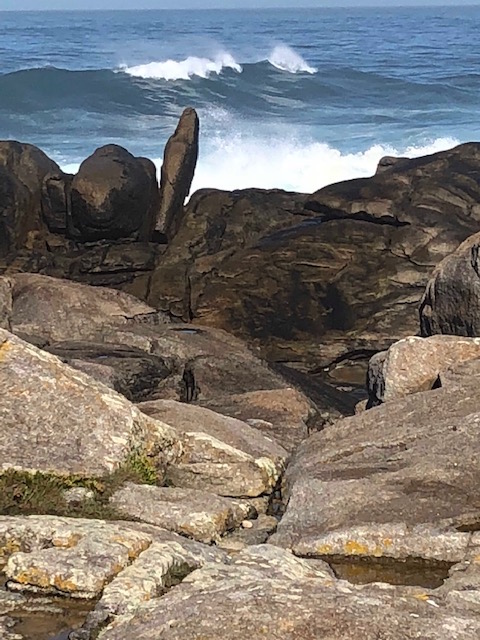
This is the official end of the Camino, so we head out to find the Camino marker noting 00.00 kilometers and are struck by the view before us; the waves crashing against the rocks, its sound both thunderous and serene. There is an ominous feel to this beauty; this area is part of the treacherous Costa de Morte (Coast of Death), known for its many shipwrecks.

We peek into a window of Our Lady of the Boat Church. Struck by lightning on Christmas Day 2013, only the outside has been fully restored and it lacks an interior roof. According to legend, it was on this site that the Virgin Mary met St. James and encouraged him to preach throughout Galicia. It is believed that by a miracle of God, the body of St. James was carried by boat to Muxia, then taken to Santiago.

I am drawn to the area’s spiritual and mystical side and am anxious to find the rocking stone (Pedra de Abalar). Balanced just right, it sits straight up and rocks with the wind. It is said that it has magical powers; touching it can provide spiritual and physical healing.

We find a rock to sit on and soon I am deep in thought, mesmerized by the sound of the ocean. Time seems to stand still. I think about the many pilgrims before me that have sat in this same spot and reflected on their physical, mental and mystical journey with only the screeching of the seagulls to distract them back to reality.

Oct. 17: Muxia

There’s not much to do in a beach town on a rainy day, so it’s a good time to do some writing, reading and plan our upcoming itinerary. We’ll have some time left before we are to meet Big A* in Madrid, so we grab a window seat at our hotel’s café, order some tea and get to work.

By evening, our work is completed and we toast with a glass of wine in the same window seat and decide to venture over to the harbor for dinner. Known for its fishing industry, it is said that the boats you view while you are dining have just unloaded the fish you are dining on for dinner. Once again, we choose a window seat and after much discussion with the waiter (whose dream is travel to the U.S. and drive Route 66) select just the right seafood dishes and white wine to complement them.

Photo Finisterre

Oct. 18: Finesterre

Finesterre is Latin for “end of the earth.” Back when the world was still thought of as flat, this was considered its end. Like Muxia, this town also has a population of 5000 and is also a fishing port, but there is something so much more charming and robust about this city. It has a thriving city center and streets that meander up and down, along the ocean. The Hotel Langosteira has a great vibe. Its whimsical décor features colors of the sea; mosaic tiles in the shape of fish design the walls and even the key chains are wooden fish. Our porch has a view of the ocean and we already plan to make sure we’re up early to see the sun rise.

We get our bearings by walking from one side of the town to the other, scoping out places for dinner by the water.

Oct. 19

We head to the lighthouse, the area’s beacon since 1853, and pause at the bronze boot statue. Perched on a rock, it’s a symbol to all pilgrims of the end of the journey. Signs request that pilgrims no longer practice the ancient ritual of burning an article of clothing here as a symbol of new beginnings, but up ahead we notice a tight group of people standing in circle holding hands and smoke billowing out from the center.

I wish we would have known about the O Semaforo Hotel balanced on the cliffs, but we settle for a beer on their patio overlooking the ocean. While we are initially surprised at the number of tour buses and pilgrims here, as we climb up to the boulders that surround the ocean, there is unexpected silence. Unlike the rough seas of Muxia, here the ocean is tranquil, lapping at the sun dappled rocks, lulling you into awe and leaving you speechless.

I situate myself on a flat rock and sit cross legged with my eyes closed and my hands in prayer at my heart. Out of nowhere, I hear the sound of a flute; a young man has chosen this spot to play for tips. His melody is harmonizing with the sound of the waves and I experience such peace. For a moment, I feel as if I am outside my body and wonder if this is what practicing meditation correctly feels like. The word “peace” keeps coming to mind and I tell myself that I don’t want to forget this feeling when I go back to my busy life. Eyes now open, I feel energized, yet so serene.

We walk back through town and head to the beach. We’ve read of a famous restaurant right on the beach and decide to splurge on a late lunch at Tira do Cordel, enjoying the razor clams and grilled fish. Afterward, we walk the length of the beach, searching for shells and dipping our feet in the water.

It’s been a long day. As we head back to our hotel, I notice two older pilgrims walking toward us. The one that looks like Santa Claus (except that he’s wearing sandals and shorts) stops in front of me and hands me something. I hesitate and shake my head no, but he insists and says “…Yes, for you…” He walks on and I look down to see what he has given me. It is a card with a hand drawn picture of a dove in royal blue paint. Across the bottom are the words “…Peace, Paz…”


*Who’s who? See “Cast of Characters” on the “About” page.

Oct. 13 – 15: O Pedrouzo to Santiago de Compostela

Photo Santiago

We made it to Santiago!

Oct. 13: O Pedrouzo to Santiago- 13 miles, 5 1/2 hours

As we make our way to Santiago, the wonderful scent of the eucalyptus forest and the old, gnarled trees, that resemble the talking trees in the “Wizard of Oz,” distract us from the fact that the inclines and descents today are quite steep.

A city sign announces that we’ve made it to Santiago and we’re getting excited, even though we still have a 45 minute walk on asphalt to the historic city center. One minute we are walking through a dark tunnel serenaded by a bagpiper and the next minute, we exit into the light of day with the Cathedral welcoming us in all its glory. We hug hard and long in the Praza do Obradoiro (the golden square), amongst the other pilgrims who are laughing, crying and/or laying on the ground and looking up at the cathedral. It’s a very emotional moment; we are glad to have arrived, but sorry to see it end.

Santiago is the capital of Galicia and a UNESCO World Heritage Site. And if welcoming pilgrims and tourists isn’t enough excitement for one city, there is also a festival being celebrated. Tents selling grilled meats, artisan bread and foods share space with clothing and jewelry. The streets are filled with jubilant crowds and bagpipe music fills the air. Baby grand pianos have been placed all over town with an invitation to sit down and play.

The Hostal Aires Nunes is just two blocks from the Cathedral on a quiet back street. Our room is decorated in the Spanish version of country French: stone archways, wooden beams on the ceiling, iron chandeliers and a lovely glassed-in sun porch outfitted with two chairs and a table.

What a nice surprise to run into the pilgrim couple from Tacoma, Washington that we met last night when eating pizza. We enjoy another dinner together and plan to meet again tomorrow too.

Oct. 14

We arrive at the Cathedral early to get a seat for the noon pilgrim mass. According to legend, St. James, one of Christ’s Twelve Apostles, was buried in a nearby forest by his disciples. In 1075, a sanctuary began to be erected around his relics resulting in today’s monumental Cathedral. The highlight of the mass is the swinging of the Botafumiero, the largest incense burner in the world. Originally, its purpose was to fumigate the sweaty and disease-ridden pilgrims. Six attendants continue the ritual of the swinging which reaches a speed of over 40 miles per hour.

Unfortunately, we are not able to touch the central column of the Door of Glory; too many hands before us have eroded the marble, so it is now covered with plexiglass. We do, however, maneuver through the crowds to the crypt under the altar to view the relics of St. James and offer up a prayer.

Next, we head to the Pilgrim Office to obtain our Compostela (certificate of completion). The line snakes around and we’re told it’s an hour wait, but running into our pilgrim friend from Lake George, New York makes the time fly by.

She tells us of the older man that she had first met on her flight to Spain. His wife had recently died and he felt so lost and alone. She then confided that she had also lost her spouse, so understood his pain. What a surprise it was to see him exit the same hotel elevator that she was entering in Santiago, now over a month later. They dined together that night and he seemed like a different person, recounting how he had learned so much from the pilgrims he had encountered along the way. The emotionally charged conversation also taught her a thing or two and she felt as if she had come full circle along with him.

We hugged and a minute later, she was lost in the crowd. I stood there with tears in my eyes, wanting to hold on to this newfound relationship, then realizing that I had none of her contact information. This is the essence of the Camino; the deep connections that you make with pilgrims from all walks of life and from all over the world that are even more precious because they are in the moment.

Oct. 15

The weekend crowds are gone, so we head back into the Cathedral to do a little more exploring. Today, we are able to view the church in all its glory and the Baroque altar glittering with gold stands in full view. All through Spain, whether the smallest of villages or the larger towns, the amount of money that the Catholic church has spent on its churches through the years is astounding. It’s hard for me to fathom that I am one of the many pilgrims that have arrived here since the Middle Ages, taking time to reflect at the end of the journey just as they did all those years ago.

After a walk through the public market and a lunch of grilled pulpo (octopus), we spend the afternoon exploring the narrow, winding, cobblestone streets. Then, it’s time to meet the pilgrim couple from Tacoma and toast both husbands, who will soon be celebrating a special birthday, just one day apart.

No one seems to want to go home after the Camino. Our friends are off to Porto, Portugal and we are headed to the “end of the earth.”


Oct. 10 -12: Palas de Rei to O Pedrouzo

437A6CB9-4AF2-49AA-9C9A-995586119D03

You never know what you’ll find around the next corner.

Oct. 10: Palas de Rei- 16 miles, seven hours

It always surprises me when a pilgrim walks by me smoking, but in Europe cigarettes are part of the culture. It’s very common to see generations of the same family all smoking together at the local cafe.

As we travel through woods and farmlands, I sense that the inclines and descents are steeper than yesterday. We’re traveling through dairy country and corn cribs are everywhere. They look like little houses on stilts and are used to dry and store the corn used to feed the animals. To make the time go by, we play a game, calling out the oldest (one said 1856 on it), newest, most decorated and most likely to fall apart if blown on. I tell Mr. Wiz* that I’d like one for my birthday. I hope he knows I’m kidding.

Pensíon Palas is a bit outside of the city and we’re glad to finally arrive. It’s nothing special; plain, but clean. We head into town and see our Canadian friend, who asks us to join her for a glass of wine. We enjoy hearing about her adventurous life, starting with boarding school in Belgium, then living abroad in different cities. She excuses herself in order to enjoy her bathtub (most rooms only come with a shower) and we head to dinner.

Oct. 11: Arzúa- 16 miles, seven hours

The forecast says rain and we trudge up and down through farmland all day long. Just as we’re heading for the steepest part of our trek, we meet a pilgrim from Lake George, New York. We pass the time with my stories of the many happy childhood vacations there. The Caldo Gallego we find for lunch is good and hot and it hits the spot. It’s my favorite soup, made with onions, white beans, potatoes, kale and/or cabbage.

Just as we see the sign for the turn-off to Casa Garea, the rain turns to drizzle. As we head into the eucalyptus forest, the wonderful scent and the singing birds help us to forget for the moment that we feel like two wet rags.

The buildings are old, but the beamed ceilings, stone and starched white linen curtains give it a homey feel. After settling in, we enjoy a glass of wine in the common area. Our Lake George friend greets us with a big smile and announces that this is the first time on the Camino that she will have a private room. We tease her that she will not be able to return to the albergue bunk beds. When we notice a single place setting at one of the dining room tables, we invite her to join us for dinner and a good time is had by all.

Oct. 12: O Pedrouzo- 15 miles, seven hours

It’s drizzling, but we head back through the eucalyptus forest to return to the Camino route with a spring in our step, thinking of the bacon and egg breakfast we plan to treat ourselves to.

The rain is playing a game with us all day; every time we decide we’re too hot and take off our raincoats, it starts to drizzle again. In the end, we decide that the cool mist feels better.

We’re walking right through farms all afternoon, so much so that at one point a farmer asks us all to stop, so his cows can cross the road to his other pasture. The drizzle turns to a pouring rain and the cows are the only ones that seem content.

Pension LO is only a couple of years old. It’s all white decor and contemporary feel are a welcome change. I like the quote that decorates the wall above our bed in script: “The best things in life are the people we love, the places we’ve been and the memories we’ve made along… the Way.”

Only breakfast is served in their dining room and we are not looking forward to having to head to town for dinner in the driving rain. The woman at reception asks us if we’d like to order pizza from a local takeout place, the two couples eating in the dining room give us a thumbs-up on the food they are enjoying and we are so happy that we don’t need to venture out. We enjoy a cozy evening, dining and chatting with the couples from California and Washington state.

*Who’s who? See “Cast of Characters” on the “About” page.

Oct. 7 – 9: Sarria to Portomarín

571B5230-58AE-4216-BDE8-AC7BCD81F49C

Oct. 7: Sarria

Our next stop should be O’Cebreiro, but there are no rooms available anywhere (we even try three towns before and after), so we opt to bus to Sarria. As the Camino gains in popularity, it’s becomes harder to be spontaneous. Then again, we could have followed the three pilgrims who left at 5 a.m., walked in the dark for three and a half hours, then waited in front of the municipal albergue for two hours until they opened (they don’t accept reservations) and did make it to O’Cebreiro.

We are on the bus to Lugo, but the bus arrives late and we miss our connection. Rather than wait four hours, we find that there is a train leaving sooner and decide to walk over to the train station. Two women pilgrims from South Africa ask if they can tag along. Chatting with them in the bus station makes the time go by and we are soon on our way.

Hotel Alfonso IX can’t seem to decide if it’s a modern or an Old World hotel, so it’s somewhere in the middle. It’s a perfect day to sit on their outside patio right on the river and enjoy a glass of wine. We soon strike up a conversation with a pilgrim from Canada. This woman has grit; not only is she a single mom, she’s traveling alone and got bedbugs her very first night on the Camino!

A word here about bedbugs; we’ve heard a lot of horror stories along the way, but have never personally experienced any. When we travel, we are in the habit of checking every hotel bed, regardless of the hotel’s level. As soon as we enter the room, we strip the bed and check it from top to bottom, looking for any black dots. If none, we are good to go.

Oct. 8: Sarria

First priority on our rest day is to get our laundry done. The laundromats are a pleasure to visit; clean, with bowls of hard candies, tissues and copies of the latest tabloid magazines for their guests. The magazines help us practice our Spanish, even though we don’t know any of the people that are featured.

One of the other pilgrims doing laundry introduces himself. He is a professor at the University of Alabama with a Ph.D. in divinity studies and is taking a survey about spirituality while on the Camino. Would we mind completing a survey? We are happy to do it and it helps the time to pass quickly. He jots down his email and says he’d be willing to share his findings once the data has been analyzed.

Oct. 9: Portomarín – 14 miles, 6 1/2 hours

Nothing like starting the day with a steep vertical incline, but we know we are headed to a breakfast of eggs, bacon and thick hunks of bread, so we power up and keep moving.

The path will be more crowded now, all the way to Santiago. Pilgrims that walk these last 100 km will also be entitled to a Compostela, the document of completion. We chat with pilgrims from Canada, Seattle and California and all agree that we can tell the newbies by their clean boots. Somehow, between the barking dogs, mooing cows and throngs of new pilgrims, we seem to lose the crowd, find ourselves all alone and appreciate the silence. The faint sound of bagpipes coming from the woods sounds magical. We come around a turn and in the middle of nowhere stands a young man dressed in traditional garb, playing proudly, for tips.

We are not enjoying crossing over this long bridge. The guard rails are very low on each side and we try to stay right in the middle, not looking down at the river below on the one side or the oncoming traffic on the other.

We are so happy that our hotel is the first one in town. Vistalegre is a brand-new contemporary hotel, only four months old. Though it’s all white, the mix of textures (stone and tile) give it a sophisticated look and the sound of the water sculpture from the glass enclosed garden is a lovely touch. The rooms are not very big, but we vote the shower the best on the Camino.

Later, we run into an older pilgrim from Michigan that we first met at the beginning of the walk. He was initially so shy and withdrawn that we always made it a point to say hello and walk with him a bit. Now, here he was, greeting us heartily, laughing and chatting away. He introduces us to his new friend, another pilgrim who is about his age. It is wonderful to see them interact, despite the fact that neither one speaks the others language. It is said that the Camino provides and once again, it’s beautiful to see it unfold.


Oct. 4 – 6: Rabanal del Camino to Villafranca del Bierzo

78487E87-9F8B-469F-9252-C5F2B88529CE

San Nicholas Real Monastery

Oct. 4: Rabanal del Camino- 13 miles, five hours

I prayed, practiced positive thinking and E.F.T. (the psychological form of acupuncture) and even had a long talk with my right knee, but she was stubborn. She had no intention of healing until she was ready. And, in 10 days as quickly as it happened, my knee miraculously healed.

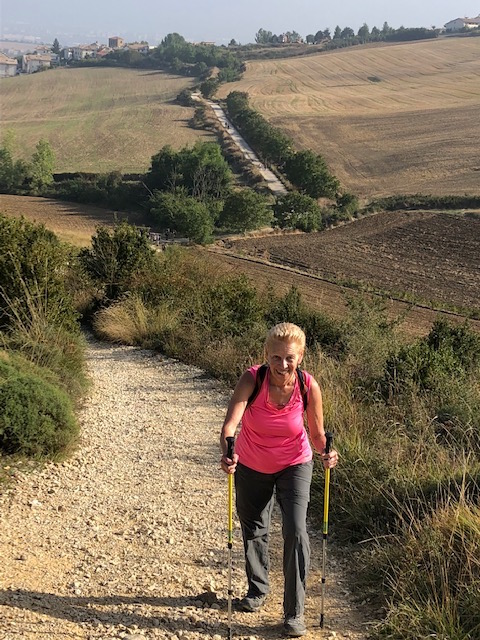
I am so happy that I think even the scruffy brush we are walking through is beautiful. In the quiet of the morning, I find myself hypnotized by the mosaic patterns on the hard ground made by the grids of the many boot soles that have passed here before me (over 300,000 completed the Camino in 2017). I look up to notice that the earth is such a beautiful copper color it looks as if it’s been painted. It’s a fairly flat path, so I amuse myself by wondering what is behind the ancient stone buildings (some thousands of years old), with majestic wooden doors. Are the homes beautiful and modern inside? Or, does the outside reflect the inside?

The front door of the Hotel Rural Casa Indie opens to a courtyard and all the rooms encircle it. The room’s French doors and beamed ceilings give the rustic feel we expected, but the old wooden floor planks are so uneven that a trip to the bathroom in the dark will be an adventure.

Before dinner, we head to the church for Latin Vespers led by the Benedictine monks. It is beautiful in its simplicity. The original stone on the barrel-vaulted ceilings and the walls peeks out from ancient paint. When the lights are turned off, the crucifix on the wall behind the altar, lit from above, has an even more dramatic presence. One of the monks walks around the pews and blesses us all with holy water. Afterward, we greet one of the monks who speaks English and he is so pleased to hear that we enjoyed the experience.

Oct. 5: Molinaseca: 16 miles, eight hours

What a lovely way to start the day; first watching the sun rise as we are walking, then being serenaded by a young pilgrim, who has carried his guitar with him every step of the way.

We’re on dirt roads most of the day, which narrow and widen as we walk. My favorite are the narrowest parts, when only one person can barely fit and the trees envelop you.

The closer we get to Alto Altar, the highest point of our entire journey (4550 feet) and Cruz de Farro, the more emotional I become. The plain metal cross stands on a mountain of stones like a beacon to pilgrims. Two days ago, I could barely walk from my bed to the bathroom and now I am almost there, ready to fulfill one of the highlights of our journey. We’ve brought two rocks from home and wrote the names of two special people who are very dear to us. We find just the right spot, wipe our tears off them, say a prayer, then nestle them in among the many other rocks. The ancient legend is that by leaving the stones behind, you are turning over your burdens to God.

The steep inclines and descents seem as if they will never end. Between the loose rock and shale, horse and cow manure and chestnuts in shells that resemble Nerf balls (except that these are covered in needles), you have no choice but to stay focused. I while away the time by thinking of the salad I am hoping to find for lunch. We turn the corner and come upon the cafe where we had the best salad of our 2016 trip. The husband and wife owners are so pleased we have returned and tell us we have made their day.

We quickly settle in at Hostal el Palacio so we can sit outside and have a glass of wine with a view of the river, the bridge and the mountains. The lovely old stone building houses rooms that are a combination of Old World and modern.

We take a walk around town and agree that the town looks like a movie set; the old stone buildings and street lights are all from a time gone by. Four teenage girls sitting on a bench with their iPhones and the Mercedes that cruises by look totally out of place.

Oct. 6: Villafranca del Bierzo: 19 miles, eight hours

It’s better that I didn’t realize beforehand that this would be our longest walk of the Camino. Luckily, it’s in the 70s (great walking weather) and the path starts out fairly flat. A walk through a neighborhood of mansions is particularly entertaining.

It seems as if we are walking up and down through vineyards for miles and miles. All of a sudden, dark clouds sweep over us, the wind picks up and it starts to rain. We already have our rain gear on, so there’s nothing else to do but take turns singing Broadway show tunes to pass the time on this unending path.

Villafranca del Bierzo (population 3500) traces its origins back to the year 791. The village flourished during the Middle Ages as an important resting spot before the mountains of Galicia for pilgrims on the Camino and still provides that same service all these years later.

Of all the days, we need to walk through the entire town to get to where we are staying: the San Nicholas Real Monastery. The sheer magnitude of the building is overwhelming. Built in the 17th century in the Baroque style, the courtyard and cloisters would be lovely to visit on a nicer day. Our room is small and all white with some basic wooden furniture, but it’s clean and the window shutters open to reveal a view of the town.

As we head up to our room, we are surprised to see our friend from Arizona. We catch up and promise to keep in touch, hoping we can plan to meet up again.

After such a long day, we agree that we will not venture out this evening. We are the only ones in the dining room and admire the frescoes on the wall and the vaulted ceilings. Enjoying dinner in our private dining room to the sound of a Gregorian chant playing softly in the background, this may not be the best menu del dia we’ve ever had, but tonight it sure seems like it is.