Unknown's avatar

About Lathornton

Author, Writer and Blogger: amoxiegirl.com

Oct. 8 – 13: Burgos to Carrión de los Condes

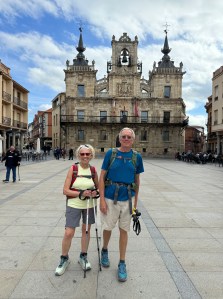
Our favorite building in Burgos

Please note:
– e = euro. The dollar and the euro are currently almost equal in value.
– Mr. Wiz = my husband, Michael, who is well versed on almost every subject and seems to know the answer to almost every question.

The French Route
Oct. 8: Madrid to Burgos
The Renfe high speed train station and plaza are jam packed. In typical Spanish fashion, people are talking, laughing, drinking, and eating. After our long travels, we opt for a quiet dinner at the nearby Charmartín Hotel dining room, We enjoy two glasses of wine each, along with a delicious three course dinner for 24 euros each. In Texas, $24 would barely cover two glasses of wine.

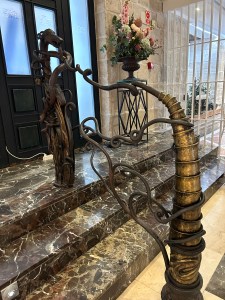
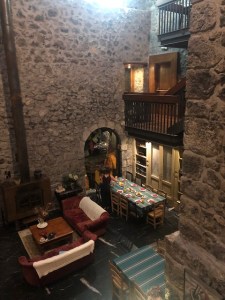
The entry to Hotel Rice Palacio Balsones

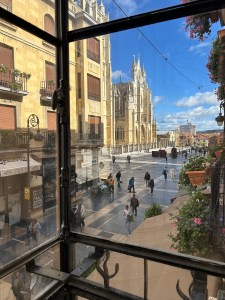
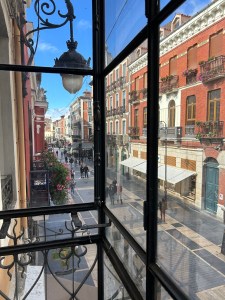
Hotel Rice Palacio de los Blasones, located in Old Town Burgos, a perfect location, is charming. Our room’s beamed ceilings, stone wall, and small balcony balance well with the contemporary furnishings.

Oct. 9: Burgos
Burgos still exhibits signs of its medieval splendor. The esplanade with its topiaries and sculptures, is the place where families and friends still dress up, meet (originally in horse and carriages, now strolling), and stop for a drink or a cafe con leche (espresso and steamed milk).

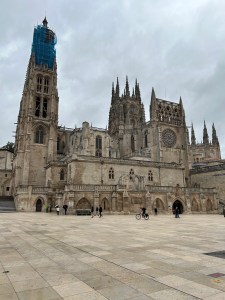
The capital of Leon and Castile for five centuries, its 12 entry gates and winding cobblestone streets give the city old world charm, but it’s the cathedral that is its highlight.

Cathedral de Santa Maria de Burgos

Construction on the Catedral de Santa Maria de Burgos began in 1221 and ended in 1567, bringing together famous architects and artists of the day to perfect the Gothic style of this UNESCO World Heritage Site.

What is a UNESCO World Heritage site?
In 1972, the United Nations Educational, Scientific, and Cultural Organization (UNESCO) adopted a treaty for “the identification, protection, and preservation of natural heritage around the world.” This agreement is unique in that 195 countries have pledged to secure the world’s most significant natural and cultural heritage from threats such as natural disasters, mass tourism, wars, and construction.

Rodrigo Diaz de Vivar, known as El Cid, is buried in the cathedral. The 11th century nobleman and military leader was born near Burgos and is Spain’s most celebrated national folk hero.

We arrive on the tail end of a hurricane. We haven’t started walking yet, so the heavy winds and occasional drizzle doesn’t affect us, but we later hear stories of some near accidents from walking and cycling pilgrims who were unaware of the storm’s magnitude.

Sunflowers and “suede” landscape

Oct. 10: Hornillos del Camino- 12 miles
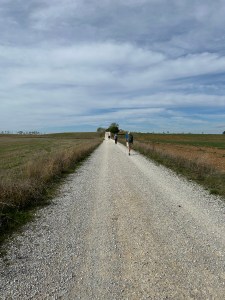
“Dale!” (Let’s do it!) It’s cloudy and cool; perfect for walking. The sunflower fields go on forever, with the sunflowers proudly standing straight up, not realizing that their golden flowers have given way to dead, black ones. The fields are a patchwork of fall colors, all mowed down for the season into what looks like suede. 

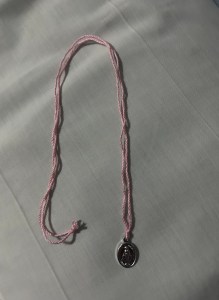
My necklace for the rest of the trip

We stop at a church to get a “sello,” a stamp on our pilgrim passport, which will be a lovely souvenir of places visited. The long line of pilgrims doesn’t deter the enthusiasm of the two nuns greeting each of us. When it’s my turn, the nun not only presents me with a medal to wear, she also blesses me and clasps my hand. I feel overwhelmed with emotion and vow to wear the necklace every day.

Flowers cheer up the building

Hornillos del Camino is a dilapidated town. With a population of 70, the decrepit buildings are a hodgepodge of different building materials. As with all of these old towns, they were once bustling commerce centers along the Camino and seem to come alive again with the arrival of pilgrims. They proudly continue their tradition of serving pilgrims and are grateful for the economy they bring.

La Casa del Abuelo is plain and old, but it’s clean and welcoming. Their sheets billow in the wind on the clothesline, interspersed with pilgrims’ clothes. The courtyard, with its unmatched tables and chairs, takes on an upbeat vibe, as pilgrims talk and laugh. A pilgrim from Idaho, with seven children and 14 grandchildren, regales us with his adventures of shooting feral hogs in Texas for $50 each and being welcomed into a motorcycle gang he had no interest in joining.

The sign on the bar says it’s closed for an hour and I assume the señora/owner is taking a rest. I happen to glance through the window and watch her lovingly feeding her mother and imagine how very full her days must be. When we leave, I tell her how special she is to care for family and for us and we hug.

A yellow arrow points the way to Castrojerez

Oct. 11: Castrojerez- 13 miles
We’ve just enjoyed our first, second breakfast; a Camino tradition. It’s a cool, quiet morning and the rocky trail keeps us focused on our footsteps. We stop at the Ruinas del Convento de San Antón, a monastery from the 14th century, which devoted itself to caring for pilgrims.

Castrojerez’s Main Street

With a population of 500, this sleepy town mirrors Hornillos. There’s not much to discover on our walk around town and we joke with a couple from Northern Ireland, asking each other if there’s something we’ve missed. The senior couple both live on the Irish Sea ( she swims in the see each morning!) and they met by chance on the beach only a year ago. We all agree, if we lived closer, we would be fast friends.

El Manzano, our alburgue, is plain and clean. We are glad for the savvy companies that deliver ready made pizzas, pastas, and paellas to these establishments, leaving their customers with just the task of heating them up and serving them hot and fresh to us. Our dinner entertainment is hearing the story of a family cycling the Camino with a 10 year old ( who is also biking) and his mother pulling an infant carrier. When they finish the Camino, they plan to camp in Morocco for six months.

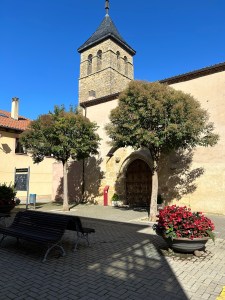
The church in Castrojerez sparkled as we left in the early morning

All the way up, then all the way down!

Oct. 12: Fromista- 16 miles
We immediately start the day with a strenuous long, steep climb and an even steeper descent. Both seem never ending, but we are entertained by stories from couples that moved from St. Louis to the Virgin Islands and from Washington D.C to Sitka, Alaska. We make it a point to stop every two hours, take off our packs and hydrate, to help us keep going.

With a declining population of 840, Fromista also mirrors Hornillos, except for its Inglesia de San Martín, which is said to be the finest example of Romanesque architecture in Spain!

Spanish “bubblegum” body wash and shampoo!


Ready for a shower, we can’t seem to find any soap in our room at the Hotel Rural San Pedro, another plain and clean establishment. It seems the soap dispenser is in the shower and it makes us laugh. At home, we are so fussy about what shampoo and soap we use, but here the neon hot pink soap is just fine with us.

It’s a holiday, there are limited restaurant choices and pilgrims are hungry. Many of us line up outside a place that opens at 6 p.m. (and not the usual 8 p.m.), and are disappointed to find out a group of Korean travelers have reserved the entire restaurant. Thank goodness for the small bar that serves that same prepared food we enjoyed the day before.

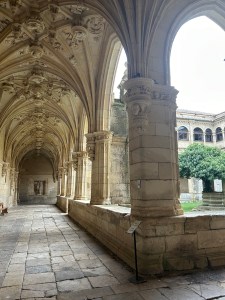
San Zoilo: view from our room


San Zoila cloisters

Oct. 13: Carrión de los Condes- 12 miles
Famous Camino guidebook author, John Brierley, calls this part of the walk the “soulless senda” or path. Whether it’s the two, narrow, side by side paths that run alongside nondescript fields or the highway, this becomes the perfect time for reflection and introspection.

This time, we found the staff aloof and preoccupied and later were disappointed to find out other pilgrims staying there were never invited to visit their lovely church, museum, and cloisters, nor were they told about the discounted dinner menu for guests of the hotel, which we asked about and did receive.

Mr. Wiz has taken it upon himself to be in charge of doing our laundry. The laundromat is busy and chaotic, with pilgrims from all parts of the world waiting their turn. We laugh with a woman from Canada who’s next and says she’s not sure if she should place her laundry bag in front of the machine or just sit in front of it. Mr. Wiz explains the process to anyone that looks confused and I ask him if he’s running for mayor or just wants a job running the place.


.


.


,


Mud, Sweat, and Tears: Why the Camino Keeps Luring Us Back

When family and friends heard we were heading back to the Camino, their first question was “Why?!” They wondered what it was about walking miles, on all kinds of terrain, in all types of weather, and for days on end that made it alluring.

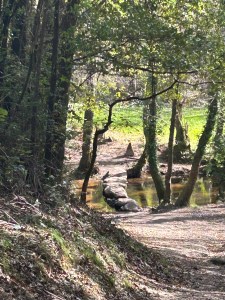
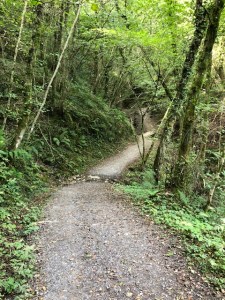
The good terrain

The not-so-good terrain

What is the Camino?

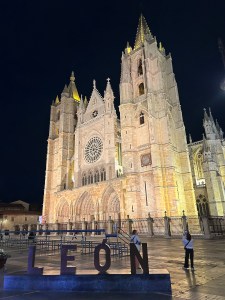
In the ninth century, a local bishop ordered a church to be built to house the remains of St. James, when they were discovered in the northwestern Spanish town of Galicia. Over time, the church grew into the grand cathedral of today, and the city became known as Santiago de Compostela – “St. James under a field of stars.”

Throughout the Middle Ages, people started their pilgrimages from their homes, which created the many routes still used today. Yellow arrows mark the routes to help pilgrims navigate. Along the way, churches, restaurants, and places to stay, stamp a pilgrim’s passport to prove they have walked the minimum 100 kilometers/62 miles required to receive the coveted certificate, or “Compostela,” from the pilgrim office in Santiago.

There are many reasons why people choose to walk the Camino. It evokes a physical, mental, spiritual, and mystical experience unlike any other.

You never know where you’ll find a yellow arrow

It’s Your Camino

Though walking is the most popular way to travel the Camino, some ride a bicycle or travel on horseback. You can travel as much or as little as you would like each day. If you tire, buses and taxis are available, and there are companies offering daily backpack transport.

You can choose to stay in a “donativo” – a mat on a church floor for a donation, a five-star hotel, and anywhere in between, such as an “albergue” – a pilgrim hostel or a “casa rural” – a guesthouse. You can make a reservation ahead of time or see where the wind takes you when you arrive in a town. To keep you energized, the three-course pilgrim meals are delicious and offered at a bargain.

Hotel Antsotegi in Etxebarria was an old iron mill turned hotel

The Olé of Spain

There’s an exuberance and an elegance to life in the Spanish cities. Working to live, rather than living to work, allows time for family and friends. Music and culture are relished, every meal is savored, and life is lived at a slower pace.

Spaniards still enjoy the tradition of the paseo. They dress up for their stroll through a town’s main street or plaza to greet family and friends. No doubt there will be stops along the way for a café con leche y dulce – espresso coffee with hot milk and a sweet – or vino y tapas – wine and appetizers.

The small towns have a charm of their own. As if traveling back in time, a car driving through the street is almost startling. At times, you may be walking through a herd of sheep or visiting a small church, and the simplicity of the moment leads you to ponder your own life.

Estella, Spain was founded in 1090

Pilgrim Power

“Buen Camino!” Each day, pilgrims wish each other a good walk as they pass each other by.

We are all heading to the same place – the Cathedral in Santiago de Compostela – which creates instant camaraderie. There seems to be no interest in who you are at home. Here, everyone is equal.

Encountering pilgrims from all over the world, you begin to realize there are very few differences between you. Very quickly, they are no longer strangers. Your interaction might be days/weeks together or just a few words in passing. Pilgrim families are created, and members may keep in touch for a lifetime. Sometimes just a quick exchange can become crucial to helping you think through an issue in your life.

You feel a positive energy around you each day. The genuine hospitality encountered by people from all walks of life throughout Spain seems to rub off on the pilgrims, who, in turn, are there for their fellow travelers. Whether it’s with a hug, a band-aid, directions, or just a listening ear, there’s a loving spirit that makes you wonder why people aren’t always like this.

Me, Myself and I

You feel an ongoing gratitude for the simplicity of each day, its daily rhythm, and the chance to reboot, as you discover the Spanish culture in slow motion. It’s easier to listen to yourself when it’s quiet and the peaceful solitude of walking alone is a nice balance.

The freedom from everyday obligations and the luxury of being unplugged from the stimuli of our daily lives gives you more time to focus on the world around you. Traveling with only the belongings that fit in your backpack makes you feel lighter. You sometimes feel as if you were turned inside out, with your senses heightened and your mind clear and open.

The mud and sweat are understandable parts of the walk. As your journey ends and you enter the plaza of the Cathedral in Santiago de Compostela, you wonder if your tears are because you conquered the goals of this demanding trip or because your journey has come to an end.

This sign shows the distance from Georgetown, Texas to Santiago de Compostela, Spain
“Live for the moments you can’t put into words.”
“The end is just the beginning”
Authors Unknown

For more information on the Camino:
Watch the movie that resurrected the Camino in the United States in 2010. “The Way” starred Martin Sheen and was written, directed, and produced by his son, Emilio Estevez.

Listen to Dan Mullins’ podcast “My Camino the Podcast” which showcases Camino stories from pilgrims from over the world.

Go to the American Pilgrims on the Camino website which shares information, supports American pilgrims, and subsidizes Camino-related projects with grant money from its dues.

Author’s Note:
IIf you enjoyed this post, please scroll down, like it, and feel free to share it!

Camp Lucy: Luxury + Nature

There are some occasions when dining out doesn’t seem like enough. Our 40th wedding anniversary celebration was one of those times and we decided it was the perfect opportunity for a getaway.

Dripping Springs prides itself on offering wedding venues of all kinds

Wanting to try someplace new, after much research, I came upon a resort called Camp Lucy. It is fitting it should be in Dripping Springs, Texas, designated the Wedding Capital of Texas by the Texas House of Representatives in 2015. Located in the Texas Hill Country, known for its picturesque landscapes, the town boasts 35 wedding venues.

Camp Lucy History
Whit Hanks promised himself he would keep the 282 acres he had inherited, away from the hands of developers. With lovely memories of times spent there during the summers, the original home still stood on the grounds.

A former antique dealer turned real estate developer, Whit was on an antique excursion in Vietnam when he came upon the frames of a church and a town hall. Struck by their beauty, intricacy, and workmanship, he purchased them on a whim. Taken apart carefully, each piece was coded and wrapped individually before being shipped.

Not sure what their final purpose would be, he first had the church reconstructed on the property and named it Ian’s Chapel, after his son who had died. Back in 2010, when Whit hosted the first wedding at Ian’s Chapel, there were only three wedding venues in Dripping Springs. Whit jokingly says Kim, a local event planner, started bringing him so much business that it was in his best interest to marry her.

His mother, Lucy, was the inspiration for the resort’s name. With combined creative vision and attention to every detail, Whit and Kim added a pool and lodging. The town building took three months to rebuild into the restaurant, Tillie’s, named after Whit’s grandmother, Attila Hancock. Attila was a prominent Austinite, whose husband, Lewis, served as mayor from 1895 to 1897. Attila and Lewis founded the Austin Country Club, whose golf course is the oldest continuously operated golf course in Texas.

Tillie’s
Driving up the long driveway, we were welcomed by the stone pillars and the Camp Lucy sign. The check-in area held the gift shop and the entrance to Tillie’s. The 400-year-old turquoise doors from India were slightly open, as a tease of what was to come. Pushing open the heavy doors, we were awestruck by the sheer beauty and unexpected uniqueness of the space.

The intricately carved wood frame encircled the space. The French statues of saints are set in individual alcoves from Whit’s private collection. The complex geometric tile flooring was designed for the space. No wonder Tillie’s was voted the most beautiful restaurant in Texas by People magazine and Open Table in their listing of The 50 Most Beautiful Restaurants in America.

We arrived in time for Sunday brunch and agreed, in fairness to our palates, that all meals should be shared. The smoked brisket hash had just the right combination of perfectly prepared brisket combined with potato, onion, peppers, and avocado crema and was topped with sunny-side-up eggs. The dark yellow egg yolks gave a hint that their chickens had recently laid them. The avocado toast was the perfect complement of (freshly baked?) sourdough bread piled high with avocado, cilantro, pickled vegetables, and cotija cheese. Sorbet with fresh berries was just one of the complimentary, anniversary, treats we were surprised with during our visit.

Of course, we dressed for dinner and made a toast with our complimentary glass of Champagne. Watching the beautiful presentations of plates pass by us, we finally decided on a starter of crisp baby romaine, which was much more complex than its name. The piparras peppers, from Spain’s Basque region, were mild and sweet, the pistachios were smokey and the olives, tomatoes, and herbs atop an avocado green goddess dressing were the perfect savory compliment. It was difficult to leave even a dot of the delicious shellfish cream sauce that covered the agnolotti pasta stuffed with potato and shrimp or the spinach coulis that was drizzled over the halibut.

We wondered if the food was as – close your eyes as you savor every bite – delicious, or if the atmosphere lent itself to us believing so. As we devoured what we agreed was, the best egg sandwich we’d ever eaten, the next morning we decided we were correct on both counts.

Lodging
From the wooden key cards to the room’s leather trash cans, the selection of Vietnamese coffees, the electric kettle with various temperature controls, the robes awaiting our arrival in the closet, and the toilet tissue folded into a point, Whit and Kim’s special touches lovingly graced our room. Our Treetop Room had a private balcony that looked out to a lovely hill country view and made it hard to leave. The room’s décor gave us a peak into the couple’s private antique collection.

Our Visit
The resort offers a variety of guest experiences, some included and some for a fee. We opted for the complimentary history tour and alpaca feeding, two great ways to get our bearings. The pool area was a lovely sanctuary, and we swam, slept, and read our afternoons away.

I took a private yoga class, which was held outside on a beautiful morning. My yoga teacher, Stephanie, introduced me to mudras, a Sanskrit word meaning gestures. Mudras are hand and finger gestures that are believed to influence energy flow in the body and mind.

As we walked around the property, a surprise awaited us at every turn: an antique bird cage, a sculpture made more beautiful with its covering of moss, a vineyard producing Camp Lucy wines, an outdoor pavilion, and handmade clay tiles, both from Vietnam. We learned that the stonework, which looked ancient, was installed by master stonemason Dario Camacho. His unique style became so popular customers began referring to it as “Dario style.”

The purchase of an antique Amish barn, brought from Ohio and, once again, painstakingly rebuilt, piece by piece, showcased the simplistic beauty of the wood and its design and is now known as the Great Hall. Measures were taken to make sure the small cross etched into the wood on the outside of the barn was on display. It was a symbol, used by the Underground Railroad, as a secret message denoting a haven for escaped slaves.

The gnarled trees that had grown up and across the dirt path to Sacred Oaks gave this outdoor wedding venue a mystical feel. As the sun dappled through the trees, we walked up to the arch and in front of the empty chairs, set up in rows, had an impromptu vow renewal ceremony. Walking back, the Camp Lucy logo, a heart-shaped emblem and a Vietnamese symbol for love and family, kept appearing on tiles and stones. When we returned to our room, complimentary gold-covered chocolate strawberries awaited our arrival. Another perfect day at Camp Lucy.

Author’s Note:
If you enjoyed this post, please scroll down, like it, and feel free to share it!

Wake Up and Make Up: Airbrushing Uncovered

z

Is that really me? Getting my makeup airbrushed on for my son’s wedding was such a treat! Of course, a makeup professional with all the proper high-end equipment makes it look so easy. As the compressor sprayed a cool mist over my face, I couldn’t believe the finished look did not feel or appear heavy. Best of all, it did a great job of hiding any facial flaws!

The only real difference between airbrush makeup and other foundation is the way in which it is applied. Joette Balsamo, a makeup artist in New York City, shared some guidelines about airbrushing:

✔️Radiant finishes may be better
Airbrush foundation formulas are typically drier than traditional ones, as they must be pushed through the compressor. (The more hydrating the foundation, the more likely it will get stuck in the apparatus.) For this reason, Balsamo recommends choosing “luminous” airbrush foundation finishes, which are less likely to accentuate dryness and wrinkles.

✔️ Go for a full kit
Airbrush makeup compressors and foundations are sometimes sold separately, but pros say the best foundation for airbrush makeup is the one that comes with the set. “I think it’s always better to go with the foundation that comes with the technology because they’ve been created to function together,” Joette advises, so there’s less likelihood of error in use.

✔️ Finish with a face mist
Whichever airbrush makeup you choose, top off your look with a spritz of facial mist. “To make the look more supple, spray a hydrating rosewater or glycerin mist all over to bring some moisture into the makeup, so it looks more like skin,” she advises.

To Airbrush or Not to Airbrush?
Since the early 1900s, Good Housekeeping has prided itself on reviewing and reporting on the best products in various categories. Still today, companies vie for the coveted Good Housekeeping Seal of Approval. Their listing of The Ten Best Airbrush Makeup Products for Flawless Skin seemed like the best place to start.

Since most of their products listed were versions of either the air spraying or the aerosol systems, I decided to narrow my focus and evaluate their top two choices, in order to make a final product decision:

#1 Best overall airbrush makeup: Art of Air Professional Airbrush Cosmetic Makeup System-
$90 (Amazon)
Includes: an airbrush, a compressor system, six different foundations, makeup for contouring and a cleanser for makeup removal.

Comments:
* The compressor system is bulky to travel with
* There is a definite learning curve to this product.
* You need to practice with water first to get the feel of the different settings.
* There is a lot of trial and error, as you work to find just the right foundation color
combination, using the six colors provided.
* Working in constant motion at the same speed in a circular motion is required, making
sure not to over or under spray.
* Only using airbrush makeup foundation increases your investment.
* The tip of the airbrush gun is very fragile and will not work if bent.
* It’s very important to keep the entire system clean. This involves taking it all apart,
   which most reviews said was complicated.

Overview:
The many pages of directions for the makeup system made me realize it was probably better to have my makeup air sprayed professionally, rather than try to do it to myself at home. Honestly, it was so intimidating that I packaged it right back up and returned it to Amazon, without even trying it.

#2 Best value airbrush makeup: Jerome Alexander Magic Minerals Airbrush-
$19.99 (Amazon)
Includes: airbrush foundation spray, kabuki brush.
With this aerosol version, you just spray the foundation on the brush and apply.

Comments:
* Very easy to apply.
* Application seemed to give the flawless look I was after.
* The only thing you need to keep clean is the brush.
* The price was right!

Overview:
The winner!
I think there is something to be said for an aerosol application versus applying foundation with a sponge. I noticed the propellant created a mist on the brush, giving my skin a more polished, finished look, different from regularly applied foundation.

The best price for the foundation spray and brush I found was $19.99 on Amazon. The Jerome Alexander website listed the same product for $24 with a 15% first time discount, but shipping was $8.95 – or free if your order totaled $49.

Before placing your order on Amazon, it’s very important to choose your foundation color.The easiest way to do this is to utilize the tools provided on the Jerome Alexander website :
* Go to “Find your shade” – top right
* Click on the model that best represents your coloring.
* This brings you down to the color of your foundation, which will also help you make your
final decision.
* I choose light medium.

For over 7000 years, women have used different forms of makeup- for spiritual, ritual, status, for their healing powers and, of course, for beauty.

“Beauty is power, and makeup is something that really enhances that; it’s a woman’s secret.”
Charlotte Tilbury, makeup artist, Prada

“Makeup is not a mask that covers up your beauty – it’s a weapon that helps you express who you are from the inside.”
Michelle Phan, beauty You Tuber and founder, EM Cosmetics

Author’s Note:
If you enjoyed this post, please scroll down, like it and feel free to share it!

Image by VintageSnipsAndClips from Pixabay.

Perils of a Perfectionist

One quick glance around each room and I can size up what needs to be done. The pictures on the wall are a bit crooked and the pillows are not aligned correctly on the sofa in the living room. The chairs around the dining table are not pushed in at the same depth. In the kitchen, the spices are not in alphabetical order and the candles are not standing straight up in their holders. Just when I roll my sleeves up, intending to get to work, my friend takes me over to the side, puts her hands on my shoulders and reminds me that we are on a Parade of Homes model home tour. 

Sometimes it’s great to have a keen eye for detail and a determination to always strive for excellence and sometimes it’s a pain in my (hopefully physically fit?) posterior. Luckily for me, I was blessed with a combination of both my parents’ personality traits. My dad’s obsessive, work ethic and drive for success, along with my mom’s easygoing, go with the flow attitude, has kept me from falling off the “obsessive, compulsive cliff.”

Early on in life, I realized that I would need to take control of my tendencies. Riding that bucking bronco of flawlessness, I had to learn to lasso that energy into a healthy focus. Being aware of who I am and actually cultivating a relationship with myself made the difference. It gave me a comfort level that the rest of the world did not see. How could I possibly begin to exude confidence if I didn’t like myself? In time, I learned that the secret connection between me and my psyche was actually a simple process: just stop, look and listen:

  • Stop: I take a couple of minutes each day to close my eyes and imagine how I want my life to be.
  • Look: I try to objectively observe how I am progressing and what I might need to tweak. 
  • Listen: When alone, I compliment myself out loud and let those few short sentences spur me on. 

My relationship with myself is a humorous one. Together, we chuckle at my ability to detail the heck out of even the smallest task. We giggle at the way I prompt myself to hum a tune as a reminder not to review a past mistake over and over again. We chortle at my micromanaging tendencies, practiced under the guise of providing useful information to anyone at any time, whether they want it or not. And we have a good laugh over whether I can finish reading an article before getting up to fix something out of place on the other side of the room. 

I realized that in order to move ahead and see the big picture, little by little, I had to let go of the minutiae of everyday life. This has given me a bit of a carefree feeling so that I now only document 41 percent of my life on Excel spreadsheets (down from 92 percent) and just last week, walked past two crooked welcome mats, outside of neighbor’s homes, without the need to straighten them.  

We are all a work in progress. I now understand that I need to embrace the odd duck in me and realize that I cannot totally change who I am at this point in my life, but I can work with myself and not against myself to create the best imperfect perfect person that I can be.

Frame Your Own Pictures

She was so delighted with the print she had purchased. It reminded my mom of a favorite vacation destination. She would prop it up against the walls all-around her home, looking for just the right spot.

I was the one that decided it needed a permanent home. I devised a scheme to sneak it out of her apartment in a bag of magazines that I was picking up, and delivered it right to the frame shop, agonizing over the perfect frame and just the right mat colors that would perfectly complement the print. 

While it was a loving gesture and I was excited to present her with this surprise birthday gift, I realized later that it really was not my picture to frame; it was hers.

In a recent Ted Talk, author Anne Lamott reminded us “We can’t arrange peace or lasting improvement for the people we love most in the world. They have to find their own ways, their own answers. You can’t run alongside your grown children with sunscreen and Chapstick on their hero’s journey. You have to release them. It’s disrespectful not to. Help is the sunny side of control. Stop helping so much. Don’t get your help and goodness all over everybody.”

I am a recovering helper. For every dollar you have, I can add in my two cents in order to assist, guide, advise, suggest or lend a hand. When I like someone, I have a tendency to go overboard and when I love someone, I can drown them in the H (help) word.

It is said that helicopter parents got their name from the yuppie moms and dads that were overprotective and took an excessive interest in their child’s life. There’s a delicate balance between involvement and smothering and you have to try very hard to remember the difference. 

When our only child was younger and was starting to make his way onto the world stage, he needed us to be his attentive audience, not standing backstage delivering him his lines. Anne Lamott was right; that would have been disrespectful. You do your very best and then set them free. But, between us, a quick spray of holy water while they are walking out your door or a little mom mental telepathy never hurt anyone. 

Back then, our son and I came up with a code word. Anytime I was exhibiting an inclination toward being overzealous, he would whisper the word “Despacio” in my ear (Spanish for slowly) It was my que to slow down. This worked then and even worked recently, when I almost fell off the wagon. 

I’m sure that by now my family and friends all know that I am there for them. I will try to control my controlling tendencies (hidden under the guise of helping), but there may be times when I veer off. One Hallmark card commercial viewed at a particularly sensitive moment may trigger an outpouring of unwanted and unwarranted assistance. 

So, just in case you see me running toward you with outstretched arms, my head turned slightly to one side and that tender look in my eyes that says “I am here for you,” just return the hug and whisper “Despacio” in my ear. I’ll get the message.

Author’s Note:
If you enjoyed this post, please scroll down, like it and feel free to share it!

Duende 

A chimpanzee and flamenco dance lessons; that’s all I wanted when I was 12 years old. The chimp never materialized, but many years later the flamenco lessons did. It was my mom that found the classes through the Chicago Park District. At a cost of $25 for six sessions on a Saturday morning, it was hard to decline. We excitedly signed up together.

First things first; this called for some shopping. It went without saying that for us to do our best, we had to look the part. It took some time to choose just the right flamenco shoes, flared long skirt and fitted top. We tried them on over and over again and had fun twirling around and breaking them in.

The class was held in the guest house behind an old mansion that the Park District now owned. Arriving early, I had time to explore. The stone structure was now one big room, with only a narrow path and some boulders separating it from Lake Michigan. I didn’t realize then how inspiring it would be to dance while watching the water “dance” outside along with us. 

I must admit, I was a bit taken aback when Señora walked into the class that first day. She was older than I had expected with a soft body and a lined face. Her hair was pulled back into a tight bun and her shoes looked as if they had accompanied her on many a dance floor. But, as she walked up to each of us, asked our name and gave us a welcome hug, I noticed her black eyes. They were piercing, bright, twinkling. There was something special about her. Then, without saying a word, she played a CD, started dancing and we were transfixed. At that moment, her body changed. Her posture was straight, her hand movements so elegant, her feet moving so quickly and precisely and her dark eyes sparkling. 

As she explained the class format, we focused on her every word. A combination of Spanish, Spanglish and English, it required concentration. We would be learning four Sevillanas. These are festival dances with simple choreography; easy to master for practice and training. Or were they? The class was made up of women, all ages, shapes and sizes. Initially, we all were so intent on clumping through the steps that we forgot to use any hand movements at all. I wondered how week after week Señora had the patience to watch this clumsy group assault the classic beauty of the art form that she had dedicated her life to

What the class lacked in structure, it made up for in entertainment value. Señora would stop abruptly at any time and start regaling us with a story from her colorful past. Sometimes, she’d carefully pass around a creased, yellowed article featuring her and her husband; a handsome young couple; carefree and excited for where life would lead them. From these snippets, we were able to piece together her life story. 

Growing up in Spain, she had learned flamenco at an early age and had excelled at it. She had caught the eye of a young man in her village, a bit older than she, who convinced her parents that she should join him and his musicians and go on tour. From then on, she lived and breathed flamenco. After performing all over Europe, they immigrated to the U.S. and danced in Las Vegas, getting to know all the big stars of the time and living large. Señora’s husband was not a businessman, so when his health deteriorated and he ultimately died, she was left with nothing but her memories. 

Each Saturday, we’d arrive early to class and stay late, hoping for another story or anecdote, so were disappointed when a stern, young woman was waiting for us this particular morning. She told us her mother was not well and she would be taking over the class. Based on her demeanor, we could tell that she wanted to be anywhere but there. We tried asking questions, but she stoically answered as little as possible. 

Nothing was the same. I gave up hope that I would ever speak to Señora again, until I noticed that the young woman was on her cellphone one day and I politely asked if it was Señora. If so, could I please speak with her? I was so happy to hear the combination of languages that I could now magically decipher. I asked about her health and told her how much she was missed. I asked if we could come visit her, but she said it wouldn’t be a good idea.

I didn’t know if I would ever get the chance to speak with her again and didn’t want to hang up. I was looking for something from this woman who sparkled, who had lived through the ups and downs of her life with such vivacity, such robustness. “What is your secret?,” I asked. She seemed to know exactly what I was referring to and responded with one word. “Duende,” she said softly. 

This Spanish term refers to a magical spirit and was traditionally used in flamenco music or other art forms to refer to the mystical or powerful force given off by a performer to draw in the audience. Nowadays, the word also refers to one’s unspoken charm or allure; that certain something that captivates. Yes, this one word encapsulated Señora and duende seemed to be the Latin version of moxie.

I thought of Señora often, especially Saturday mornings, and how I never wanted to forget her influence on me. She may very well have been my inspiration for starting this blog and a way of remembering that we need to package all we were born with into one powerful fireball and use it as the spark to live the very best life we can live. 

Author’s Note:
If you enjoyed this post, please scroll down, like it and feel free to share it!

Static Cling: The Silent Predator

After having placed her coat on our bed the other day, my mom arrived home to find two hand towels stuck to the back of it. I still shudder to think what might have happened had she wandered into a Crate and Barrel store on her way home and was confronted by a security guard. How some of our folded laundry wound up stuck to her coat is the way static cling operates. It’s not easy to combat this silent force in motion. 

Defined as “the tendency for light objects to cling to other objects owing to static electricity,” it is common in clothing, but does occur with other items. Take for example, the Styrofoam peanuts that clung to a cat’s fur. The charge of static electricity that built up on the fur, due to the cat’s motions might be easily understandable to some, but for that cat owner, it took a few cold rags on her forehead before she finally came to. 

Some stories still haunt me. Years back, I remember reading about a Chicago man who unknowingly got on the 146 bus for his daily commute to work with his daughter’s entire Beanie Baby collection affixed to the back of his cashmere coat. Luckily, the story had a happy ending, as he was able to sell most of them and pay for his daughter’s college education before reaching his stop.

Then, there are those stories (actually, unconfirmed rumors) that lurk in the static cling underground. One tells of a millennial, with a recent MBA from Stanford, confidently entering the office of a fortune 500 company for his final interview, which was abruptly cut short when the CEO noticed a pair of his girlfriend’s hot pink, Victoria’s Secret panties attached to the back of his Armani suit jacket. As the story goes, after this disastrous incident, millennials banded together in solidarity in an effort to ban the in-person interview in favor of an online dialog. Soon after, LinkedIn was born and dryer sheet consumption was at an all-time high. Coincidence? I think not.

Even as far back as 2002, The New York Times reported that guerilla marketing tactics involving static cling were unveiled when butterfly decals were discovered, stuck to surfaces around New York City to introduce a new Microsoft product. Extremists are now known to carry concealed wire hangers to assist anyone in distress (when the metal is wiggled against a skirt bottom or pant leg, it will release the static). Where will it end?

Static cling may very well be affecting your loved ones as we speak. This silent aggressor knows no boundaries and is lurking within every gender, race and socio-economic level. Let’s work together as a nation and find a way to eradicate it. Ironically, separating ourselves from static electricity may be just the issue we need to bring our country together. 

Author’s Note:
If you enjoyed this post, please scroll down, like it and feel free to share it!

Seven Secrets from a Super Ager 

I’ll never tease JC again about her early “senior dinner times.” I recently discovered that some days her schedule is so jam packed, she fits in dining when she can. Between bible study, book club, Spanish classes, ukulele lessons and Rummikub tournaments, her schedule hardly fits into the little squares of her paper calendar! Fit, healthy, taking no medication and sometimes helping me remember things I’ve forgotten, this 94 ½ year old is simply amazing

According to AARP, the Super Aging Research Initiative is studying a small group of men and women across five U.S. cities. While medical advances have helped people live longer, it’s the aging brain that usually does not match up. Super agers are defined as someone over 80 with an exceptional memory – one at least as good as a person 20 to 30 years younger. They seem to have no trouble retrieving a word or remembering a name, processing new information and multitasking. 

As it turns out, it’s not just luck or good genes that make these seniors who they are. Their lifestyle plays a big part in helping to formulate their razor-sharp thinking and memory skills. Here are a few tips from my favorite super ager: 

A positive attitude
JC just wakes up happy! Wherever she’s lived, she says she likes to start her day by looking out the window and saying “Good morning, beautiful city!” 

If her mind wanders to the past, rather than allowing herself to think about how much she misses the family and friends she has lost over the years, she’ll turn her attention to something else and try not to dwell on it.

Avoid Stress
I call JC’s ability for not letting things get under her skin, her Scarlet O’Hara philosophy. In the movie “Gone with the Wind,” the conflicted hero, Scarlet O’Hara, would always say “Fiddle Dee Dee, I’ll just think about it tomorrow,” and go about her merry way.

Take care of yourself
JC is one of those rare people that actually practices moderation. She watches her alcohol intake, eats healthy and is always watchful of her weight, making sure she can fit into the new outfits she’s purchased on her many shopping excursions. 

She absolutely hates to be ill; even getting a cold annoys her! She makes sure she sees a doctor at the slightest feeling that something is just not right. 

Socialize
A social butterfly by nature, JC can start up a conversation with almost anyone and is still known to head out solo. After returning from a recent day trip, I asked her how she decided where to sit at lunch. “Easy,” she said. “I just look for the group that is talking and laughing.”

At the senior residence where she lives, she‘s always chock full of new field trip ideas and keeps a watchful eye on their restaurants’ menu variety as a newly elected member of the resident committee.

Spirituality
JC says maintaining religious rituals, curiously examining its aspects and relying on it for comfort in difficult times plays a big role in her life. 

Keep moving: exercise your body and brain
During pleasant weather, JC walks three times a day. She knows what her body can and can’t do and doesn’t like to be told otherwise. 

An avid reader, she’ll devour books and every type of magazine, from Cosmopolitan to Archeology and Smithsonian Magazines, always remembering to pepper her conversations with an interesting fact or anecdote. 

She’s always eager and excited to learn something new. 

Be Adaptable
While her life seems almost perfect, there is one downside: JC admits she sometimes doesn’t know where she fits in. 

Realizing that at her age, it is smart for her to live somewhere safe where she can enjoy the camaraderie of others, JC says that while the residents are lovely, most are not well and not able to venture out or provide much in the way of stimulating conversation. 

Deciding she is in the need of younger friends, she has joined a church group and has already signed up for some outings and activities.

That taken care of, she can now settle down to putting the finishing touches on some upcoming travels: her grandson’s wedding and a cruise to Norway and Iceland.

Featured in the Aug. 2021 issue of Austin Fit Magazine, JC joined four other Austin seniors in sharing how to “age like an Austinite” and reminded us “It’s important to have healthy relationships and friendships, but you also have to know how to be happy and make yourself happy. It’s a balance.”

Authors Note: 
The name JC (her initials) was given to my mom years ago, back when I hired her to be my interim secretary and did not feel comfortable to ask “Any messages, Mommy?”

If you enjoyed this post, please scroll down, like it and feel free to share it!

Are You at Your Tipping Point?

The barista smiled as she took my order. Adding an English Breakfast tea bag to each cup, she then filled them with boiling water. When I handed her my credit card for the $10.83 bill, she turned her digital tablet around and waited until I decided what tip to give her: 18%, 20%, 22% or 25%. Of course, I could have tapped on the choice that said “No tip” in tiny little letters.

Research has shown that the social pressure from the hovering of the employee awaiting your decision usually relates to the customer choosing the middle tip amount, thereby increasing the amounts now shown.

I’m all for restaurant industry employees making a reasonable living, but I was confused. Wasn’t that the barista’s job? Just as tip amounts have crept up from 10%, they’ve also wormed their way into non-gratuity industries such as food delivery workers, Uber drivers, Chipotle employees, mechanics, bakeries, delis and ice cream shops. Customers say they have even been asked for a tip when they use self-checkout machines at supermarkets, cafés, sports stadiums and airports!

After a recent New York Times article about freelance workers and independent contractors now seeking tips, almost 4000 comments were received, with the majority wondering how we got to the point where customers have to step up their tipping in order to supplement workers’ salaries.

The practice of tipping began back in medieval times when a master would reward his servant for a job well done. Historians agree tipping was almost nonexistent until 1840 in the U.S. Before the Civil War, many wealthy Americans adopted this custom from their European travels, as a way to show their elite status back at home. At the same time, Europeans immigrating to the U.S. brought their tipping practice with them.

Once the Civil War ended, a flood of freed slaves joined the workforce as servants, waiters, porters and barbers. Employers found tipping to be a way to pay a meager salary, with the expectation that their new staff would earn the rest of their income from tips.

In 1904, 100,000 members of the Anti-Tipping Society of America pledged not to tip for one year. By 1909, seven states passed anti-tipping legislation, citing giving or receiving tips was a misdemeanor. In Iowa, it led to 30 days of imprisonment. By 1919, the Iowa Supreme Court ruled the anti-tipping law unconstitutional. Soon, other states followed suit and tipping became engrained in our culture.

Restauranteurs realized quickly they could benefit greatly by subsidizing their staff’s pay with guests’ money. In 1938, the first federal minimum wage law was established, but restaurant workers were excluded. This paved the way for them to be paid entirely from tips. Today, it is still legal to pay a tipped worker as little as $2.13 in the U.S.

In 2015, acclaimed restauranteur Danny Meyer, who banned smoking a decade ahead of its enforcement in restaurants and bars, was at the forefront once again. The owner of 13 restaurants, including New York’s Union Square Café and Gramercy Tavern, he announced he would eliminate tipping at his restaurants. He felt this bold move was necessary in order to narrow the disparity between servers and cooks, who receive no tips. Though not every menu item was affected, many did increase by 30% to 35%. Devil’s Chicken, a famous dish at his restaurant Maialino, went from $29 to $39.

Unfortunately, COVID ended this policy for the many restaurants that joined Meyer’s band wagon and for Meyers as well. In a recent bon Appétit article, Meyers was quoted as saying

 “You shouldn’t feel obligated to tip on quick food transactions, like picking up takeout or ordering a cup of coffee.” Yet, Meyer’s casual chain restaurants, Shake Shack and Daily Provisions, use digital tablets at their ordering counters that prompt customers to tip.

Though many are not fans of tipping, it is unlikely to be banned any time soon. Instead, an organization called Restaurants Advancing Industry Standards in Employment or RAISE, is working to enact state and federal legislation to eliminate sub-minimum wage payments for tipped workers.

Ironically, our early 1900s anti-tipping movement was embraced by Europe, creating their current non-tipping culture.

I close with a poem written in the 1940’s by a disgruntled customer, left for his unsuspecting waiter:

Your attitude spurious
Has made me quite furious
And so, I retaliate
With no tip on the plate
But, lest it construes a non-pleasurable time
At the lady’s request, I leave you a dime

Image by OpenClipart-Vectors from Pixabay

Author’s Note:
If you enjoyed this post, please scroll down, like it and feel free to share it!