Paper: Cutting to the Chase

photo paper

Good luck explaining Rock Paper Scissors to a millennial

Big A* and his cohorts looked puzzled. On a recent visit, I asked if anyone could use a file cabinet. We had an extra and thought someone might be interested. “…What do you use it for, Mrs. T? … asked one of our guests politely. As I started to explain that we keep files of all our important papers in it, I suddenly realized by their blank stares, that they had no use for this large metal contraption placed before them; millennials keep no paper. If they hold on to it at all, they scan it, take a photo of it, save it to a computer file or onto a disk.

I think they are missing out on a whole tactile experience. Technology has robbed them of such memorable experiences. There is always the excitement of choosing just the right notebook, then writing on the very first page. I’m never sure which I enjoy most; tearing open a letter that I’ve received or taking the time to send one. I can still remember how important I felt each time I would send my new European pen pal a letter on that special tissue like paper with the envelope that read “Airmail” in red and blue letters.

My prize collection of those free, small give away calendars at the Hallmark stores dates back to my teen years. Mention a year, any year and I can tell you exactly what I did each day. Many a Saturday afternoon was spent making paper airplanes or those folded puzzles that, when placed on your fingers, would tell your fortune (solely based on what you had just written on the corners). Remembering how I would while away the hours with my father and grandfather playing Hangman and Tic-tac-toe always makes me smile.

Just for fun, ask a millennial where their local library is and they will look at you quizzically. They do not know the giddiness felt when the bestselling book you are dying to read is sitting right on the shelf where it should be. Or, the feel of the book, with its shiny cover and crisp pages, as you open it to start reading, and the regret, as you finish the last page and reread the book jacket a few times, not willing to say goodbye to the characters as yet. Watching Mr. Wiz* take such pride in lining up his books from a favorite author in chronological order on our bookshelves makes me wonder if we will ever trade in our library cards for the somewhat sterile reality of online books.

Millennials are busy people. With no bookshelves to dust, no worries about running out of checks or whether they have the right wrapping paper for the occasion, they can rest on their laurels, work hard, play even harder and let their laptops do the labor. Unlike them, we may have to Band-Aid a few paper cuts once in a while, but that’s a small price to pay for the pleasure that only paper can bring.


*Who’s who? See “Cast of Characters” on the “About” page.
Lost in Culinary Crazes

photo food trends

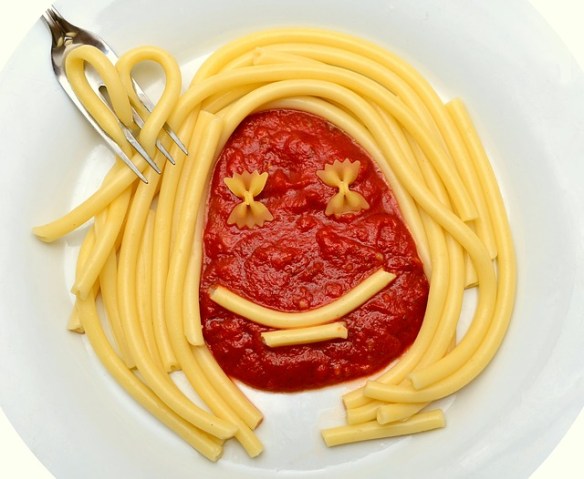
Pasta caricatures of your dinner guests; out before it was ever in. 

“…Is there anything you don’t eat?..” That’s the question I always ask any first-time guests to my home. “…Well…,” she texted back…“I’m paleo, gluten-free, vegan, pesca-centric, tropical, raw, keto and equatorial…” I stood there, dumbfounded, when I received a second text from her. “…Only kidding, Sunshine, I eat everything!..”

My jokester friend made me realize something. When was it that I began to lose control of my culinary smarts? I always prided myself as a foodie, able to converse on all the cutting-edge trends, but lately, it seems as if I can’t keep up.

All along, I thought SCOBY was a cartoon character. The rubbery, brown amoeba like creature with bulging eyes and a mischievous grin would dart in and out of adventures in his homeland of Kombucha. Leave it to some millennials on line at Starbucks who took pity on me and explained that SCOBY is an acronym for “symbiotic culture of bacteria and yeast” which forms on top of kombucha tea, a fermented drink made of tea, sugar, bacteria and yeast. Known for its health benefits, it’s been around for thousands of years. It’s rich in probiotics and is said to actually fight off some diseases.

I was caught off guard when I called for a reservation at a favorite restaurant and was told they were closed for a special sold out event. Their guests would be introduced to dark dining. All around the world restaurants are turning off their lights in the hopes that the removal of vision will enhance the other senses and increase gastronomic pleasure. At the end of the evening, night goggles off, I wonder if the waiters share stories of customers accidently eating off a neighbor’s plate, bending down to pick up a fallen napkin and realizing it’s not their lap they’ve placed it back on and navigating those crazy restroom runs.

Leave it to New Jersey to conjure up a union between unicorns and bagels. Purists everywhere are dumbfounded by The Bagel Nook’s introduction of the unicorn bagel, a blue, yellow and pink colored bagel served with cotton candy cream cheese, then dusted with unicorn sparkle dust. Speaking as a Texas resident, I shudder to think what the introduction of anything unicorn like might be in the Lone Star State. Picture thick porterhouse steaks sizzling on a large barbecue grill as flames shoot into the air. A Willie Nelson song plays softly in the background, cold beers have been passed around and it’s the kind of day to put your feet up (cowboy boots on) and relax. Are you going to be the one to suggest a sprinkle of unicorn sparkle dust on the rare hunks of beef? I rest my case.

Any way you slice it, food trends will always keep thrusting themselves into the limelight, hoping at the very least, for their 15 minutes of fame until they fade away. The Jell-O salad jiggled its way onto everyone’s table until sneaky cooks started hiding yesterday’s leftovers in it. Fondue warmed our hearts until double dippers gave us concern for germs. All we can do is open our mouths, bite the bullet and swallow hard; soon we’ll be on to yet another version of good taste.

Budapest: Nov. 1 – 3, 2018

photo budapest

Parliament sparkles at night

It was my idea to take the train from Vienna to Budapest. The ride was under three hours and I thought we might enjoy the scenery. As it turned out, I fell asleep (as I usually do in any moving vehicle) and had to rely on *Mr. Wiz and *Big A for the descriptions of the small towns and countryside that we passed. The train station is jam-packed, so it was comforting to see that little sign, with our last name on it, held by the driver that was to take us to our hotel.

In all the times I’ve stayed at Hilton hotels, I have never experienced one like this. It seems as if the staff stands at attention and clicks their heels to welcome us, with military precision. They operate together as a well-oiled machine, providing impeccable service throughout the Budapest Hilton. The subdued colors and stylish furnishings give it an elegant, yet contemporary feel.

Budapest is one of the largest cities in Europe and Hungary’s capital. Because of the considerable damage left behind after World War, the city is much more modern than Prague. It’s also more sprawling, less touristy and is known for its vibe. Budapest is actually made up of two cities, Buda and Pest, which are separated by the Chain Bridge that spans the Danube River.

With not a moment to spare, we set off to explore. Because the sights are not all within walking distance, we rely on the good old on/off tourist bus, so as not to miss anything. We pass on the funicular and decide to walk up the steep path to Castle Hill to admire the views. The third largest building in the world with over 600 rooms, the commanding presence of the Parliament building is even more impressive when it’s lit up and sparkles at night. We stroll the luxurious grounds of Buda Castle, a palace complex built in 1265. The Matthias Church, dating back to 1015, misleads us with its neo-Gothic exterior and its mystical, exotic interior. Heroes’ Square is impressive, with its stately statues honoring important Hungarian leaders. The Great Market Hall is bustling and we make sure to buy some of the city’s famous paprika to take home.

As we stroll along the Danube, we notice that people are quiet as they approach the Bronze Shoe Memorial. Between 1944 – 1945, many people (most of them Jewish) were murdered along these banks. Before being shot and having their bodies fall into the Danube to be swept away, they were forced to remove their valuable shoes, so as not to waste them. The assorted sizes and styles of shoes that have been bronzed are placed as if the person has just stepped out of them. Whether one shoe was in front of the other or one is on its side, you get the feeling of motion and of realism. It is such an emotional and moving tribute.

It’s worth the wait to eat at Mazel Tov.  The contemporary Israeli restaurant is housed in an old warehouse that looks abandoned on the outside and is one of the city’s classier ruin bars. Derelict buildings circa World War II have become a tourist attraction when transformed into bars and restaurants all over Budapest. When we take a minute to look up from our tahini, hummus, chicken shawarma and homemade, hot pita bread served in a paper bag, we notice the vines hanging from two stories up and the glass ceiling; very cool.

The Hilton recommends a restaurant down the street and we lunch on shrimp, duck pate and goulash soup along with Hungarian wine at the Baltazár Wine Bar. When we learn that two sister restaurants are nearby, our dinner decisions are made. Pierrot Restaurant is housed in a 13thcentury bakery. The black and white photos that line the walls and the pianist playing softly in the corner convey an old-world elegance. We share tastes of the duck in puff pastry, beef tenderloin, venison loin and are starting to appreciate Hungarian wines. By the time we arrive at the 21 Restaurant, Mr. Wiz is well versed on local wines and has an interesting conversation with the manager. Together, they choose a bottle to compliment the rack of lamb, crispy duck and chicken paprikash, which is accompanied by homemade spätzle.

We cannot leave Budapest without visiting Szimpla Kert, the first ruin bar and now known as one of the world’s most famous bars. Created in an abandoned warehouse in the Jewish Quarter, It’s hard to describe; think of a giant, dark junk shop that serves liquor (in a good way). The DJ is housed in a glass room, music is blaring and people from all walks of life (babies in strollers to a senior citizen tour group and everyone in between) are either sitting down (on bar stools, in an old bathtub fitted with benches or inside the body of a car) or strolling around to view what looks like a Fellini movie on steroids.

Is it the entire room filled with old televisions featuring psychedelic patterns on the screens, the wide-eyed doll heads glaring at me from the wall-to-wall shelves or the knight in armor standing next to the six-foot ceramic rabbit amid a collection of old typewriters dangling upside down from the ceiling that will give me nightmares this evening (in a good way)?

Instead, I fall asleep with visions of tomorrow’s last sumptuous buffet breakfast in the lovely hotel dining room, complete with castle views out every window followed by a morning of last minute sightseeing before saying goodbye to Buda and Pest and heading home.


*Who’s who? See “Cast of Characters” on the “About” page.


*Who’s who? See “Cast of Characters” on the “About” page.
Vienna, Austria: Oct. 29 – Nov. 1, 2018

Photo Vienna

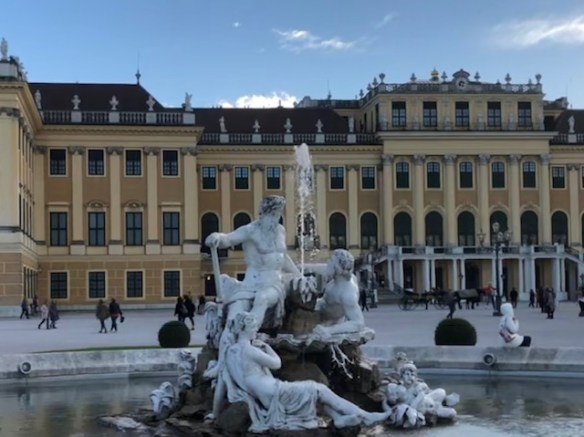
Schönbrunn Palace

It’s a short flight from Prague to Vienna and by the time we get settled in our seats, we are already there. It’s a good feeling when you arrive in a foreign airport and see that little sign with your last name on it, so, once again, we hire a driver sent from our hotel.

The Der Wilhelmshof Hotel is a unique, family run boutique hotel. Designed in collaboration with Viennese artists, their art is not just placed on the walls or on display, but actually becomes part of the décor. Our room has a contemporary mural painted on the wall behind the bed that playfully continues onto the wall sconces.

We enjoy a drink in the hotel bar, as the cheery cocktail waitress (she introduces herself as “Pauline from Poland”) and the concierge assist us in a restaurant selection for the evening. The decision is unanimous; Schweizerhaus is a landmark from the 1920s serving traditional cuisine in a beautiful beer garden. It’s a short walk through a lovely park and a carnival that’s in full swing. We’re seated at a long communal table next to a large Viennese family. We smile, say hello and when they hear that we are from Texas, they are fascinated and have many questions. They guide us through the menu and do not steer us wrong. The gigantic, crispy pork knuckle arrives on a large wooden platter along with a helping of wiener schnitzel (thin pan-fried, breaded pork cutlets) and a warm potato salad made with oil rather than mayonnaise. The ice cold beer tops off a perfect meal. We thank our new friends, who all line up to shake our hands when they leave.

While walking the city streets, we discover that there is a refined and artistic elegance to Vienna. The largest city in Austria, it’s the birthplace of Mozart and Beethoven and known for its many imperial palaces. We feel as if we are taking a step back in time when we visit Schönbrunn Palace, a UNESCO World Heritage Site and the former summer home of the Habsburg family.

St. Stephen’s Cathedral is considered the most important religious building in Vienna with its mix of Gothic and Romanesque architecture and magnificent spires dating back to the 1300s. Considered the “mother church” to Roman Catholics, it was built on an ancient cemetery dating back to Roman times.

There is no time to visit them all, so we let Mr. Wiz* choose which museum we will explore. He makes a good choice; the Albertina Museum. The magnificently furnished state rooms from the Habsburg Palace come alive when they are accompanied by narratives of its occupants. The dramatic black and white photographs chronicling everyday life in poor New York City neighborhoods in the 1930s by Helen Levitt startle us. The comprehensive exhibit of Claude Monet details his life, revealing little known accounts that give us new insight and on display were paintings we’ve never seen at any other museums.

Once again, all the restaurant research Big A* and I have done has paid off. The music is loud, the place is packed and the tables are communal at Miznon, an Israeli restaurant. We stand on line to order lunch, gawking hungrily at the open kitchen. Both the lamb and beef burgers served in pita bread have won raves, but it is the charred, spiced cauliflower that is the star of the show. Grilled and served whole, we pull it apart and dunk it into tahini, one of the sauces offered. At Ulrich, a hip, casual restaurant, we lunch on chorizo flatbread and smoked salmon and trout. We are lucky to secure a dinner reservation at an upstairs table with a city view at Lugeck. Sharing entrees seems like the right thing to do, so we can all taste the fried chicken, shrimp and goulash with homemade spaetzle.

We go to great lengths to plan just the right cocktail hours. Alfred Loos is known as one of the pioneers of modern architecture, so we had to experience Loos American Bar. Designed in 1908, the groundbreaking concept combines dark mirrors, low lighting, wood and onyx into the 290 square foot space and fools you into thinking it is surprisingly larger. With Ella Fitzgerald serenading us softly in the background we’re reminded that this is one of those few times that the word “swanky” is apropos.

Das Loft Bar is perched on the 18th floor of the Sofitel Vienna. It’s dark and moody. The ceiling is covered with what looks like flowing silk awash in a combination of colors. Blended with the 360-degree views of the city sparkling back at us, we can’t help but  snuggle into our seats, order another round of cocktails and make another toast to beautiful Vienna.

* Who’s who? See “Cast of Characters” on the “About’ page