
The Camino, the Dog and the Girl

Photo Camino Dog

I wondered why she needed a service dog, but it’s not something you ask someone. On the Camino, dogs were a novelty. He was the star of the show, receiving so much attention. Head down and the ever-present cigarette between her fingers, she remained out of the spotlight, answering every question about him with as few words as possible. She was petite and cute, but there was a toughness about her that told you that this was someone you did not want to mess with. When she did look up, I noticed that she seldom smiled and her eyes were devoid of any sparkle. They were hauntingly dark and piercing, as if they held secrets that were not discussed in polite company.

We seemed to be on a similar pace and ran into each other almost daily. I made sure that I greeted her every day with a smile and a quick “Hola” or “Buenos Dias” so as not to interfere with her solitude. While others around her were sometimes talking and laughing together, she and her dog always walked alone. He was her best friend and the way they interacted brought a tear to my eye.

One morning, I noticed that the dog was walking right next to an older woman, rather than his master. Out of character for the girl, she asked the older woman if she was feeling all right. Without too much explanation, she briefly mentioned that her dog was able to sense low blood sugar in humans through his sense of smell. The woman brushed it off, thanked her and continued on.

When I saw her the next morning, I asked about the older woman after my usual morning greeting. I was surprised that she actually seemed to want to respond and spoke with more emotion in her voice than I had ever heard before. Luckily, the woman was staying at the same albergue (hostel) as she and her dog. As soon as the older woman sat down on her bed, she passed out. Realizing that the dog’s diagnosis was correct, the girl was able to get help for her immediately and, by dinner time, the woman was feeling better. Another example of how the Camino provides.

Our relationship reverted back to my daily one word acknowledgments until one evening the following week. I was sitting outside at a café, enjoying a glass of red wine and she asked if she could join me. Startled, I agreed and hoped that we would not suffer those long pauses of discomfort when conversation does not come naturally.

I can’t recall what actually happened next. I may have commented about the day’s terrain, but all I remember is that she started to speak. And when she did, the words came like an avalanche; spilling out of her so rapidly. It was as if they had filled her up, swelled to capacity and finally exploded. She hardly seemed to breathe as she told a captivating story of her life: the military, a college education, promotions, Iran, Iraq, Afghanistan, Post-Traumatic Stress Disorder (PTSD), an honorable discharge, her service dog, the Camino.

I was lost in her words, my mind racing to keep up with her story. It took all I had in me to not interrupt. I had so many questions, but this was her moment. What if digging deeper put her over the edge?

When she abruptly stopped speaking and took a deep breath, we just looked at each other for a moment. She looked different; her posture seemed less rigid, her expression was softer. I was unsure of what to say, but when the jovial group of pilgrims that I was to meet there joined us, she hurriedly said her goodbyes and she and her dog left.

A few days went by and I wondered why I had not run into her. I was glad to see her the following day, smiled and gave my usual greeting, but she did not smile back. “…I have to leave…” was all she said in a flat tone. She explained that the pads of her dog’s feet were scraped and bleeding and he couldn’t walk anymore. She had tried ointments, but nothing had worked. She knew he would stand by her side regardless and just keep going, but this was the right thing to do. She was confident they would return next year and pick up where they had left off.

She then put one finger on my arm and whispered “…Thank you, my friend…” I returned the one finger touch and replied softly “…Buen Camino…” It was the first thing that came to mind, but I meant it in the bigger sense. I had so much more I wanted to say, but at that particular moment, words did not seem appropriate. For her that small gesture of intimacy was at the same level as the “Heimlich Hugs” that my Spanish grandmother was famous for and I knew I would always cherish the fact that she chose me to share it with.

She and her dog were gone the next day. Unlike others you might meet and connect with along the Camino, we did not exchange contact information. I thought about her a lot. I wondered why I had been chosen to be the one to interact with her. In this brief relationship, who was the student and who was the teacher? Just as in the military, I questioned if the Camino was breaking me down and rebuilding me from the bottom up in order to make me a better person.

For days, I would hear pilgrims say out loud “…Hey, where’s the dog?..” and I would answer that they went home, each time hoping to myself that they would find a place in the world to call home and that that there would be another arm for her to put her one finger on.



Time: Yours, Mine and Hours

Photo Time

In my imaginary world that I call “Lindita Land,” I wake up whenever I want to. I take the art of putzing to a new level as I push my to-do list aside and do a series of inconsequential things that I will not remember tomorrow. Never glancing to see what time it is, I continue through my day combining important tasks with inconsequential tasks. The day has a wonderful flow to it; there are no deadlines and there is no immediacy to anything. Magically, by nightfall, everything I had planned to do has been completed. I fall into a deep sleep and do not wake up during the night; a miracle in itself. I am the star of my dreams, without a worry or a care as to the who, what, where and when of tomorrow.

Yikes! Both the timer on the stove and the alarm on my phone have gone off at the same time and I am startled me back to reality. I’m not sure which task to do first, so I bounce back and forth between the two, promising myself that tomorrow will be different.

I take a break and decide that it’s time to try to outsmart Father Time and his gremlins (similar corporate setup to Santa and the elves, only snarkier). I will grab that extra flesh of time and squish it into the girdle of my day. Are you with me? Do you have any ideas to share? Here’s what I’ve come up with so far:

  • Create a daily to-do list, so it’s less intimidating.
  • Check emails only once or twice a day and act on them immediately: respond, delete or save.
  • Make a menu and a shopping list and only grocery shop once a week.
  • Keep a list by store and only travel there when you need a few items.
  • Plan a logical route, so you can complete errands all at once.
  • Multi task: water plants or do food prep while you are on the phone.
  • When you are asked to volunteer, sleep on it; never answer immediately.
  • Learn that sometimes you just need to just say no.
  • Promise yourself a treat once your daily tasks are done.

I am not the only one trying to make my way in life with a little help from paper and a pen. A big industry of time management journals has sprung up from the ashes of those little pads that used to spur you on with their cute headings. Now, ranging in theme from passion planners to academic planners, you can time block your day, month and year in order to be more efficient and productive in a customized version of yourself. The thought behind this is that if you enter a room with a pastel Lily Pulitzer life planner under your arm, it will mask the fact that you may actually not be feeling all that light and airy. Then, there is the latest version, the Life Planner 3000. This newest “super-size me” style is available with wheels.

My homemade to-do list is divided into segments entitled “Call,” “Do” and “Go.” It’s not for everyone, but it works for me. And now that I’ve stolen those precious minutes here and there, it actually feels workable. I am able to evaluate the best use of my time and get things done.

I’m sitting in my kitchen enjoying a cold, grapefruit flavored club soda after a particularly busy day and decide that I actually have some extra time to sit outside and read. I toast the sign on my kitchen wall that reads “Never Enough Thyme” and hurriedly head out before the time gremlins catch up with me again.


Touched by an Artist’s Power and Purpose  

Photo Jenn Hassin

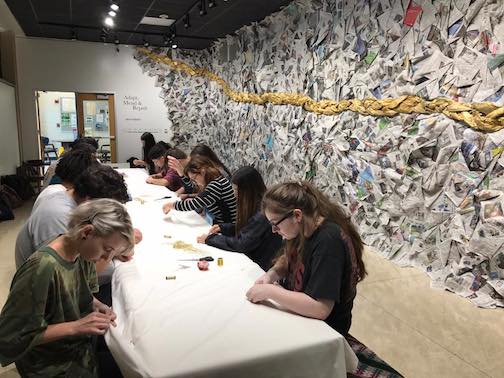
She was not what I expected. The pretty young woman that stood before us in the art gallery smiled demurely, as she was introduced. It was when she began to speak about her art and her life that I became captivated. There was a power that came from her words. Jenn Hassin spoke with an authority that is usually honed through age and experience.

Hers was a life filled with clashes of the presumed and the unexpected: not the childhood one would hope for, a family friend turned mentor, a stint in the military, a college degree in studio art, a divorce, a single mom, a second marriage, another child and a happy, supportive extended family made up of an ex-husband and his parents. Her personality celebrated a dichotomy of military precision and artistic creativeness. This helped to explain how she single handedly was able to get her work, Letters of Sacrifice, exhibited at the Pentagon.

Kintsugi: that was the philosophy that this exhibit was based on. Jenn went on to explain that the Japanese art of repairing broken pottery with gold dusted lacquer treats breakage and repair as a part of the object’s history. Rather than disguising the damage, it works to make it more beautiful.

Jenn’s art installation entitled Embrace the Damage took over the entire wall. As Jen explained, “…The wall of current newspapers from the U.S. and around the world are folded and assembled in a chaotic, yet systematic manner. They represent my personal feelings regarding the overwhelming nature of our current sociopolitical climate. The woven gold braid meandering through it signifies the crack in society and the beauty and strength that can and will prevail for having gone through our current tensions…”

The second part of the installation, Listen and Repair, was interactive. According to Jenn, “…One of the biggest problems we face today is that we do not listen to one another. This offers the opportunity to cut and then mend a tablecloth together; to commune with one another. A gold thread will be used to mend the tablecloth, creating a seam and a border that both divides and connects. I encourage those who participate to converse with one another. You will be sitting on garments and blankets from around the world; talk to one another about culture or about what is going on around the world. Connect or debate, but above all, hear one another. The outcome of the work when the exhibit ends is to create an image of what listening looks like…”

As she spoke, everything took on a new perspective. Jenn, so youthful, became the wise old sage. Her art, subtle in its tone, transformed itself into a powerful and intense message.

Jenn Hassin’s art is a rich composite of the atypical experiences that have shaped her life. Along with the hands of the many volunteer veterans that have touched so many of her works and helped her to bring her messages to life, so will you be deeply touched.

The High, the Low and the No of Expectations  

Photo Expectations

In the celebrated new novel, Great Eggspectations, the protagonist is in hot water, scrambling to turn her life around. She’s blamed everything and everyone around her for her disappointment, rather than realizing she is expecting too much and is about to crack.

Warning: high levels of expectation can be detrimental to your health. Going through life possessing a strong belief that something will happen in a certain way can lead to crushing disappointment.

The word itself seems a bit haughty in tone; anticipating that it’s our way or the highway is the egotistical equivalent of the overwhelming desire to put words in someone’s mouth and then be the puppeteer that pulls their strings.

I’ve come to realize that expectations can actually work with and against us. Our internal expectations can work alongside our goals to produce positive results. It’s when we unleash our external expectations that the situation muddles. We have no control over what someone will say or do or how a situation will play out. Yet, we waste time and energy creating the perfect scenario and then we feel so let down when things don’t go our way.

Shakespeare said “Expectation is the root of all heartache.” Letting go of that feeling of control is not easy, but maybe little by little we can remember to be happy, grateful and content and just let our lives unfold as they were meant to.