Oct. 17- Palas de Rey: 16 miles, six hours
The path is nothing but mud and it’s drizzling. I’m sweating in my rain jacket and trudging along. A fellow pilgrim, a lovely older woman traveling alone catches up to me and with a sparkle in her eyes, says “What a beautiful morning! I love the mist. It changes the entire perspective of the landscape.” As I’m listening to her, I unzip my jacket, pull down my hood and the light drizzle instantly cools me off. By the time she goes on her way, I’m feeling great and the rain has already stopped.
We’re up and down again, walking right through farms and past lovely old stone farm houses, catching a glimpse of daily life: an old woman humming to herself as she hangs laundry; a farmer out in the pasture tending his sheep; a woman picking raspberries who stops to offer us some; the cows lazily grazing in the fields; the dogs sleeping in the sun. I find I have acquired a new skill and though it may not be resumé material, it’s interesting to note: I am now able to differentiate an animal’s manure by its smell.
I laugh to myself as I coin a new phrase: “In Spain, what goes up, must come UP”! Walking in the forest always seems a bit mystical, especially the way the light plays on and around the trees, lined up in exact rows. The scent of the eucalyptus trees is even stronger when we crush some leaves in our hands.
The outside tables are still wet in the little taverna when we stop for a cold drink. A fellow pilgrim is wiping off his table with a rag from the owner and when he sees us, he wipes off ours too. I pass on the kindness by wiping the table for some other pilgrims that sit at the next table. It’s a small gesture, but speaks to the feeling of community.
The Pensión Palas is simple, modern and clean, but the town seems old and rundown. The big excitement of the evening is that I am served rice with my dinner, rather than the ever-present french fries.
Oct. 18- Castañeda: 13 and one-half miles, six and one-half hours
The temperature is in the high 60s and cloudy; perfect walking weather. We’re up and down, through forests, farmlands and towns. It seems it will be a fairly uneventful day until we come to a river. The bridge is made up of boulders covered in mud. I take a minute to access the route and see I have no choice. I feel more confident with my poles, until I realize that the last two boulders narrow and the poles won’t fit. I panic for a second, but tell myself I have to keep moving forward; other pilgrims are behind me and there’s nowhere else to go. It takes all I’ve got in me to slowly make my way to the end. I’m amazed at my newfound grit and it gives me a spring in my step.
Casa Garea, our Casa Rural for the evening, is located at the beginning of town on the main road. The shoulder is narrow on the road and the cars are zooming by at breakneck speeds. Our only option is to walk through a big field. Our boots are sinking into the fresh dirt, making the walking more difficult. On arrival, the owner greets us and asks if we enjoyed the walk through the forest. We realize that we were too quick to get off the pilgrim path; a few kilometers ahead there was a sign that would have led us right to our destination. Lesson learned: always refer to our map.me app. (which requires no internet connection), especially when tired.
The room is cozy with wooden beams on the ceiling and white, starched linen curtains on the windows. After we freshen up, the owner brings in some wood for the fireplace and we sit in the downstairs sitting room with a glass of wine and relax. It’s not that cold out, but the warmth of the fire feels good. We make sure not to fall asleep and miss dinner.
Oct. 19- Pedrouzo: 16 miles, 6 and one-half hours
I spend my morning saying a prayer for each of the pilgrims that we pass that are not well but keep plodding along: five limping; three with food poisoning; and one with an intestinal virus. I am humbled by their strength and determination and feel a bit guilty that I have made it to this point unscathed; me, with the weak stomach, who always thought of myself as clumsy. I want to hug them and tell them how much I admire them, but each of them seems to be in a type of meditative state, some even wincing with every step. “Buen Camino,” the usual greeting, does not seem appropriate. All I can think of is to give them a thumbs-up as I pass them by.
Pensión LO is brand-new, all white and very modern, but the room has one design flaw: there are no shelves or closets! We balance what we’ll need for the evening on our backpacks and hope for the best. There’s lots of traffic in this town, but it looks a bit old and bleak, so we head back to the Camino path to find a restaurant for dinner. After some hugs and catching up, a friend we run into suggests the place she’d just dined at. It’s very contemporary, with a wooden communal table in the middle and shelves lined with gourmet foods; it looks so out of place. The food is good and the service is slow, but the wine is served right away and we are entertained by a mother and her 15-year old precocious son from Finland traveling the Camino together.
Oct. 20- Santiago: 13 miles, five hours
It feels like Christmas morning! We’re up early and excited to get going, but the sun has yet to rise. It’s still dark when we head out, but we only need the flashlight for a few minutes. The path takes us through some suburban towns, past the airport and alongside some roads, with just enough inclines and descents to make us realize that just because it’s our last day of walking does not mean it will be an easy one.
All that’s separating us from entering Santiago is a bridge. As we draw closer, we notice that it’s an old, depilated, wooden bridge with missing, uneven slats. The guard rails are unusually low, so as the traffic speeds by both beside us and below us, it gives us the sensation of Vertigo. We try to focus on walking exactly down the middle, keep our heads down and watch every step we take as quickly as we can.
We’re standing in front of the Santiago city sign, but after what it took to get here, it seems like a bit of a lackluster greeting. Besides the sign to welcome us, there is a gas station and a row of restaurants. It takes another hour to get to the old section of the city. Just when we feel our energy waning, some local residents assure us we are almost there and give us a thumbs-up.
As we approach, we hear the faint sound of bagpipes. There’s a musician dressed in a cloak and a feathered hat playing in the tunnel. As we exit the tunnel, the Cathedral comes into full view, sparkling in the sunlight. Now that’s the dramatic welcome we were hoping for!
We hug longer than usual and both get teary eyed. Amongst the tourists who quite don’t know what to make of this, the Plaza de Obradoiro (known as the “golden square”) is full of pilgrims hugging, chatting, taking group photos, sitting cross legged in groups or just laying down on the ground in the sun around the Cathedral.
It’s time for lunch and we agree that some wine might be necessary to celebrate and to help us to sort out our emotions. We’re so grateful for a safe journey and not sure how we feel. Are we elated to have arrived or melancholy that it’s over?
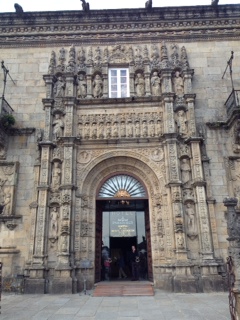
We’re splurging and staying at the Hostal de los Reyes Católicos, the famous five star parador (see photo at top of page). Paradores are a hotel network of government owned, restored historical buildings throughout Spain. This massive structure was originally a hospital built in 1499 by Queen Isabella and King Ferdinand (hence, the hotel’s name) and is said to be the oldest hotel in Europe. We explore every corner of the four courtyards, the church and the sitting areas. We read every historical sign that tells the story of each area and makes it come to life. Our room is a lovely retreat with a feeling of Old World Spain that looks out onto one of the courtyards.
Santiago is a vibrant city with a bit of a carnival atmosphere, due in part to the large number of pilgrims descending on it each day. Streets filled with shops, restaurants and outdoor cafes twist and turn into narrow passageways that open to small plazas.
We had befriended a pilgrim couple early on in the walk and talked of sharing a celebratory dinner in Santiago in the hotel dining room. With the reservation now made, we now realize that our pilgrim clothes might not be suitable and some shopping might be in order. We laugh and wonder if we will recognize each other, all cleaned up. As we head back to the hotel, we join a group of fellow pilgrims for a celebratory drink. It’s a lovely evening enhanced by the gourmet dinner and the wonderful company. We end the evening with a toast to the continuance of our newfound friendship.
Oct. 21: Santiago
All Camino routes end at Santiago’s Cathedral where Saint James, the patron Saint of Spain, is buried. We head to the Cathedral early in order to get a seat for the noon Pilgrims’ Mass, a pilgrim tradition. We are disappointed that we are no longer able to place our hand on the column in the inner portico as a mark of gratitude for a safe arrival. After millions of pilgrims wore finger holes in the solid marble over time, the area is now covered by a protective barrier. The highlight of the Mass is the swinging of the Botafumeiro, a giant incense burner (featured in the movie “The Way”). It was originally used to fumigate the dirty and disease-ridden pilgrims. The eight attendants start pulling up and down until it swings as high as the ceiling. We lift our heads to follow it and realize it is right over our heads; a strange feeling.
Next, we head to the Pilgrims Office to obtain our Compostelo Certificate of Completion. All along the route, we have obtained stamps from hotels, restaurants, churches, etc. on our Pilgrim Passports, denoting what towns we visited. From Sarria on, we were required to obtain two stamps a day. The 45 minutes fly by as we compare notes with fellow pilgrims. We run into some pilgrims and agree that a last glass of wine together is in order. It’s hard to say goodbye…
Since I’ve arrived in Santiago I have not slept well. All the sights and sounds of the last 35 days are swirling around in my head and I am trying to sort them out. It is said that the Camino is divided into three parts. The first is physical, as your body gets used to the grueling daily regimen. The second is mental, as you walk the flat, somewhat boring paths of the meseta. The last is spiritual, as you near Santiago and the end of your long journey.
The Camino books and YouTube videos tell stories of pilgrims experiencing some sort of spiritual epiphany and I am hoping that I am one of them, but as I analyze each day and experience nothing comes to mind. I open our Camino book and start to flip through it, not sure why. We have owned this book for over a year and have referred to it many times throughout each day, but for some reason I have never turned to the last page until now. The words of a poem by Marianne Williamson (made famous by Nelson Mandela in his freedom speech) make the hair on my arms stand up on end and bring tears to my eyes. My spiritual gift was waiting for me in those last pages:
Our deepest fear is not that we are inadequate.
Our deepest fear is that we are powerful beyond measure.
It is our Light, not our darkness, that most frightens us.
We ask ourselves, who am I to be brilliant, gorgeous, talented and fabulous?
Actually, who are you not to be? You are a child of God.
Your playing small doesn’t serve the world.
There’s nothing enlightened about shrinking.
So that other people won’t feel insecure around you.
We were born to make manifest the Glory of God that is within us.
It’s not just in some of us; it’s in everyone.
And as we let our Light shine,
We consciously give other people permission to do the same.
As we are liberated from our own fear,
Our presence automatically liberates others.
 A Moxie Girl