
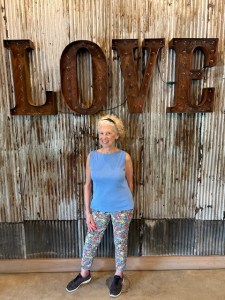
Perils of a Perfectionist

One quick glance around each room and I can size up what needs to be done. The pictures on the wall are a bit crooked and the pillows are not aligned correctly on the sofa in the living room. The chairs around the dining table are not pushed in at the same depth. In the kitchen, the spices are not in alphabetical order and the candles are not standing straight up in their holders. Just when I roll my sleeves up, intending to get to work, my friend takes me over to the side, puts her hands on my shoulders and reminds me that we are on a Parade of Homes model home tour. 

Sometimes it’s great to have a keen eye for detail and a determination to always strive for excellence and sometimes it’s a pain in my (hopefully physically fit?) posterior. Luckily for me, I was blessed with a combination of both my parents’ personality traits. My dad’s obsessive, work ethic and drive for success, along with my mom’s easygoing, go with the flow attitude, has kept me from falling off the “obsessive, compulsive cliff.”

Early on in life, I realized that I would need to take control of my tendencies. Riding that bucking bronco of flawlessness, I had to learn to lasso that energy into a healthy focus. Being aware of who I am and actually cultivating a relationship with myself made the difference. It gave me a comfort level that the rest of the world did not see. How could I possibly begin to exude confidence if I didn’t like myself? In time, I learned that the secret connection between me and my psyche was actually a simple process: just stop, look and listen:

  • Stop: I take a couple of minutes each day to close my eyes and imagine how I want my life to be.
  • Look: I try to objectively observe how I am progressing and what I might need to tweak. 
  • Listen: When alone, I compliment myself out loud and let those few short sentences spur me on. 

My relationship with myself is a humorous one. Together, we chuckle at my ability to detail the heck out of even the smallest task. We giggle at the way I prompt myself to hum a tune as a reminder not to review a past mistake over and over again. We chortle at my micromanaging tendencies, practiced under the guise of providing useful information to anyone at any time, whether they want it or not. And we have a good laugh over whether I can finish reading an article before getting up to fix something out of place on the other side of the room. 

I realized that in order to move ahead and see the big picture, little by little, I had to let go of the minutiae of everyday life. This has given me a bit of a carefree feeling so that I now only document 41 percent of my life on Excel spreadsheets (down from 92 percent) and just last week, walked past two crooked welcome mats, outside of neighbor’s homes, without the need to straighten them.  

We are all a work in progress. I now understand that I need to embrace the odd duck in me and realize that I cannot totally change who I am at this point in my life, but I can work with myself and not against myself to create the best imperfect perfect person that I can be.

Frame Your Own Pictures

She was so delighted with the print she had purchased. It reminded my mom of a favorite vacation destination. She would prop it up against the walls all-around her home, looking for just the right spot.

I was the one that decided it needed a permanent home. I devised a scheme to sneak it out of her apartment in a bag of magazines that I was picking up, and delivered it right to the frame shop, agonizing over the perfect frame and just the right mat colors that would perfectly complement the print. 

While it was a loving gesture and I was excited to present her with this surprise birthday gift, I realized later that it really was not my picture to frame; it was hers.

In a recent Ted Talk, author Anne Lamott reminded us “We can’t arrange peace or lasting improvement for the people we love most in the world. They have to find their own ways, their own answers. You can’t run alongside your grown children with sunscreen and Chapstick on their hero’s journey. You have to release them. It’s disrespectful not to. Help is the sunny side of control. Stop helping so much. Don’t get your help and goodness all over everybody.”

I am a recovering helper. For every dollar you have, I can add in my two cents in order to assist, guide, advise, suggest or lend a hand. When I like someone, I have a tendency to go overboard and when I love someone, I can drown them in the H (help) word.

It is said that helicopter parents got their name from the yuppie moms and dads that were overprotective and took an excessive interest in their child’s life. There’s a delicate balance between involvement and smothering and you have to try very hard to remember the difference. 

When our only child was younger and was starting to make his way onto the world stage, he needed us to be his attentive audience, not standing backstage delivering him his lines. Anne Lamott was right; that would have been disrespectful. You do your very best and then set them free. But, between us, a quick spray of holy water while they are walking out your door or a little mom mental telepathy never hurt anyone. 

Back then, our son and I came up with a code word. Anytime I was exhibiting an inclination toward being overzealous, he would whisper the word “Despacio” in my ear (Spanish for slowly) It was my que to slow down. This worked then and even worked recently, when I almost fell off the wagon. 

I’m sure that by now my family and friends all know that I am there for them. I will try to control my controlling tendencies (hidden under the guise of helping), but there may be times when I veer off. One Hallmark card commercial viewed at a particularly sensitive moment may trigger an outpouring of unwanted and unwarranted assistance. 

So, just in case you see me running toward you with outstretched arms, my head turned slightly to one side and that tender look in my eyes that says “I am here for you,” just return the hug and whisper “Despacio” in my ear. I’ll get the message.

Author’s Note:
If you enjoyed this post, please scroll down, like it and feel free to share it!

Duende 

A chimpanzee and flamenco dance lessons; that’s all I wanted when I was 12 years old. The chimp never materialized, but many years later the flamenco lessons did. It was my mom that found the classes through the Chicago Park District. At a cost of $25 for six sessions on a Saturday morning, it was hard to decline. We excitedly signed up together.

First things first; this called for some shopping. It went without saying that for us to do our best, we had to look the part. It took some time to choose just the right flamenco shoes, flared long skirt and fitted top. We tried them on over and over again and had fun twirling around and breaking them in.

The class was held in the guest house behind an old mansion that the Park District now owned. Arriving early, I had time to explore. The stone structure was now one big room, with only a narrow path and some boulders separating it from Lake Michigan. I didn’t realize then how inspiring it would be to dance while watching the water “dance” outside along with us. 

I must admit, I was a bit taken aback when Señora walked into the class that first day. She was older than I had expected with a soft body and a lined face. Her hair was pulled back into a tight bun and her shoes looked as if they had accompanied her on many a dance floor. But, as she walked up to each of us, asked our name and gave us a welcome hug, I noticed her black eyes. They were piercing, bright, twinkling. There was something special about her. Then, without saying a word, she played a CD, started dancing and we were transfixed. At that moment, her body changed. Her posture was straight, her hand movements so elegant, her feet moving so quickly and precisely and her dark eyes sparkling. 

As she explained the class format, we focused on her every word. A combination of Spanish, Spanglish and English, it required concentration. We would be learning four Sevillanas. These are festival dances with simple choreography; easy to master for practice and training. Or were they? The class was made up of women, all ages, shapes and sizes. Initially, we all were so intent on clumping through the steps that we forgot to use any hand movements at all. I wondered how week after week Señora had the patience to watch this clumsy group assault the classic beauty of the art form that she had dedicated her life to

What the class lacked in structure, it made up for in entertainment value. Señora would stop abruptly at any time and start regaling us with a story from her colorful past. Sometimes, she’d carefully pass around a creased, yellowed article featuring her and her husband; a handsome young couple; carefree and excited for where life would lead them. From these snippets, we were able to piece together her life story. 

Growing up in Spain, she had learned flamenco at an early age and had excelled at it. She had caught the eye of a young man in her village, a bit older than she, who convinced her parents that she should join him and his musicians and go on tour. From then on, she lived and breathed flamenco. After performing all over Europe, they immigrated to the U.S. and danced in Las Vegas, getting to know all the big stars of the time and living large. Señora’s husband was not a businessman, so when his health deteriorated and he ultimately died, she was left with nothing but her memories. 

Each Saturday, we’d arrive early to class and stay late, hoping for another story or anecdote, so were disappointed when a stern, young woman was waiting for us this particular morning. She told us her mother was not well and she would be taking over the class. Based on her demeanor, we could tell that she wanted to be anywhere but there. We tried asking questions, but she stoically answered as little as possible. 

Nothing was the same. I gave up hope that I would ever speak to Señora again, until I noticed that the young woman was on her cellphone one day and I politely asked if it was Señora. If so, could I please speak with her? I was so happy to hear the combination of languages that I could now magically decipher. I asked about her health and told her how much she was missed. I asked if we could come visit her, but she said it wouldn’t be a good idea.

I didn’t know if I would ever get the chance to speak with her again and didn’t want to hang up. I was looking for something from this woman who sparkled, who had lived through the ups and downs of her life with such vivacity, such robustness. “What is your secret?,” I asked. She seemed to know exactly what I was referring to and responded with one word. “Duende,” she said softly. 

This Spanish term refers to a magical spirit and was traditionally used in flamenco music or other art forms to refer to the mystical or powerful force given off by a performer to draw in the audience. Nowadays, the word also refers to one’s unspoken charm or allure; that certain something that captivates. Yes, this one word encapsulated Señora and duende seemed to be the Latin version of moxie.

I thought of Señora often, especially Saturday mornings, and how I never wanted to forget her influence on me. She may very well have been my inspiration for starting this blog and a way of remembering that we need to package all we were born with into one powerful fireball and use it as the spark to live the very best life we can live. 

Author’s Note:
If you enjoyed this post, please scroll down, like it and feel free to share it!

Static Cling: The Silent Predator

After having placed her coat on our bed the other day, my mom arrived home to find two hand towels stuck to the back of it. I still shudder to think what might have happened had she wandered into a Crate and Barrel store on her way home and was confronted by a security guard. How some of our folded laundry wound up stuck to her coat is the way static cling operates. It’s not easy to combat this silent force in motion. 

Defined as “the tendency for light objects to cling to other objects owing to static electricity,” it is common in clothing, but does occur with other items. Take for example, the Styrofoam peanuts that clung to a cat’s fur. The charge of static electricity that built up on the fur, due to the cat’s motions might be easily understandable to some, but for that cat owner, it took a few cold rags on her forehead before she finally came to. 

Some stories still haunt me. Years back, I remember reading about a Chicago man who unknowingly got on the 146 bus for his daily commute to work with his daughter’s entire Beanie Baby collection affixed to the back of his cashmere coat. Luckily, the story had a happy ending, as he was able to sell most of them and pay for his daughter’s college education before reaching his stop.

Then, there are those stories (actually, unconfirmed rumors) that lurk in the static cling underground. One tells of a millennial, with a recent MBA from Stanford, confidently entering the office of a fortune 500 company for his final interview, which was abruptly cut short when the CEO noticed a pair of his girlfriend’s hot pink, Victoria’s Secret panties attached to the back of his Armani suit jacket. As the story goes, after this disastrous incident, millennials banded together in solidarity in an effort to ban the in-person interview in favor of an online dialog. Soon after, LinkedIn was born and dryer sheet consumption was at an all-time high. Coincidence? I think not.

Even as far back as 2002, The New York Times reported that guerilla marketing tactics involving static cling were unveiled when butterfly decals were discovered, stuck to surfaces around New York City to introduce a new Microsoft product. Extremists are now known to carry concealed wire hangers to assist anyone in distress (when the metal is wiggled against a skirt bottom or pant leg, it will release the static). Where will it end?

Static cling may very well be affecting your loved ones as we speak. This silent aggressor knows no boundaries and is lurking within every gender, race and socio-economic level. Let’s work together as a nation and find a way to eradicate it. Ironically, separating ourselves from static electricity may be just the issue we need to bring our country together. 

Author’s Note:
If you enjoyed this post, please scroll down, like it and feel free to share it!

Seven Secrets from a Super Ager 

I’ll never tease JC again about her early “senior dinner times.” I recently discovered that some days her schedule is so jam packed, she fits in dining when she can. Between bible study, book club, Spanish classes, ukulele lessons and Rummikub tournaments, her schedule hardly fits into the little squares of her paper calendar! Fit, healthy, taking no medication and sometimes helping me remember things I’ve forgotten, this 94 ½ year old is simply amazing

According to AARP, the Super Aging Research Initiative is studying a small group of men and women across five U.S. cities. While medical advances have helped people live longer, it’s the aging brain that usually does not match up. Super agers are defined as someone over 80 with an exceptional memory – one at least as good as a person 20 to 30 years younger. They seem to have no trouble retrieving a word or remembering a name, processing new information and multitasking. 

As it turns out, it’s not just luck or good genes that make these seniors who they are. Their lifestyle plays a big part in helping to formulate their razor-sharp thinking and memory skills. Here are a few tips from my favorite super ager: 

A positive attitude
JC just wakes up happy! Wherever she’s lived, she says she likes to start her day by looking out the window and saying “Good morning, beautiful city!” 

If her mind wanders to the past, rather than allowing herself to think about how much she misses the family and friends she has lost over the years, she’ll turn her attention to something else and try not to dwell on it.

Avoid Stress
I call JC’s ability for not letting things get under her skin, her Scarlet O’Hara philosophy. In the movie “Gone with the Wind,” the conflicted hero, Scarlet O’Hara, would always say “Fiddle Dee Dee, I’ll just think about it tomorrow,” and go about her merry way.

Take care of yourself
JC is one of those rare people that actually practices moderation. She watches her alcohol intake, eats healthy and is always watchful of her weight, making sure she can fit into the new outfits she’s purchased on her many shopping excursions. 

She absolutely hates to be ill; even getting a cold annoys her! She makes sure she sees a doctor at the slightest feeling that something is just not right. 

Socialize
A social butterfly by nature, JC can start up a conversation with almost anyone and is still known to head out solo. After returning from a recent day trip, I asked her how she decided where to sit at lunch. “Easy,” she said. “I just look for the group that is talking and laughing.”

At the senior residence where she lives, she‘s always chock full of new field trip ideas and keeps a watchful eye on their restaurants’ menu variety as a newly elected member of the resident committee.

Spirituality
JC says maintaining religious rituals, curiously examining its aspects and relying on it for comfort in difficult times plays a big role in her life. 

Keep moving: exercise your body and brain
During pleasant weather, JC walks three times a day. She knows what her body can and can’t do and doesn’t like to be told otherwise. 

An avid reader, she’ll devour books and every type of magazine, from Cosmopolitan to Archeology and Smithsonian Magazines, always remembering to pepper her conversations with an interesting fact or anecdote. 

She’s always eager and excited to learn something new. 

Be Adaptable
While her life seems almost perfect, there is one downside: JC admits she sometimes doesn’t know where she fits in. 

Realizing that at her age, it is smart for her to live somewhere safe where she can enjoy the camaraderie of others, JC says that while the residents are lovely, most are not well and not able to venture out or provide much in the way of stimulating conversation. 

Deciding she is in the need of younger friends, she has joined a church group and has already signed up for some outings and activities.

That taken care of, she can now settle down to putting the finishing touches on some upcoming travels: her grandson’s wedding and a cruise to Norway and Iceland.

Featured in the Aug. 2021 issue of Austin Fit Magazine, JC joined four other Austin seniors in sharing how to “age like an Austinite” and reminded us “It’s important to have healthy relationships and friendships, but you also have to know how to be happy and make yourself happy. It’s a balance.”

Authors Note: 
The name JC (her initials) was given to my mom years ago, back when I hired her to be my interim secretary and did not feel comfortable to ask “Any messages, Mommy?”

If you enjoyed this post, please scroll down, like it and feel free to share it!

Are You at Your Tipping Point?

The barista smiled as she took my order. Adding an English Breakfast tea bag to each cup, she then filled them with boiling water. When I handed her my credit card for the $10.83 bill, she turned her digital tablet around and waited until I decided what tip to give her: 18%, 20%, 22% or 25%. Of course, I could have tapped on the choice that said “No tip” in tiny little letters.

Research has shown that the social pressure from the hovering of the employee awaiting your decision usually relates to the customer choosing the middle tip amount, thereby increasing the amounts now shown.

I’m all for restaurant industry employees making a reasonable living, but I was confused. Wasn’t that the barista’s job? Just as tip amounts have crept up from 10%, they’ve also wormed their way into non-gratuity industries such as food delivery workers, Uber drivers, Chipotle employees, mechanics, bakeries, delis and ice cream shops. Customers say they have even been asked for a tip when they use self-checkout machines at supermarkets, cafés, sports stadiums and airports!

After a recent New York Times article about freelance workers and independent contractors now seeking tips, almost 4000 comments were received, with the majority wondering how we got to the point where customers have to step up their tipping in order to supplement workers’ salaries.

The practice of tipping began back in medieval times when a master would reward his servant for a job well done. Historians agree tipping was almost nonexistent until 1840 in the U.S. Before the Civil War, many wealthy Americans adopted this custom from their European travels, as a way to show their elite status back at home. At the same time, Europeans immigrating to the U.S. brought their tipping practice with them.

Once the Civil War ended, a flood of freed slaves joined the workforce as servants, waiters, porters and barbers. Employers found tipping to be a way to pay a meager salary, with the expectation that their new staff would earn the rest of their income from tips.

In 1904, 100,000 members of the Anti-Tipping Society of America pledged not to tip for one year. By 1909, seven states passed anti-tipping legislation, citing giving or receiving tips was a misdemeanor. In Iowa, it led to 30 days of imprisonment. By 1919, the Iowa Supreme Court ruled the anti-tipping law unconstitutional. Soon, other states followed suit and tipping became engrained in our culture.

Restauranteurs realized quickly they could benefit greatly by subsidizing their staff’s pay with guests’ money. In 1938, the first federal minimum wage law was established, but restaurant workers were excluded. This paved the way for them to be paid entirely from tips. Today, it is still legal to pay a tipped worker as little as $2.13 in the U.S.

In 2015, acclaimed restauranteur Danny Meyer, who banned smoking a decade ahead of its enforcement in restaurants and bars, was at the forefront once again. The owner of 13 restaurants, including New York’s Union Square Café and Gramercy Tavern, he announced he would eliminate tipping at his restaurants. He felt this bold move was necessary in order to narrow the disparity between servers and cooks, who receive no tips. Though not every menu item was affected, many did increase by 30% to 35%. Devil’s Chicken, a famous dish at his restaurant Maialino, went from $29 to $39.

Unfortunately, COVID ended this policy for the many restaurants that joined Meyer’s band wagon and for Meyers as well. In a recent bon Appétit article, Meyers was quoted as saying

 “You shouldn’t feel obligated to tip on quick food transactions, like picking up takeout or ordering a cup of coffee.” Yet, Meyer’s casual chain restaurants, Shake Shack and Daily Provisions, use digital tablets at their ordering counters that prompt customers to tip.

Though many are not fans of tipping, it is unlikely to be banned any time soon. Instead, an organization called Restaurants Advancing Industry Standards in Employment or RAISE, is working to enact state and federal legislation to eliminate sub-minimum wage payments for tipped workers.

Ironically, our early 1900s anti-tipping movement was embraced by Europe, creating their current non-tipping culture.

I close with a poem written in the 1940’s by a disgruntled customer, left for his unsuspecting waiter:

Your attitude spurious
Has made me quite furious
And so, I retaliate
With no tip on the plate
But, lest it construes a non-pleasurable time
At the lady’s request, I leave you a dime

Image by OpenClipart-Vectors from Pixabay

Author’s Note:
If you enjoyed this post, please scroll down, like it and feel free to share it!
Are We Liking Viking? River Cruise Pros and Cons

Being known for what you are not, rather than for what you are has been a successful marketing philosophy for Viking. Named #1 for river cruising by Condé Nast Traveler, Viking proudly advertises their “No” listing: 

  • No casinos
  • No children under 18
  • No umbrella drinks
  • No photography sales
  • No art auctions
  • No charge for beer & wine with lunch & dinner
  • No charge for Wi-Fi
  • No inside staterooms
  • No smoking
  • No waiting in lines
  • No formal nights, butlers or white gloves
  • No nickel and diming

Joking that since we now officially had a reservation, rather than just traveling to the Heart of the cities, we now could say in an English accent, we’d be traveling to the “Haat” of the cities, just like on the TV commercials. 

Our Rhine Getaway on the Viking Tialfi takes us from Basel, Switzerland to Amsterdam. The complimentary tour in each city not only enlightens us, but the tour guides also offer insight into what it’s like to live in their cities. No relaxing in the mornings; tours are scheduled early and we meet our tour guides at 8 a.m.

Basel, Switzerland
Basel welcomes all its tourists with free transportation for the duration of their stay. On arrival, you show your hotel reservation on the bus. Once at your hotel, you receive your travel card. 

Our Hotel Spalentor is in a great location and we can walk everywhere. A small, friendly hotel, we agree it’s more of a 3-star, rather than a 4-star hotel, since it does not have a 24-hour front desk and its lobby and lounge looks a bit antiquated. 

There is a modern side of Basel, known as the hub of Switzerland’s pharmaceutical industry, but we are transfixed by the picturesque Alstadt (old town). We hike to the Basler Papiermühle in St. Alban, a medieval mill honoring paper, to lunch in their restaurant and choose to have dinner at Löwenzorn, known for their classic swiss menu. 

The next morning, it’s time to head to the ship. 

The Tialfi
With only having ocean cruise ships to compare it to, our first impression of the ship is that it’s not that attractive. Its long, rectangular shape accommodates the rooms, a restaurant, lounge small library and outdoor sun deck. In true Scandinavian design, areas are modern and minimalistic in neutral shades.

Our room is about half the size of the one on our last ocean voyage and the bathroom is downright tiny, but the floors are heated; a nice touch! River cruising friends suggest we not pay extra for a balcony, since the ships pull into port alongside, rather than behind each other. This makes for views of others’ balconies, rather than lovely vistas. 

Not yet comfortable with the protocols (do we invite ourselves to join others?) and with no seating for two, we and the other guests seem to quickly get our bearings. Before we know it, we meet two other couples who become our cruise pals for the duration and make the trip all the more enjoyable. 

Breisach, Germany
The Black Forest conjures up the dark beauty of its misty, dense forest along with favorite childhood fairytales. It’s a brisk day, but we don’t mind hiking and then learning how the area’s warm climate made it famous for its wine growing. 

Strasbourg, France
Cobblestone streets, “gingerbread” half-timber homes and those iconic canals contributed to the Petite France section of Strasbourg being named a UNESCO World Heritage Site. 

Built between 1015 and 1439, the Strasbourg Cathedral is said to be the world’s most beautiful example of Gothic architecture and holds many secrets and folklore inside its walls. During World War II, Hitler planned to turn it into a German monument. The stained glass windows, removed and hidden in 74 cases in a salt mine for protection, were later found in 1945 by the U.S. military’s “Monument Men.”

Speyer, Germany
The quiet town boasts the Imperial Cathedral, the burial site of eight emperors and a UNESCO World Heritage Site. We are surprised to see a statue honoring Camino pilgrims, some who start their journey from here to Santiago, Spain.  

Koblenz, Germany and Castles Along the Rhine
A light drizzle does not keep the guests from viewing the castles from the ship’s outside deck. As we slowly stride past, we are regaled with their stories and served hot mulled cider to keep us warm.

Cologne, Germany
Cologne seems old and gritty to us. We’re surprised when our tour guide mentions that the outside of the city’s massive Cologne Cathedral, a UNESCO World Heritage Site, could use a good cleaning.  

With 95% of the city bombed after World War II, leave it to the women left behind to ask the Turkish Embassy for assistance. After sending 45,000 workers, Cologne welcomed them to move to their city, creating the Turkish district that still thrives today. 

Kinderdijk, Netherland
Without windmills, water could not have drained from the flat marshy land and farmers could not have grown fruit, vegetables or tulips. Touring the 19 working windmills that still stand, you can appreciate the volunteer millers’ dedication to keeping them in working order. Despite the steep staircases, small living areas and heating bills they must pay for the uninsulated space, families have a long proud tradition of this way of life. 

Amsterdam, Netherlands
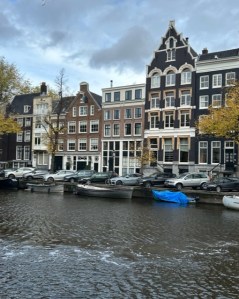
In the country of the Netherlands, in the state of Holland sits the city of Amsterdam. Known for its 62 miles of canals and named a UNESCO World Heritage Site, its Dutch Baroque canal houses combine 16th and 17thcentury architecture with a layering of styles through the centuries. Interesting is the exterior pulley at the top of each home, used for hauling furniture to the top floors. 

Practical Amsterdam is known for its water management and its amazing bicycle infrastructure. We were warned that people in Amsterdam are very kind…until they climb on their bicycles… because they will not stop! Each time you cross a street, you must look left, right and then behind you. We did not notice anyone wearing bicycle helmets (not even babies or children), but decided maybe pedestrian tourists should!

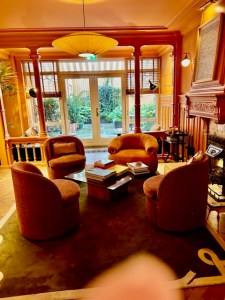
We say goodbye to our cruise pals and head to our hotel Jan Lyuken Amsterdam. Originally a townhouse on an upscale residential street, we instantly get the feel of what it might be like to live here. With a lovely library, sitting area, outside garden and dining room, we are treated to breakfast, all day pastries, coffees, an open bar and hors d’ oeuvres. Thank goodness there is an elevator; the very steep staircases that mimic ladders, would never pass code in the U.S. 

The hotel is in the museum district and very central. A canal tour gives us our bearings and takes us all-around the city, which has the feel of a big village. We stroll along the Brouwersgracht Canal, one of the most picturesque, ogling at the stately canal homes and the many houseboats- some quirky, some upscale. The Jordaan neighborhood’s trendy shops lure us in. 

The Anne Frank Museum has become so popular that you must reserve six weeks in advance on their website; we were glad we did. We book the introductory program, to get more background, before heading off on our tour. You could hear a pin drop, as people followed through the rooms, reading the information and taking in the photos, before climbing up to the space in which the families hid for two years; a very emotional experience. 

We spend hours at the Rijksmuseum, the national museum of the Netherlands, awestruck by the works of the great Dutch masters such as Rembrandt, Vermeer and Van Gogh. A free app on our iPhone enlightens us with wonderful background stories. 

It’s worth the walk to the Grand Hotel Amrath, which was originally in the running as a hotel choice. Originally the joint head office of six shipping companies built in 1916, the hotel is an astounding example of Art Nouveau. We can’t decide which is more impressive: the map of the world made of leaded glass on the ceiling, the woodwork carved in Indonesia or the stained glass panels that decorate the dining room ceiling, so we have a cocktail in their bar and mull it over.

Café Wester is a great choice for lunch near the Anne Frank Museum. The Seafood Bar reminds us how delicious great seafood can be and Brasserie Keizer fulfills our craving for French comfort food. 

Will You Choose to Cruise?
A few days in Amsterdam, off the ship, gives us time to ponder how we feel about river cruising. 

As foodies, we can say the meals were good, but didn’t match up to the flavors, sauces and presentations on our last Royal Caribbean cruise, where my favorite joke to our server was “I can’t eat this; it’s too beautiful!”

Though wine and beer are complimentary during lunch and dinner on Viking River Cruises, guests are invited to the lounge every day at 5:30 p.m. for a get-together. Since dinner was not served until 7 p.m., we calculated that rather than purchasing individual drinks, their Silver Spirits Beverage Package was a better option. 

The Tialfi staff, while pleasant, were much more reserved, most probably trained in the Scandinavian style of formality. By day two, everyone we came in contact with on a daily basis on Royal Caribbean was already addressing me as “Miss Linda.” 

Though not the fault of Viking, when the river levels are low (due to no rain), there are times, guests must be transported by bus to a next location. If the ship is able to travel at low river levels, you can expect somewhat loud engine noise at night. 

The days seemed a bit too regimented for us. With only one restaurant, one lounge and piano music in the evening, there was a sameness to the day that some might find comforting. Just when guests were getting to know other guests, each evening at the lounge get together, the ship’s program director would interrupt to present/sell the next day’s afternoon excursions. We had already reviewed them at home and decided there wasn’t anything we were interested in purchasing. With nowhere else to go on the ship, we were a captive audience. 

Whether you’re a river cruiser, ocean cruiser or a landlubber, get out there and enjoy and remember, as Carl Jung once said:

                           “The shoe that fits one person, pinches another”

Author’s Note:
If you enjoyed this post, please scroll down, like it and feel free to share it!
Ugly Words: A Life Sentence of Harsh Sounds

Have you ever noticed how some words just don’t roll off your tongue? They have a sandpaper/nails on a chalkboard sound to them. Who created these ugly words and where did they come from?

Here are a few of my least favorites words, and to balance the equation, I’ve included a neologism for each; a new favorite word, meaning a newly coined word or expression:

Blog

The word blog is a portmanteau of the words web and log. Portmanteaus – defined as two words combined into a new one- have fascinated me for quite some time. Read my post “Do you Portmanteau?” for more insight and a laugh or two.

Two regular guys are responsible for initiating the term, blog, using it on their websites back in the 1990’s. Initially, websites were online diaries, hence the word log. The “B” is said to either come from the word bit, as in small piece of information or broadcast as in sharing information. As if that wasn’t enough, the word vlog was later introduced to define video, rather than written content.

Blogger, blog, vlog; they all sound like words borrowed from a foreign language, but not pronounced correctly. They mimic the sound of blah, blah, blah! Is that what bloggers want to be known for?

From their humble beginnings, blogs have now matured into marketing wonders, yet their name just doesn’t hold up to the higher status they’ve attained.

Neologism: Skywriter, Skywriting
Rationale: Information held in The Cloud + writers: get it?

Fishmonger

From the Latin word “mongo,” meaning dealer or trader, fishmonger made its way into the word world, to mean fish dealer. Fishmongers can be wholesalers or retailers. They sell raw fish and seafood, but are also trained at selecting, purchasing, handling, gutting, boning, fileting, displaying, merchandising and selling their product. In other words, that’s a big kettle of fish!

In his play “Hamlet,” Shakespeare is said to use the word fishmonger to mean fleshmonger or pimp. So, where does that leave fishmongers? And, who even has their own fishmonger these days?

I picture martinis being served at a private club, when overheard is a chuckle and the starts of a conversation: “So my fishmonger tells me this joke the other day. Did you hear the one where the crab stuffed lobster and the Pacific white shrimp go into a bar?”

The word fishmonger stays on your tongue like a raw oyster served with too much Tabasco Sauce. Hard working fishermen deserve more from their word than a garbled ending.

Neologism: Seafood Scholar
Rationale: This will give fishermen that fish-eating grin they deserve!

Armpit

While the official anatomical term of axilla would have served as a perfectly good word, the area underneath your upper arm went from being called arm hole in the 14th century to the not-very-lovely word armpit or- my least favorite – pit.

Keep in mind, if you meet someone on the street and the conversation turns to armpits, you will face a conversation upwards of 30 minutes on antiperspirants unless you have the wherewithal to turn and run.

I think of a ballet dancer’s exquisite arms raised, as they practice their port de bras – carriage of their arms – and to me, the word armpit is a plebian phrase that has no place in that scenario – or any other.

Neologism: Arm hollow
Rationale: A kinder, softer term even a ballet dancer would be proud to use.

Diarrhea

Let’s just call it the “D word” and get on with my last and final ugly word. It was coined by Hippocrates, derived from the Greek term “to flow through.” Leave it to Pepto-Bismol to create a song and dance routine out of a gastrointestinal disease.

In a recent TV commercial, a young attractive couple sit down in a restaurant. You sense an uncomfortable look on the man’s face. All of a sudden, the woman jumps up. Fortunately, she and the four others, who come from out of nowhere, all happen to be dressed in Pepto-Bismol pink. They break into song and dance, acting out the words- nausea, heartburn, indigestion, upset stomach and, wait for it… make their big finish with the “D word!”

Meanwhile, the young man, already not feeling well and now mortified his issues have been announced to the entire restaurant, has learned some good lessons: never share intimate health details with someone you’ve just met and remember to make sure to scrutinize the dating websites even more next time.

Neologism: Acute colon
Rationale: A play on words and a kinder way to have to hear a diagnosis.

Next project: I’m going to start wooing the Merriam Webster Dictionary editors to see if any of my neologisms will become real words.

Author’s Note:
If you enjoyed this post, please scroll down, like it and feel free to share it!
Image by Gerd Altmann from Pixabay

Three Straightforward Ways to Ward Off Those That Aren’t Your Cup of Tea

Twice in the same week, I was verbally “assaulted” by complete strangers. I think what struck me the most was their anger and aggressive stance over. . . actually not very much of anything. 

As I finished up on a machine at my fitness center, a woman appeared in front of me, from out of nowhere, and started scolding me loudly for not wiping down the machine with the provided disinfectant wipes. I was actually about to walk over to get some fresh wipes, but rather than respond, I just walked away, feeling her stare following me as I did.

A couple of days later, I was at the grocery store, in deep concentration in the fruit aisle contemplating as to how many bananas I should buy. An older man, started walking directly toward me, pulled the bananas right out of my hand and yelled “Oh, no, you’re not going to start breaking apart the bunches!” He put them in his basket and walked away, leaving me standing there stunned.

More than once, I’ve tuned in to a favorite podcast, but instead- another one would magically start to play. It happened again. This time, it was Joel Osteen, televangelist and bestselling author and the title was “Dealing with Difficult People.” Needless to say, it received all my attention. 

Disinfectant wipes and bananas aside, I think Osteen would have been proud of my reaction. In both cases, the sun was shining out and I was having such a great day, I didn’t want the negativity of strangers to spoil it. He makes it a point to remind you to not let anyone steal your joy. 

In theory that sounds like a good rule to follow, but I wonder how flexible I would have been, had this been a situation with a family member or close friend. With that in mind, I paid attention to some of Osteen’s suggestions: 

1.Strive to take the high road. 

The phrase “Take the high road” became popular during Thomas Dewey’s 1948 presidential campaign, which explained his reaction against Harry Truman’s dirty campaign tactics. 

It’s not always easy to turn the other cheek. In researching, I found taking the high road doesn’t actually refer to forgiving someone or keeping them in the picture, it means not retaliating. That’s a big difference.

Osteen says we should all strive to be eagles. His analogy describes the difficult people in our lives as crows, always antagonizing their prey, while eagles fly higher, above all the contention, resisting the temptation to take the bait.

2.Keep your expectations realistic

According to Psychology Today, “Expectations are premeditated resentments.” The term, used in many 12 step programs, helps us understand that if we expect others to act in ways that are not consistent with their own interests, they will probably resist our expectations. While letting go of expectations is difficult, think of how much disappointment we could avoid. 

Of course, there’s the other side of this theory that relates to positive thinking, the law of attraction and how you have the power to actually steer things your way. Check out my blog post “Unearthing the Paths to Positive Thinking.”

3. Success is the best revenge

Rather than waste your time and energy on reviewing an unpleasant scenario over and over again in your head and plotting on how you plan to get even, why not just redirect that power into a positive direction?

Smile down – from your eagle perch – at those you are not connecting with, channel your animosity, anger and negativity and use it to empower and motivate yourself to achieve your goals. It will last longer than the satisfaction received from revenge and be much sweeter in the long run. 

As televangelists are famous for, Osteen dramatically uses revivalist-style preaching when he asks his audience to imagine they are being anointed with the “oil of joy,” whereby nothing can stick to them and negativity just slides right off. 

I don’t know about you, but I would be the first one on line at Costco to purchase their new product: the ten-gallon plastic container size of oil of joy, complete with a handy spray bottle for quick anointings. 

Author’s Note:
If you enjoyed this post, please scroll down, like it and feel free to share it!

Image by Emily_WillsPhotography from Pixabay

Listen to the Music!

Stevie Nicks, lead singer, Fleetwood Mac

Hmmm… flight tomorrow at 6 a.m. Do I pack and go to bed early or go see a Fleetwood Mac Tribute Band concert? 

While the “Linda” in me, logical and organized, would decide the practical thing to do would be to get some rest, my “Lola” side, adventurous and spirited, would think nothing of hopping over the unopened luggage and heading out the door. 

A little background on Lola: JC* had told me the story of how I was almost named Lola, after the wife of my dad’s boss. A lovely older woman from Spain, JC was infatuated with her elegance and kindness. In stepped my Latin grandmother, whose dark eyes sparkled when she was happy and burned a hole in you when she was not. Her usual form of soft persuasion convinced JC that Linda, which means “beautiful” in Spanish, was more befitting a baby girl.

This has led to countless hours of me wondering if a different name might have made me a different person. Do you grow into your name or are you who you are regardless of it? And what about the Oscar Meyer Wienermobile? How will it fair after recently being stripped of its signature moniker in the prime of its celebrity status and forced to be called the Frankmobile? 

As I sat at the concert, tapping my feet and singing along, I became lost in the music and all the memories it conjured up, never giving a thought to anything more than that moment. Being free of my usual multitasking and planning felt wonderful, if only for a little while. I wondered why I had waited so long to invite more music back into my life and vowed to check more concert schedules and start playing music during the day. 

Once home, blasting the Fleetwood Mac Greatest Hits CD seemed like the right thing to do, as the background to our task at hand. Interrupted by a favorite song, which led to an impromptu dance together, made packing more fun, even though it took a bit longer. 

Mr. Wiz* and I reminisced about the Fleetwood Mac concerts we had attended. The one where the couple in front of us, who refused to sit down, were escorted out by security, giving us a bird’s eye view of the stage. The one where we especially noticed teenage fans rocking with seniors, whose walkers were parked nearby, all united, in that moment, for the love of the music. 

The morning came too quickly. We looked at each other, winced and then smiled, deciding our slight headaches might actually be worth it. it There was no time to think about anything, but getting out the door. 

Once on the plane, with my eyes closed, I smiled to think of how music has that magical ability to transport you, whether it be the joy that comes from being awakened by the warble of a songbird; the inner peace brought on by a Gregorian chant or the jolt of energy you get from singing a favorite song at the top of your lungs. Turns out the concert that evening was an important reminder to slow down a bit, take some time to tune out the world and savor the music. 

Image by Gregory Sigrist from Pixabay

*Who’s Who? See “cast of Characters” on the “About” page. 

Author’s Note:I
If you enjoyed this post, please scroll down, like it and feel free to share it!