The barista smiled as she took my order. Adding an English Breakfast tea bag to each cup, she then filled them with boiling water. When I handed her my credit card for the $10.83 bill, she turned her digital tablet around and waited until I decided what tip to give her: 18%, 20%, 22% or 25%. Of course, I could have tapped on the choice that said “No tip” in tiny little letters.
Research has shown that the social pressure from the hovering of the employee awaiting your decision usually relates to the customer choosing the middle tip amount, thereby increasing the amounts now shown.
I’m all for restaurant industry employees making a reasonable living, but I was confused. Wasn’t that the barista’s job? Just as tip amounts have crept up from 10%, they’ve also wormed their way into non-gratuity industries such as food delivery workers, Uber drivers, Chipotle employees, mechanics, bakeries, delis and ice cream shops. Customers say they have even been asked for a tip when they use self-checkout machines at supermarkets, cafés, sports stadiums and airports!
After a recent New York Times article about freelance workers and independent contractors now seeking tips, almost 4000 comments were received, with the majority wondering how we got to the point where customers have to step up their tipping in order to supplement workers’ salaries.
The practice of tipping began back in medieval times when a master would reward his servant for a job well done. Historians agree tipping was almost nonexistent until 1840 in the U.S. Before the Civil War, many wealthy Americans adopted this custom from their European travels, as a way to show their elite status back at home. At the same time, Europeans immigrating to the U.S. brought their tipping practice with them.
Once the Civil War ended, a flood of freed slaves joined the workforce as servants, waiters, porters and barbers. Employers found tipping to be a way to pay a meager salary, with the expectation that their new staff would earn the rest of their income from tips.
In 1904, 100,000 members of the Anti-Tipping Society of America pledged not to tip for one year. By 1909, seven states passed anti-tipping legislation, citing giving or receiving tips was a misdemeanor. In Iowa, it led to 30 days of imprisonment. By 1919, the Iowa Supreme Court ruled the anti-tipping law unconstitutional. Soon, other states followed suit and tipping became engrained in our culture.
Restauranteurs realized quickly they could benefit greatly by subsidizing their staff’s pay with guests’ money. In 1938, the first federal minimum wage law was established, but restaurant workers were excluded. This paved the way for them to be paid entirely from tips. Today, it is still legal to pay a tipped worker as little as $2.13 in the U.S.
In 2015, acclaimed restauranteur Danny Meyer, who banned smoking a decade ahead of its enforcement in restaurants and bars, was at the forefront once again. The owner of 13 restaurants, including New York’s Union Square Café and Gramercy Tavern, he announced he would eliminate tipping at his restaurants. He felt this bold move was necessary in order to narrow the disparity between servers and cooks, who receive no tips. Though not every menu item was affected, many did increase by 30% to 35%. Devil’s Chicken, a famous dish at his restaurant Maialino, went from $29 to $39.
Unfortunately, COVID ended this policy for the many restaurants that joined Meyer’s band wagon and for Meyers as well. In a recent bon Appétit article, Meyers was quoted as saying
“You shouldn’t feel obligated to tip on quick food transactions, like picking up takeout or ordering a cup of coffee.” Yet, Meyer’s casual chain restaurants, Shake Shack and Daily Provisions, use digital tablets at their ordering counters that prompt customers to tip.
Though many are not fans of tipping, it is unlikely to be banned any time soon. Instead, an organization called Restaurants Advancing Industry Standards in Employment or RAISE, is working to enact state and federal legislation to eliminate sub-minimum wage payments for tipped workers.
Ironically, our early 1900s anti-tipping movement was embraced by Europe, creating their current non-tipping culture.
I close with a poem written in the 1940’s by a disgruntled customer, left for his unsuspecting waiter:
Your attitude spurious
Has made me quite furious
And so, I retaliate
With no tip on the plate
But, lest it construes a non-pleasurable time
At the lady’s request, I leave you a dime
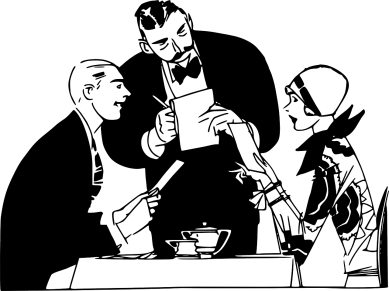
Image by OpenClipart-Vectors from Pixabay
Author’s Note:
If you enjoyed this post, please scroll down, like it and feel free to share it!
 A Moxie Girl